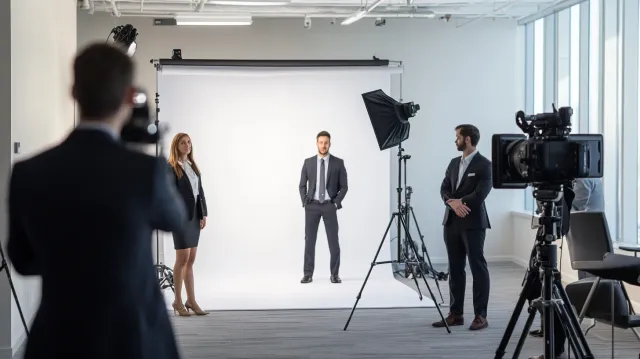
Headshots
Corporate Headshots for Teams: How to Organize a Group Session
How to organize a smooth corporate headshot session for 5 to 50 employees — scheduling, wardrobe, logistics, and what to expect on session day.
Chris McCarthy
Professional Photographer, Photography Shark · April 7, 2026 · Updated May 18, 2026
Team headshot sessions are one of the most logistics-dependent photography engagements there is. Getting 10, 20, or 50 people in front of a camera with consistent results requires more planning than most companies anticipate — and the planning happens before the photographer arrives, not on the day of the shoot.
I've organized group headshot sessions for companies ranging from 4-person startups to teams of 60+, both at my studio in Rockland and on-site at offices across the South Shore and Boston. (For context: I'm Chris McCarthy, owner of Photography Shark, and corporate group sessions have been a steady part of the studio's work since 2019.) This is a practical guide to what actually makes these sessions run smoothly.
Start With the Numbers
Before anything else, get a firm headcount. This sounds obvious but it's consistently where corporate headshot sessions go sideways. "About 15 people" can mean 12 or can mean 22 on the day, and those two numbers require different amounts of time, equipment, and planning.
Get a confirmed list of participants with names — not a department or a headcount — at least two weeks before the session. Build your schedule from that list.
When you have your number, calculate time realistically. For consistent professional headshots with proper lighting and direction, 10–15 minutes per person is the working standard. This accounts for setup transitions, a brief conversation to help the subject relax, 3–5 minutes of actual shooting, and the natural time between subjects.
Time planning guide:
- 5–8 people: 2 hours
- 10–15 people: 3–4 hours (half day)
- 20–30 people: 5–6 hours (full day)
- 40–60 people: 2 days, or two separate half-day sessions
These are honest numbers assuming reasonable punctuality. Build buffer into the schedule — 5–10 minutes of float per hour. Groups sessions run late because people run late, not because photographers run slow.
Studio vs. On-Site
The first decision is where to shoot. Both work well with the right setup; the right choice depends on your team size and logistics.
Studio sessions produce the most consistent results. The lighting is controlled and repeatable — every participant is shot in the same light, on the same background, with the same camera settings. There are no environmental variables (office windows, overhead fluorescents, color-cast walls) to compensate for. Studio sessions are the right choice for teams of up to about 20 people who can reasonably travel to Rockland. South-of-Boston companies routinely book through the South Shore team headshots service, which quotes the per-person rate before logistics get nailed down.
On-site sessions make sense for larger teams or for companies where employee time is tightly constrained. I bring a full portable studio — Godox strobe heads, softboxes, backdrop stand and paper — and set up a dedicated shooting area in your space. The practical requirement is a space of roughly 12x10 feet with 8-foot ceilings and the ability to control ambient light (close blinds, turn off overhead fluorescents). A conference room is ideal.
The trade-off: on-site sessions add 60–90 minutes for setup and breakdown, and portable equipment is slightly less flexible than a permanent studio. For large teams or companies with multiple Boston-area locations, on-site is usually the more practical choice.
Scheduling Participants
How you schedule participants has as much impact on the quality of the results as any technical factor.
Avoid back-to-back marathon blocks. Schedule participants in groups of 4–5 with 15-minute breaks between groups. This gives me time to review what's working, make minor equipment adjustments, and not fall behind if one subject takes longer than expected.
Put the most camera-shy participants in the middle of the day. First-slot participants often arrive to find the setup still being finalized. Last-slot participants are often rushed or tired. The middle of the day is when the session is in rhythm and the lighting is dialed in.
Don't schedule back-to-back from the same department. Mixing departments in the schedule reduces the "group pressure" effect where people feel watched by colleagues — which reliably produces worse expressions.
Send a reminder with specifics 48 hours out. Include: exact start time, what to wear, where to go (specific room if on-site), and how long it will take. "10 minutes for your headshot" is honest and reduces late arrivals from people who thought they had more flexibility.
Wardrobe Guidance
Send a wardrobe brief to all participants one week before the session. Include:
Background color information. If the company has a standard background (navy, gray, white, black), tell participants what it is so they can choose complementary clothing. Light clothing on light backgrounds and dark clothing on dark backgrounds both create visual noise. A charcoal gray background works with almost everything except mid-gray.
What to avoid. Bold stripes, fine hatchings, and busy patterns often create moiré interference in the final image. Logos and text on clothing are distracting and don't photograph well in a professional context. Very bright colors (neon, highly saturated red) can introduce color cast.
What works. Solid colors in navy, charcoal, black, white, and muted jewel tones (burgundy, forest green, slate blue) photograph consistently well. Blazers and structured tops read as professional regardless of industry. Bring options if you're uncertain — wardrobe changes are fast and the extra 2 minutes is worth it.
Jewelry and grooming. Keep it simple. Statement jewelry distracts from faces. For anyone who wears glasses, clean the lenses immediately before their slot — smudges and glare are significantly more visible in photographs than in daily life.
Consistency Across the Session
One of the most common problems with team headshot sessions is consistency: the first 10 people look one way, the last 10 look different because of adjustments made during the day.
The way to prevent this is to shoot test frames with a stand-in before the session starts, lock in the lighting settings, and not make significant changes unless something is actually wrong. Small incremental "improvements" throughout the day introduce inconsistency that becomes visible when images are displayed together on a website or directory.
For sessions with both individual headshots and group photos, shoot the group photos at the start of the day before anyone has time to get disheveled.
Delivery and Distribution
When images are ready — typically 3–5 business days for groups up to 15 — I deliver via a shared online gallery with individual download links. Each participant gets their own link for easy self-service download.
For company websites, Slack directories, or internal systems, you may want to specify a maximum file size or dimensions. Let me know in advance and I can deliver appropriately sized exports alongside the full-resolution files.
For companies that need to retake specific individuals — someone who was absent, a new hire, a recent executive join — I keep lighting records for 90 days to match new participants to an existing team look.
The consistency checklist — what to lock before the first frame
For team headshot sessions, visual consistency across the final deliverables is what separates a coherent firm bio page from a patchwork. The technical specs to lock in before the first participant arrives:
- Background color, brand, and width. Same seamless paper across the entire session. Document the manufacturer + color code (e.g., Savage Thunder Gray #41) so any future hires can match.
- Lighting position and modifier. Strobe heads on identical positions (height, distance, angle), same modifiers (38" octa as key, 1×4 strip as fill). Photograph the lighting diagram once and reference it for any subsequent shoot.
- Camera height and distance. Locked tripod position. A change of 6 inches in camera height shifts perceived face proportions enough to be visible in the final grid.
- Lens choice. 85mm or 100mm on full-frame is the headshot standard. Inconsistent lens choice (using 50mm for some and 100mm for others) produces visibly different facial compression.
- ISO, aperture, shutter, white balance. All four locked manually. Auto-anything across a long session produces drift.
- Crop ratio. Decide on 4:5, 5:7, or 1:1 before shooting. Communicate to participants so they know what'll be cropped (e.g., shoulders included or just face).
- Retouching register. Document the retouching approach (skin smoothing intensity, color grade, sharpening) so every participant gets the same treatment. Inconsistent retouching is more visible than inconsistent capture.
A 90-second pre-session walkthrough with the company contact reviewing these specs prevents 80% of consistency issues that surface after delivery.
Onboarding new hires after the main session
Companies that hire continuously need a workflow for adding new employees' headshots to an existing team page without re-shooting everyone. The pattern that works:
- Schedule "headshot day" quarterly — one half-day every 3 months for all hires from that quarter. Same studio, same lighting, same backdrop, same retouching.
- Save the lighting diagram for the original session. Recreate it exactly for every quarterly add-on shoot. Photography Shark maintains lighting records for 90+ days post-session.
- Match the original crop ratio and retouching style. New photos that don't match the existing register on the team page are immediately visible.
- Avoid one-off photographer changes. If the original shoot was at Photography Shark, subsequent add-ons should be too. A switch to a different photographer mid-team produces visible style drift even when the technical specs match on paper.
For Boston-area companies with rapid hiring (typical 2026 patterns at biotech, fintech, and PE-backed firms), quarterly headshot day reduces total photography costs by 30-50% vs ad-hoc individual sessions and produces dramatically more cohesive team pages.
The ROI math for corporate team headshots
For a 10-person team, the standard pricing math:
- Per-person individual headshots: $395 × 10 = $3,950 (a full 10-image session for each person)
- Team session, at the Rockland studio or on-location at your office: $395 for the first person + $200 × 9 = $2,195 (5 retouched images each)
- Teams larger than 10, and recurring headshot-day programs: quoted individually — contact us for pricing
The non-obvious win on team blocks: scheduling efficiency. A 30-person team booked individually would consume roughly 22 hours of company time (employees commuting + waiting). A team block consumes 3-4 hours of total company time. Soft cost savings on lost productivity easily exceed the direct photography savings.
Handling common executive pushback
A few patterns that come up when scheduling team headshots:
- "The CEO doesn't want to wait in line." Schedule the CEO at the very start of the day before other participants arrive. Their session takes 15-20 minutes and they leave; the rest of the team rotates through afterward. CEO appears, executes, departs.
- "The remote team can't make it." Offer a Zoom-pre-meeting + parallel session option: the team flies in or drives in once per quarter, and remote workers are scheduled into the next quarterly cycle.
- "We want everyone in the same outfit / branded apparel." This works for one specific use case (a coordinated retail brand team), but reads as costume-y for most corporate contexts. Push back politely: a consistent background, lighting, and crop produces visual cohesion better than a uniform shirt.
- "Can you re-shoot just person X individually next week?" Possible, but maintain the original lighting setup precisely. Schedule the individual within the 90-day lighting-record window.
- "We've already started with another photographer for half the team." Continue with the other photographer for consistency, OR re-shoot the entire team for visual cohesion. Mixing photographers mid-team is the worst option.
Next Steps
If you're planning a corporate headshot session for a team of 5 or more, contact us to discuss scheduling, on-site vs. studio options, and pricing. For context on individual headshot pricing and what to expect from a session, see the Boston headshots service page or the corporate headshots page.
For teams across the South Shore, the studio in Rockland is accessible from Route 3 with free on-site parking — no Boston parking logistics for your team to deal with.
Frequently Asked Questions
How long does a group corporate headshot session take?
It depends on group size and the number of backgrounds or looks you want. For a consistent single-background look, plan for 10–15 minutes per person including transitions and touch-ups. A team of 10 can typically be completed in about 2 hours; a team of 25 in a half-day. Larger groups (50+) typically require a full day or a multi-day on-site engagement.
Should the team come to the studio or can you shoot on-site at our office?
Both options work. Studio sessions at the Photography Shark studio in Rockland produce the most consistent results — controlled light, multiple background options, and no environmental variables. On-site sessions at your Boston or South Shore office are available for teams of 10 or more; I bring portable strobe equipment and set up a temporary studio in a conference room or open space. On-site is often more practical for large teams or for companies with employees who can't easily leave the office.
How do we ensure wardrobe consistency across a large team?
Send a wardrobe brief to participants at least one week before the session. Specify background color so employees can choose contrasting clothing, recommend avoiding bold stripes or busy patterns that read as distracting in headshots, and suggest solid colors in navy, charcoal, black, and white ranges. For leadership team photos, some companies choose a consistent color palette; for larger all-staff sessions, a general dress code is more practical than prescribing specific colors.
How long until we receive the finished headshots?
For groups up to 15 people, standard turnaround is 3–5 business days for fully retouched digital images. For larger groups (15–50 people), plan for 5–7 business days. Rush delivery is available for an additional fee. Images are delivered as high-resolution JPEGs via a shared online gallery, with individual download links for each participant.
What if an employee is unhappy with their headshot?
Re-shoots for individual team members are available at a reduced session rate within 30 days of the original session. In practice, this is rarely needed — the primary way to prevent dissatisfaction is time: giving each person enough session time to produce a range of frames they feel represented by. Rushed 5-minute slots reliably produce unsatisfied subjects.
Related Posts

You Might Also Like
About the Author
Chris McCarthy
Chris McCarthy has run Photography Shark Studios in Rockland, MA for over 10 years and 500+ sessions, with executive headshot work for Rockland Trust, Clean Harbors, M&T Bank, and McCarthy Planning; founder portraits for AI startups including Lowtouch.ai; product photography for South Shore brands like Lauren's Swim; and headshots across South Shore legal, medical, financial, and academic practices. Every session is personally shot and edited by Chris on Sony mirrorless and Godox strobe systems — no assistants, no outsourcing, no batch retouching. Galleries deliver in 3–5 business days. About Photography Shark →
Photography Shark · Boston & South Shore MA
Ready to Book a Session?
Professional headshots, senior portraits, boudoir, and model portfolios. Studio in Rockland, MA — 25 miles south of Boston. Sessions from $395.