Headshots
How to Look Natural and Confident in a Headshot
Camera anxiety is the biggest obstacle to a strong headshot. Techniques actors and professionals use to find authentic expression under studio lighting.
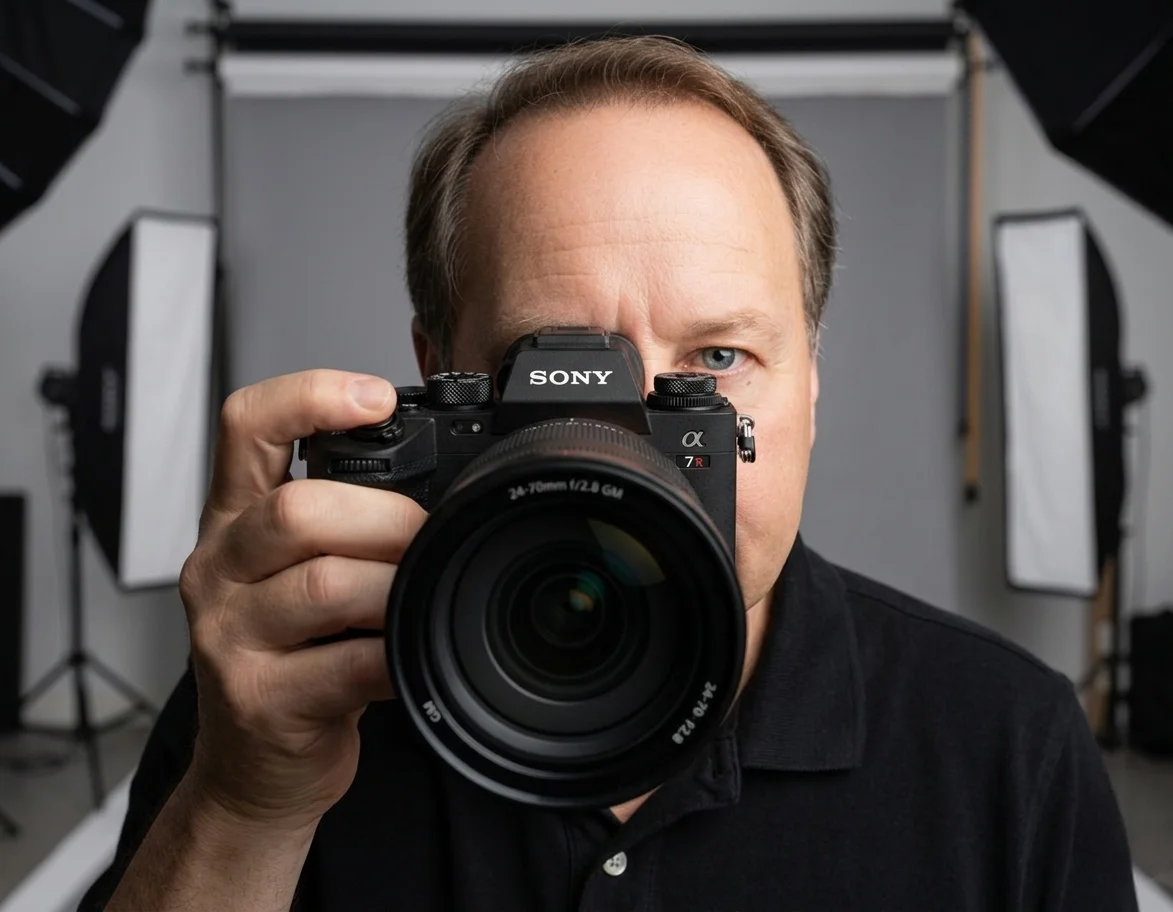
Chris McCarthy
Professional Photographer, Photography Shark · April 14, 2026
Most people are surprised by how uncomfortable they feel in front of a camera at a professional headshot session. They've spent years posing for casual phone photos with friends and assume the same casualness will translate. It usually doesn't. The professional studio environment — lights on stands, camera on a tripod, photographer directing the session — activates a self-consciousness that doesn't show up in casual photo contexts.
The good news is that camera-comfort is a learned skill, not an innate trait. Actors and professionals who look natural in their headshots got there through specific techniques and a few minutes of session warm-up. Nobody walks into a studio and immediately produces a strong headshot — there's a process.
I'm Chris McCarthy. My studio is at 83 E Water Street in Rockland, about 30 minutes south of Boston. I shoot headshots for actors, executives, advisors, and professionals across greater Boston and the South Shore. Most of the people I photograph aren't comfortable in front of the camera at the start of the session. By the end, they're producing photographs that look like the most relaxed and confident version of themselves.
Here's what's actually happening, and what works.
Why You Look Stiff in Photos When You're Not Stiff in Person
The face on camera responds to the camera as a stimulus. Most people, even those comfortable in social settings, hold subtle facial tension when they know they're being photographed. The tension is usually:
- Slightly raised shoulders
- Tightened jaw or clenched mouth
- Held smile that's not connected to genuine feeling
- Fixed gaze that doesn't track or breathe naturally
- Frozen breathing — short, shallow, held
Each of these reads on the photograph. The shoulder tension makes the neck look shorter. The jaw tension flattens the lower face. The held smile looks artificial. The fixed gaze looks vacant or anxious. The frozen breathing creates a held quality that doesn't match how the person actually looks in normal interactions.
The fix is not to "relax" — telling someone to relax usually makes the tension worse. The fix is specific direction and movement that breaks the held quality.
The First 5 Minutes Are Always the Worst
The opening of a headshot session is structurally the hardest. The subject is settling into the studio environment, the lights, the awareness of being photographed. The photographs from the first 30 seconds are almost always tighter and stiffer than what comes later.
This is normal and accounted for. I generally don't expect the first frames to be the keepers — they're warm-up. The session moves fairly quickly through the early shots while the subject settles in, then slows down once the expressions are loosening.
If you're going into a headshot session, knowing this helps. The early stiffness isn't a failure; it's the warm-up. Trust the process and let the session do its work.
What Direction Actually Sounds Like
A well-directed headshot session is conversational. The photographer is talking continuously — not loudly or constantly, but with a steady stream of small directions, observations, and connection points. The talking gives the face something to respond to, which produces more honest micro-expressions than asking the subject to manufacture them internally.
Direction during a session sounds like:
- "Drop your shoulders an inch."
- "Eyes here. Slightly down toward the lens itself."
- "Take a breath in. And out. Soften the jaw on the exhale."
- "Now think about something specific — what are you having for dinner tonight?"
- "Chin down a hair. Yes — that's it."
- "Now turn your shoulder slightly toward me. Yes. Hold that."
- "Smile, but smile in your eyes, not your mouth."
- "Now think about someone who annoys you. Yes — there it is. That's the look."
The directions are small, specific, and continuous. They're also responsive — when something is working, we stay there and refine; when something isn't, we shift. The session is collaborative rather than passive.
Techniques That Actually Help With Camera Anxiety
A few specific techniques help most people settle into the session:
Breathing. Conscious breathing reduces the held quality that creates stiffness in photographs. A simple cycle: in for 4 counts, hold for 1, out for 6 counts. The exhale releases jaw and shoulder tension naturally. We do this between sets during the session.
Naming what you see. When the camera is uncomfortable, focus attention away from the camera and onto something specific in the room. Naming objects ("light stand, gray wall, coffee cup") for 30 seconds shifts focus and breaks the held intensity.
Thinking specifically. Generic "think happy thoughts" direction usually produces generic expressions. Specific direction ("think about a time you laughed at something inappropriate") produces specific expressions that read as genuine. We use specific prompts during the session — they generate more honest moments than abstract direction.
Movement between frames. Holding still between shots lets tension build. Moving — small head shifts, a deep breath, repositioning shoulders — breaks the buildup. The session uses small movement breaks every few frames.
Talking aloud. For some people, talking quietly through the session helps. Discussing what we're shooting, what's working, asking questions. The talking keeps the face engaged with the present moment rather than performing for the camera.
The Specific Trick for Better Eye Expression
The eyes carry most of the expressive work in a strong headshot. The most common eye-expression failure is a "frozen lens-stare" — fixed gaze that goes vacant after a few seconds. The fix is small intentional shifts of attention:
- Look at the lens.
- Briefly look slightly off to the side (no more than a beat).
- Return to the lens with renewed attention.
- Repeat.
The brief look-away gives the eyes something to "come back from" when they return to the camera. The returning gaze is more alive than the held one. This is a small technique but it's responsible for a substantial portion of the difference between alive and dead eyes in headshots.
What the Studio Environment Looks Like
The studio at 83 E Water Street in Rockland is designed to be uncluttered and focused without being clinical. Single backdrop, controlled lighting, music if you want it. The session typically runs about 30 minutes for a single look or 60 minutes for multiple looks. The pace is unhurried — there's time to settle in, to find the expressions, to adjust if something isn't working.
I'm the only person in the room with you during the session — no assistant, no audience, nobody else watching. This matters more than people expect. The presence of additional people creates self-consciousness that small-group sessions specifically avoid. If you've had a headshot session before with multiple people in the room and felt awkward, the difference of being in a quiet single-photographer setup is substantial.
The studio is in a converted mill building with free on-site parking. Walking in, the energy is calm rather than commercial-photography hectic. This is intentional — relaxed energy in the room produces relaxed expressions in the photographs.
Specific Things That Help During the Session
A few small things that consistently help people produce stronger photographs:
- Arrive 10 minutes early. Walking in directly from a stressful drive doesn't settle. Time to breathe, sit, drink water before the session helps.
- Eat lightly that morning. Heavy meals create slight facial puffiness that's visible in photographs.
- Hydrate. Water for the day before; a glass before the session. Dehydration shows up in skin and eyes.
- Don't wear new makeup for the session. The session is not the time to test a new makeup style. Use what you typically wear.
- Wear what fits comfortably. Slightly snug is usually better than slightly loose — but neither should be uncomfortable. Discomfort shows up.
- Trust the photographer's direction. If something feels weird in direction (a head angle that feels exaggerated, an expression cue that feels strange), it's usually right on camera. The face perceives itself differently than the lens does.
Book Your Session
Contact me with what you need — actor headshot, corporate headshot, LinkedIn — and your timeline. Sessions are $395 for 30 minutes, $545 for 60-minute multi-look bookings. Full Boston headshot pricing on the investment page. Free parking at the Rockland studio.
For specific session structure: Boston Actor Headshots covers actor sessions, Boston Headshots covers corporate and professional, LinkedIn Headshots Boston covers the LinkedIn-specific calibration.
Frequently Asked Questions
Why do I look stiff or fake in photos when I'm not stiff or fake in person?
Because being photographed is a learned skill, and most people haven't practiced it. The face on camera responds to the camera as a stimulus — most often with a subtle tension that reads on the photograph. That tension dissolves with the right session direction and a few minutes of warm-up. The actors and professionals who look natural in headshots got there through technique, not natural talent.
What's the most common mistake people make in front of the camera?
Trying to maintain a fixed expression instead of letting it move naturally. The face is most expressive when it's slightly in motion between micro-expressions. A held smile freezes; a relaxed face that occasionally smiles or shifts captures honestly. The session is structured to work in micro-bursts — small expressive moments — rather than asking the subject to hold one expression for an extended time.
Will the photographer direct me, or do I need to bring poses?
I direct continuously throughout the session — facial expression, head angle, eyes, breathing, where to put attention. Most people aren't used to being directed and find it a relief. The session is conversational rather than silent; my voice gives the face something to respond to, which produces more honest expressions than asking the subject to perform internally.
What if I don't know what to do with my hands?
Standard headshots crop above the hands, so this rarely matters. For wider three-quarter framing where hands might appear, I'll direct hand placement. The most important thing is shoulders relaxed and not holding tension; hands tend to relax naturally when shoulders do.
Should I practice expressions in the mirror beforehand?
No — practiced expressions tend to look practiced. Better preparation: get adequate sleep the two nights before, eat lightly the day of, hydrate, and arrive 10 minutes early to settle in. Walk into the session as your default self; the photographer's job is to direct your face into the right registers from there.
What if I'm self-conscious about specific features?
Tell me at the start of the session. We can work the lighting and angle to manage almost any feature concern — eye asymmetry, smile lines, double chin, certain profile angles. The session is structured to find the angles and lighting that work for you specifically rather than assuming a one-size approach.
Related Posts
Headshots
Dance Headshot Examples: Four Frames Broken Down
Headshots
How to Prepare for Pageant Headshots: A Complete Prep Guide
Headshots
ERAS Photo Guide: The Residency Application Headshot, Explained
Headshots
Headshot Poses for Women: A Practical Guide
Headshots
Average Professional Headshot Cost by City: 2026 Data Study
Headshots
Headshot Mini Sessions vs. Full Sessions: Why I Don't Cut It Short
You Might Also Like
About the Author
Chris McCarthy
Chris McCarthy has run Photography Shark Studios in Rockland, MA for over 10 years and 500+ sessions, with executive headshot work for Rockland Trust, Clean Harbors, M&T Bank, and McCarthy Planning; founder portraits for AI startups including Lowtouch.ai; product photography for South Shore brands like Lauren's Swim; and headshots across South Shore legal, medical, financial, and academic practices. Every session is personally shot and edited by Chris on Sony mirrorless and Godox strobe systems — no assistants, no outsourcing, no batch retouching. Galleries deliver in 3–5 business days. About the photographer →
Photography Shark · Boston & South Shore MA
Ready to Book a Session?
Professional headshots, senior portraits, boudoir, and model portfolios. Studio in Rockland, MA — 25 miles south of Boston. Sessions from $395.