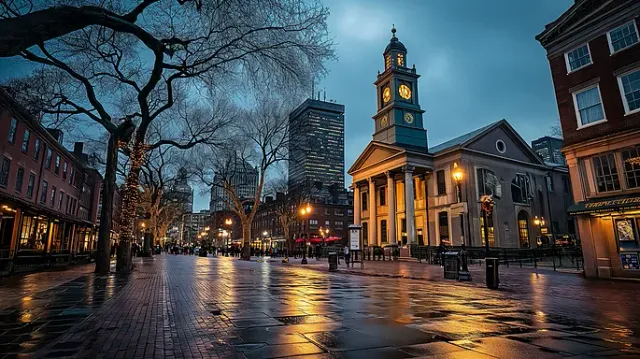
South Shore Locations
Boston's Historic Landmarks: A Photographer's Guide
A photographer's guide to Boston — seasonal light, Freedom Trail angles, Beacon Hill, the waterfront, and how Photography Shark shoots the city.

Chris McCarthy
Professional Photographer, Photography Shark · February 13, 2024 · Updated March 10, 2026
Photographing Boston: A Practical and Technical Guide
Boston is one of the most photographically rich cities in the United States — a place where colonial-era brick architecture exists within sight of contemporary glass towers, where every neighborhood has a distinct visual character, and where the quality of light changes dramatically between the seasons. For photographers based on the South Shore, Boston is also immediately accessible — 25 minutes north on Route 3 from Rockland — and worth treating as a photographic resource rather than just a destination.
I have shot at locations across the South Shore and Greater Boston for over a decade, and the best spots are rarely the most obvious ones.
At Photography Shark, we photograph in Boston and throughout the South Shore, including portrait sessions in the city for clients who want an urban backdrop. We also draw on Boston as a photographic resource when planning location shoots for headshot sessions, family portraits, and commercial work. This guide shares what we have learned about photographing Boston well.
Understanding Boston's Light
Light in Boston varies significantly by season, neighborhood, and time of day. Understanding these variables before you go out significantly improves your results.
Seasonal Light
Fall is Boston's most photographically spectacular season. The combination of golden foliage in the public parks, lower sun angles that cast longer shadows and warmer light, and the clarity of autumn air creates conditions that make almost everything look good. The period from late September through mid-October is peak quality. The Commonwealth Avenue Mall — a linear park with double rows of mature American elms running through the Back Bay — is one of the most beautiful outdoor spaces in Boston during peak fall color.
Winter offers the lowest sun angles of the year, which means golden hour light that is almost theatrical in its warmth and direction. The trade-off is short windows — golden hour happens earlier and ends earlier, and the cold limits how long you can work outdoors without loss of dexterity. Snowfall transforms the city, particularly the Boston Common and Public Garden, but the window between fresh snow and the gray slush that follows it is narrow.
Spring brings soft, diffuse light and the explosion of flowering trees — cherry blossoms in the Public Garden, magnolias throughout Beacon Hill. The light in late April and May in Boston is particularly good: warm but not harsh, with long hours and the quality of clean post-winter air.
Summer presents the most challenging light for outdoor photography — harsh midday sun creates unflattering shadows and blows out highlights. Sunrise and golden hour sessions are your best options. The benefit of summer is the longest days, which gives you the most total golden-hour time.
Neighborhood Light and Shadow
Boston's compact urban density means buildings create significant shadow patterns that change dramatically between morning and afternoon. Knowing which side of the street or which time of day gives you clean light on the subjects you want to photograph requires familiarity built through experience.
The Freedom Trail and Beacon Hill are primarily north-south oriented, which means late afternoon sun falls on the facades from the west. Morning light tends to be better in the Charlestown Navy Yard and along the eastern waterfront. The Public Garden and Boston Common sit in the center of the city and receive direct sun from most angles throughout the day.
The Freedom Trail: More Than Tourists See
The Freedom Trail is Boston's most photographed route, and most of the photography it produces is unremarkable precisely because everyone shoots the same angles from the same positions. Getting compelling Freedom Trail photography requires going earlier, staying longer, and finding the perspectives that tourist traffic obscures.
The Massachusetts State House
The gold dome of the State House is a landmark that rewards creative composition more than most. The dome photographs beautifully against sky — particularly at golden hour when it catches the warm light and the sky transitions to deep blue. The steps and entry facade are most compelling in early morning before foot traffic begins.
Practical tip: The State House sits at the top of Beacon Hill with a clear western exposure. Late afternoon light in fall and spring falls directly on the south-facing entrance from the Beacon Street side. Arrive before 5 PM in fall for clean golden light on the facade.
The Granary Burying Ground
One of Boston's most visually distinctive outdoor spaces: centuries-old slate headstones with carved skulls and hourglasses, arranged under canopies of old elms and maples. The quality of afternoon light filtering through the trees produces dappled patterns that photograph beautifully. This is one of the few Freedom Trail sites that rewards slow, close work rather than wide-angle establishing shots.
Acorn Street on Beacon Hill
Acorn Street is arguably Boston's most photographed cobblestone street — 19th century brick rowhouses, gas-lit iron streetlamps, and a narrow width that creates a natural leading line. The street runs east-west, so morning light illuminates the north face of the south-side houses and vice versa. This is worth scouting at different times of day because the light quality changes the image dramatically.
Avoid late morning through mid-afternoon. The street is narrower than it looks in photographs, foot traffic is continuous, and the light is unflattering. Early morning, particularly on weekday mornings, gives you the street largely to yourself.
Charlestown and the Navy Yard
Charlestown is underrepresented in Boston photography relative to its visual quality. The neighborhood has excellent historic architecture, and the Charlestown Navy Yard offers photography opportunities that most visitors miss.
USS Constitution at Pier 1
The USS Constitution — the world's oldest commissioned warship still afloat — is best photographed from the Charlestown pier at low tide, when the waterline is lower and the ship's full hull profile is visible. The Boston skyline across the harbor provides immediate depth in the background. Early morning and golden hour produce the most atmospheric results.
Technical note: Shooting a dark-hulled ship against a bright sky or water requires exposure compensation or graduated neutral density filtration. If you expose for the sky, the hull goes black. If you expose for the hull, the sky blows out. Managing this requires either careful metering of a mid-tone value or bracketing exposures for post-processing.
The Bunker Hill Monument and Obelisk
The Bunker Hill Monument photographs best from Monument Square below — shooting upward to show the obelisk against sky. In strong directional light, the shadow patterns across the granite surface create strong graphic interest.
The Rose Kennedy Greenway and North End
The Greenway's linear park running through downtown Boston creates a transition zone between the city's neighborhoods that offers strong compositional opportunities. The combination of large public art installations, reflecting pools, and the surrounding architecture provides variety within walking distance.
The North End
Boston's historic Italian neighborhood is one of the city's most visually coherent environments — narrow streets, densely packed brick buildings, ornate wrought-iron details on windows and fire escapes, and the visual texture of a neighborhood that has changed slowly. Salem Street and Hanover Street repay slow walking and close attention.
The North End photographs best in late afternoon when the sun is dropping to the west and the facades begin to light up in warm amber tones. Avoid the middle of the day when the streets are busiest and the light is flattest.
The Charles River Esplanade
The Esplanade along the Cambridge/Boston side of the Charles River is one of Boston's most versatile photographic environments. The river creates a natural zone of open sky and water, which means consistently good light even when the surrounding urban environment would be challenging.
The Hatch Shell and River Views
Shooting west from the Esplanade, particularly in the early morning or at golden hour, produces river views with the Cambridge skyline behind and clear sky above. The trees along the Esplanade path create natural framing elements.
Shooting east produces the Boston skyline across the water — this view is most dramatic at blue hour (20 to 30 minutes after sunset) when the skyline lights are visible and the sky still has residual color. A tripod is essential for blue-hour work.
The Footbridges
The pedestrian bridges connecting the Cambridge shore to the Esplanade offer elevated angles that change the spatial relationship between the river and the surrounding architecture. Shooting from the bridge surface creates strong leading lines toward the city.
Copley Square: Trinity Church and the Library
Copley Square is the architectural heart of Boston's Back Bay and offers a direct visual confrontation between two of the city's most significant buildings — Trinity Church (H.H. Richardson's 1877 Romanesque Revival masterpiece) and the John Hancock Tower (I.M. Pei's glass modernist tower from 1976), which reflects the church's facade in its glass curtain wall.
Trinity Church
Trinity Church's stone exterior benefits enormously from directional morning light — the rich warm tones of the Milford granite and Ohio brownstone glow in early sun in a way they simply do not in flat midday light. The church entrance faces west, so afternoon light falls on the facade directly.
The interior of Trinity Church is one of Boston's most extraordinary photographic environments — Richardson's decorative scheme, the murals, the quality of light through the stained glass. Available light shooting here requires high ISO capability and a lens with optical stabilization or a tripod.
The Boston Public Library
The BPL's McKim Building entrance on Dartmouth Street is one of Boston's most architecturally refined facades — the arched windows, the inscription, the bronze doors. The interior is extraordinary: the vaulted entrance hall, the courtyard, and the reading rooms on the upper floors. Photography inside the BPL is permitted in most areas and the quality of natural light through the interior windows is exceptional.
Capturing Boston for Portrait Photography
From a portrait photography perspective — which is how Photography Shark approaches Boston photographically most often — the city offers a range of location backdrops that translate directly into session options.
Urban professional backgrounds for headshots and corporate portraits are available throughout the Back Bay, Financial District, and Seaport neighborhoods. Clean architectural surfaces, weathered brick, and contemporary glass all provide backdrop options.
Historic character for editorial and personal portraits is available throughout Beacon Hill, the North End, and along the Freedom Trail. The cobblestones, gas lamps, and brick of these neighborhoods create immediate visual context that standard studio backgrounds cannot replicate.
Green space for relaxed, natural portraits is available at the Public Garden, Boston Common, the Southwest Corridor, and along the Esplanade. The scale of the Public Garden's trees and the quality of the light filtered through them makes this one of the best outdoor portrait locations in Boston.
Waterfront contexts for portraits with an expansive, open quality are available along the Harborwalk, at the Charlestown Navy Yard, and at Fan Pier in the Seaport.
The drive from Photography Shark's Rockland studio to any of these Boston locations is approximately 25 minutes under normal conditions. For South Shore clients who want an urban Boston backdrop for their portrait session without committing to the logistics of shooting in the city, we can coordinate Boston location sessions as part of a larger portrait or headshot booking.
Photographing Boston in Different Seasons: A Quick Reference
| Season | Best Light | Best Locations | Notes |
|---|---|---|---|
| Spring (April-May) | Soft, warm afternoon | Public Garden cherry blossoms, Commonwealth Ave | Best floral photography window |
| Summer | Golden hour only | Waterfront, Esplanade | Harsh midday light; long golden hour window |
| Fall | All-day warm tones | Beacon Hill, Common, Comm Ave Mall | Peak period; book sessions early |
| Winter | Early morning, blue hour | Downtown lights, Frog Pond | Snow sessions require flexible scheduling |
The South Shore as a Photographic Complement
For photographers and portrait clients based on the South Shore, the region's own visual resources are often underutilized in favor of the more obvious Boston settings. The coastal landscapes from Hingham to Plymouth, the historic character of South Shore towns, and the quality of ocean light on the South Shore all offer photographic resources that are genuinely distinctive and often more accessible than Boston locations.
Photography Shark works throughout the South Shore region for location sessions, bringing 10+ years of familiarity with the area's best photographic environments to every session. If you are weighing a Boston location session against a South Shore option, the conversation about what serves your specific project best is worth having.
Ready to Book Your Session?
Whether you want a Boston location backdrop for your portrait session, a South Shore coastal setting, or our private Rockland studio, Photography Shark is ready to plan the right session for your goals.
Contact us to discuss your vision and reserve your session date.
Studio headshots near Rockland, MA · Headshots in Cambridge, MA
Frequently Asked Questions
Does Photography Shark shoot portrait sessions in Boston?
Yes. Chris McCarthy shoots headshots, family portraits, and engagement sessions in Boston as well as throughout the South Shore. The studio is based in Rockland — about 25 minutes south on Route 3 — and Boston sessions are booked regularly.
What Boston locations does Photography Shark use for portrait sessions?
Commonly used locations include Boston Public Garden, Beacon Hill, the Seaport District, the Charlestown Navy Yard, and the Freedom Trail. Location is chosen based on session type — headshots, engagement, family — and the season.
What is the best time of year to shoot portraits in Boston?
Fall (late September through mid-October) offers the best light and foliage. Spring (late April through May) is excellent for the Public Garden's cherry blossoms and tulips. Winter morning sessions produce dramatic, low-angle light with minimal crowds.
Do I need a permit to shoot in Boston Public Garden?
Yes. The City of Boston requires a permit for professional photography in the Public Garden. Photography Shark handles permit planning as part of session preparation — you don't need to arrange this yourself.
How much does a Boston portrait session cost?
Studio sessions are $395 for 30 minutes with 10 fully retouched images. On-location sessions are $495. Contact Photography Shark to discuss Boston session logistics and any travel considerations.
Can I combine a Boston outdoor shoot with a studio session in Rockland?
Yes. Some clients use the Photography Shark studio at 83 E Water Street, Rockland for controlled lighting shots and pair it with an outdoor Boston or South Shore location session on the same day or separate days.
Related Posts


You Might Also Like
About the Author
Chris McCarthy
Chris McCarthy has run Photography Shark Studios in Rockland, MA for over 10 years and 500+ sessions, with executive headshot work for Rockland Trust, Clean Harbors, M&T Bank, and McCarthy Planning; founder portraits for AI startups including Lowtouch.ai; product photography for South Shore brands like Lauren's Swim; and headshots across South Shore legal, medical, financial, and academic practices. Every session is personally shot and edited by Chris on Sony mirrorless and Godox strobe systems — no assistants, no outsourcing, no batch retouching. Galleries deliver in 3–5 business days. About the photographer →
Photography Shark · Boston & South Shore MA
Ready to Book a Session?
Professional headshots, senior portraits, boudoir, and model portfolios. Studio in Rockland, MA — 25 miles south of Boston. Sessions from $395.