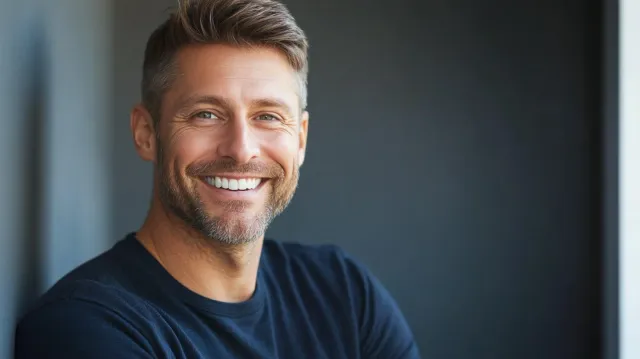
Dating Photography
Best Tinder Profile Photos: A Photographer's Guide to More Matches
What actually works on Tinder — first-photo rules, the six-slot lineup, what to wear, smile vs. serious, common mistakes, and where professional photos beat selfies, from a Boston headshot studio.
Chris McCarthy
Professional Photographer, Photography Shark · May 29, 2026
The single biggest lever on Tinder is the first photo. Tinder shows that image alone in the swipe stack, and the half-second decision that follows determines whether anyone ever sees photo two, your bio, your prompts, or anything else you've worked on. Get the first photo right and the rest of your profile gets a fair audience; get it wrong and the strongest bio in the world doesn't help. This guide breaks down what actually works in 2026 — the first-photo rules, the six-slot lineup, what to wear, smile versus serious, and the mistakes that cost matches before a swipe even happens.
I shoot headshots and dating-profile sessions out of a studio in Rockland, MA, and a meaningful share of those clients come in specifically to fix a Tinder lineup that has stopped pulling matches. The patterns are consistent enough to be predictable. Here is the full breakdown.
What Tinder Actually Shows First
It helps to know what swipers are looking at. Tinder loads your top photo full-frame in the stack, and the next images only become visible if someone taps your profile. Practically, that means:
- Photo one carries almost all of the early-swipe weight. It is the image that determines whether you get the tap at all.
- Photos two through six get a smaller, more interested audience — the people who have already half-decided based on photo one.
- The bio, prompts, and lifestyle tags get read by even fewer people, and almost none of them read those before forming a first impression from the photos.
The implication is straightforward: spend the most effort on the first photo, then build a six-image lineup that holds up the impression the first photo creates. A great first photo with a thin or contradictory lineup converts worse than a coherent, evidence-rich profile that the first photo opens the door to.
What Makes a Good First Photo on Tinder?
The frame that wins as your first photo on Tinder is, almost without exception:
- Head-and-shoulders. Close enough that your face is clearly readable at thumbnail size.
- Front-facing. You are looking at the camera, not at someone off to the side.
- Eyes visible. No sunglasses, no hat brim shadowing the upper face.
- Genuine warm smile. Not a forced grin, not a stoic neutral — the natural smile you make when something actually amuses you.
- Clean, non-distracting background. A neutral wall, an out-of-focus park, a coffee-shop window — anything that doesn't compete with your face.
- Recent and recognizable. You look like this when you walk into the bar on the first date.
A photo that hits all six of these out-performs nearly everything else. If you are wondering why your match rate is low, the first place to look is whether the lead image clears every line on that list. Most don't.
For the deeper craft on what makes a portrait read well at small sizes, the importance of a perfect dating profile photo walks through the small-thumbnail problem in more detail.
How Many Photos Should You Have on Tinder?
You have six slots. Use all of them. Profiles with full six-image lineups consistently outperform profiles with two or three, because each additional image is another reason to say yes — and another piece of evidence that you are the person the first photo suggests. A useful default mix:
- Strong head-and-shoulders portrait — the first-photo rules above. Your single best frame.
- Full-body shot — clear, well-lit, in clothes that fit. People do scroll to this and the absence of one reads as something to hide.
- An activity or interest — playing music, hiking, cooking, surfing, climbing, traveling. Something that shows what your life looks like.
- Social context — you with friends, clearly recognizable, in a way that signals you have a life. Not a wedding group of twelve where you can't tell which one is you.
- A second portrait with a different mood — composed, thoughtful, slight smile or none. Adds range and depth to the lineup.
- A wild card — pet, travel landmark, a creative project, somewhere distinctive. Something that gives a person who already likes you a conversation hook.
The trap is to use six versions of slot one — six tight smiling portraits in slightly different shirts. That reads as either vain or one-dimensional, and a swiper has nothing new to learn after photo two.
Should You Smile in Tinder Photos?
Smile in your first photo. The data here is consistent across multiple platforms: warm, genuine smiles in the lead image outperform neutral expressions in nearly every swipe-app study that has been published. A real, eye-reaching smile reads as approachability and emotional safety, which is most of what people are scanning for in the first half-second.
Where a composed-neutral frame earns its keep is in a later slot — photo three, four, or five — to add range. A thoughtful, direct-eye-contact image suggests depth and confidence. But a stoic first photo is one of the most common reasons profiles that should pull matches do not.
The genuine-versus-forced distinction matters. A forced smile reads as nervous, not warm. This is the single biggest reason DIY dating photos struggle: it is very hard to produce a real smile on cue, alone, holding a phone. Professional dating sessions solve this by having someone behind the camera who is actually reacting to you — joking, asking questions, directing — so the smile is a response to something real, not a performed expression.
What to Wear
The rule of thumb: clothes that fit, in solid muted colors, that match the personality you want to project.
Colors that photograph well. Solid navy, charcoal, deep green, burgundy, warm earth tones. These render cleanly at thumbnail size and don't fight your face for attention. Bright reds and electric blues can work but tend to dominate the frame; pure white and pure black sit at the extremes and lose detail in compressed app images.
Patterns and logos. Avoid. At thumbnail size, busy patterns turn into noise and large logos turn into a billboard that's the first thing a swiper notices. A solid, well-cut piece outperforms an interesting print almost every time.
Fit. This is the single most under-rated element of dating-profile wardrobe. A well-fitted t-shirt looks better in a photo than an ill-fitting designer piece. Anything baggy or visibly tight reads worse than something that simply fits.
Variety across the lineup. Don't wear the same outfit in five of six photos. A smart-casual look for the lead portrait, an outdoor or activity-appropriate outfit for the action shot, and maybe one slightly dressier frame for range. Stay consistent with how you actually dress on a date — wardrobe whiplash between business suit and tank top reads as performance.
The professional headshot wardrobe guide covers fit, fabric, and color decisions in more depth, and most of it applies directly to a dating-profile lineup.
Lighting, Backgrounds, and Why Selfies Underperform
The technical reason selfies usually lose to professional shots is the same one that makes them look "off" even when you can't articulate why: the front camera on a phone uses a very wide lens, and held at arm's length, that lens distorts facial proportions. Your nose looks bigger, your forehead looks longer, and the angle is almost always too low or too high. A swiper doesn't consciously think "that's barrel distortion at 24mm equivalent" — they think "something looks weird, swipe left."
Lighting compounds the problem. Bathroom mirror selfies are lit from above by harsh ceiling lights, which throws shadows under the eyes and nose. Outdoor selfies in midday sun do the same. The flattering light for a face is soft, slightly elevated, and frontal — exactly what a window or a controlled studio setup provides and exactly what a handheld phone in most environments doesn't.
Backgrounds are the other half. Bathrooms, messy bedrooms, dim car interiors, and parking lots are all working against you before you even smile. A clean, simple, non-distracting background lets the face do the work. If you are shooting yourself, a blank wall with diffused window light to one side beats nearly any "scenic" backdrop you can find with your phone.
If you want a deeper breakdown of why pro images convert and where DIY holds up, the diy headshots vs. professional post walks through the side-by-side comparison.
The Mistakes That Lose Matches
These are the recurring problems I see on profiles that are otherwise solid:
- The group-photo lead. Forcing a swiper to play "guess which one" is a quick swipe left.
- Sunglasses or a hat across the eyes. Eyes are the single most important feature in a portrait. Hide them and you've hidden the photo.
- The distant shot. If the swiper can't read your face at the size Tinder displays, it functionally isn't a photo of you.
- The mirror selfie. Especially in a bathroom. Reads as low effort and shows a phone-in-hand rather than a person.
- The aggressive filter. Creates a trust gap when you show up on the first date looking different.
- The cropped-out-ex. A visible disembodied shoulder or arm is loud, and everyone reads it instantly.
- Six nearly identical photos. Wastes the slots and reads as either vain or having only one usable image.
- Outdated by years. If you don't look like the photo, the photo is hurting you.
Each one is a small avoidable negative. Stack two or three and the profile underperforms regardless of how attractive the lead photo is.
When a Professional Session Pays for Itself
The economic question most people ask is whether a $395 session is worth it. For an active dater, the honest answer is almost always yes, and for a specific reason: the same images keep working for twelve to eighteen months across every app you use. A professional dating-profile session typically produces eight to ten usable frames — enough to fill your Tinder six-slot lineup with images to spare, plus extras for Hinge, Bumble, and anywhere else you maintain a profile.
The match-rate uplift is real but not magic. The actual mechanism is more boring than the marketing claims suggest: a professional session removes the things that quietly cost you matches — bad lighting, lens distortion, forced smiles, inconsistent looks, missing slots — and replaces them with frames that clear the bar on each. The aggregate effect is that more swipers tap through to photo two, more of them tap through to your bio, and more of them say yes.
You can see the full Boston dating-profile photographer overview for what a session at Photography Shark covers and how the shoot itself runs.
A Quick Pre-Session Checklist
If you're booking a session or shooting it carefully yourself, before the day:
- Three outfits, all fitted, all solid colors. One smart-casual, one slightly dressier, one activity-appropriate.
- Haircut about a week out, not the day before.
- Sleep. Under-eye shadows are harder to fix in post than people assume.
- A short list of looks you want — smile, composed, outdoor context, one activity. Even a five-shot plan beats showing up with nothing in mind.
- Eye drops, lip balm, and a comb in your bag. Small fixes between frames matter.
- No fresh tan, no fresh facial. Skin needs to look like skin.
$395 for a Tinder Lineup That Actually Performs
The pitch is simple: one 30-minute studio session in Rockland, MA — 35 minutes south of Boston (or 60 minutes for two looks, $495) — produces eight to ten frames usable across every dating app. Tinder's six slots get the strongest portrait + full-body + activity mix. Hinge and Bumble lineups come from the same shoot at no extra cost. The base rate is $395 with 10 fully retouched high-resolution images and 3–5 day turnaround. Most active daters recoup the cost in the first month of better matches; the lineup keeps working for 12–18 months. Book a session or call (781) 312-8824.
Local Tinder photo sessions: Boston · Quincy · Hingham · Plymouth · South Shore
Free download: free 18-page dating profile photo guide — prep, wardrobe, posing and the six-photo lineup in one PDF.
Related reading: Bumble photographer in Boston · Best Hinge profile photos · Dating profile photos for men · How to take good dating profile pictures · Boston dating profile photographer
Frequently Asked Questions
What is the best first photo for Tinder?
A well-lit, front-facing, head-and-shoulders shot of you alone, smiling genuinely, with no sunglasses or hats and nothing competing for attention in the background. The first photo carries almost all of the early-swipe weight on Tinder because it is what people see in the stack before any other slot loads, so it should be the clearest, warmest, most recognizable image you have. Group photos, distant shots, and heavily filtered images are the three most common first-slot mistakes.
How many photos should you have on Tinder?
Use all six slots. Profiles with the full six photos consistently receive more matches than profiles with two or three, because each additional image gives a swiper one more reason to say yes and one more piece of evidence that you are who the first photo suggests. The mix that works is one strong portrait first, then a variety that shows face, full body, interests, and social context — not six near-duplicates of the same angle.
Should you smile in Tinder photos?
Yes in your first photo. A genuine, eye-reaching smile reads as warmth and approachability, which is what most swipers are scanning for in the half-second the first photo gets. You can mix in one or two composed-neutral shots in later slots — a thoughtful, eye-contact frame adds depth — but a stoic first photo is one of the most common reasons otherwise attractive profiles get passed.
Are professional photos worth it for Tinder?
For active daters, almost always. Match-rate data across swipe apps consistently shows that profiles led by professionally taken photos outperform selfie-led profiles by a meaningful margin — often two to three times. A $395 session that produces eight to ten usable images typically pays for itself in the first month of better matches, and the same photos keep working for a year or more before they need to be refreshed.
What should you wear in Tinder photos?
Clothes that fit, in solid muted colors, that match the personality you want to project. Solid navy, charcoal, deep green, burgundy, and warm neutrals photograph best; loud patterns and bright logos compete with your face at thumbnail size. Across the six slots, vary the look — smart-casual for the headshot, an outdoor-appropriate outfit for an active shot, and one slightly dressier frame for range — but stay consistent with how you actually dress on a date.
What Tinder photos hurt your chances the most?
Group photos as the first image, sunglasses or hats hiding the face, distant or blurry shots where the face is not clearly readable, mirror selfies (especially in a bathroom), aggressively filtered photos that create a trust gap with the real you, and pictures with an ex visibly cropped out. Each of these gives a swiper a reason to keep scrolling before they even decide whether they like you.
How often should you update your Tinder photos?
Every twelve to eighteen months at minimum, or sooner if your appearance has changed in any noticeable way — hair, glasses, facial hair, fitness, weight. Match rate also tends to decline on stale profiles because the algorithm down-weights images that have already been served to the local pool. Refreshing the lineup with new images often produces a visible bump in matches in the first week or two.
Related Posts

You Might Also Like
About the Author
Chris McCarthy
Chris McCarthy has run Photography Shark Studios in Rockland, MA for over 10 years and 500+ sessions, with executive headshot work for Rockland Trust, Clean Harbors, M&T Bank, and McCarthy Planning; founder portraits for AI startups including Lowtouch.ai; product photography for South Shore brands like Lauren's Swim; and headshots across South Shore legal, medical, financial, and academic practices. Every session is personally shot and edited by Chris on Sony mirrorless and Godox strobe systems — no assistants, no outsourcing, no batch retouching. Galleries deliver in 3–5 business days. About the photographer →
Photography Shark · Boston & South Shore MA
Ready to Book a Session?
Professional headshots, senior portraits, boudoir, and model portfolios. Studio in Rockland, MA — 25 miles south of Boston. Sessions from $395.