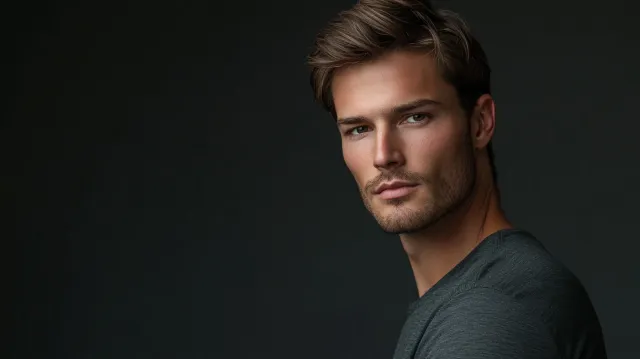
Headshots
Modeling Headshots vs Actor Headshots — What is Actually Different
Modeling and actor headshots look similar but are calibrated for different markets — lighting, expression, wardrobe, and submission specs all differ. How to know which one you actually need.
Chris McCarthy
Professional Photographer, Photography Shark · May 15, 2026
Modeling headshots and actor headshots look superficially similar — a person from the shoulders up, clean background, neutral expression — and from a distance the difference can be hard to articulate. They are not the same photograph. They are calibrated for different markets, different buyers, and different submission systems, and the calibration choices show up at every stage: lighting, expression, wardrobe, retouching, and the technical specs of the file that lands in front of an agency or casting director.
In my experience shooting headshots across Boston and the South Shore, the details that matter most are rarely the ones clients worry about.
The cost of getting it wrong is not that the photograph is bad. The cost is that the photograph is directed at the wrong audience, and people inside the relevant industry pick that up immediately. An actor submitting modeling-style images to Boston Casting or Casting Networks signals that they do not know how submissions work. A model submitting actor-style images to Maggie Inc. or Model Club signals the same thing in the opposite direction. Both photographs may be technically excellent. Neither is doing its job.
This post is the decision-helper. If you are not sure which one you need, or you are someone who works in both worlds and wants to understand how to ask for both correctly in a single session, this is the framework.
What Each Type Actually Serves
The clearest way to see the divergence is to look at what the photograph is actually being used for, and who is making the buying decision on the other side of the screen.
| Dimension | Actor Headshot | Modeling Headshot |
|---|---|---|
| Primary buyer | Casting director, casting associate | Agency booker, scout, client booking direct |
| Lead question being asked | "Can this person play this role?" | "Can we book this person for this client?" |
| Submission platform | Actors Access, Casting Networks, agent submission emails | Agency websites, agency comp cards, digital scouting forms |
| Style register | Theatrical (range) + commercial (warmth) | Commercial (catalog) + fashion/editorial (campaign) |
| Retouching tolerance | Very light — must match in person | Very light — must match in person |
| Decision speed | Seconds per submission across hundreds | Seconds per submission across hundreds |
| Refresh cadence | Every 1–2 years, sooner if look changes | Every 6–12 months for active models |
The structural similarity is that both are filtered fast and both penalize misrepresentation. The structural difference is in the question being asked. A casting director scanning Actors Access for an "early-30s warm dad type, beer commercial" is not evaluating bone structure — they are evaluating whether the photograph already suggests a man who looks like the dad in a beer commercial. An agency booker scrolling through new submissions for a sportswear catalog client is not evaluating range — they are evaluating whether your face, skin, and proportions will book under the right kind of natural light on a shoot day.
Those are different jobs. The photograph has to be built for the right one.
Lighting and Expression Differences
This is where the two genres diverge most concretely, and it is the easiest place for an inexperienced photographer to flatten them into the same image.
Actor headshot lighting runs slightly more directional, with deliberate contrast in the face. The eye is the focal point — sharp, lit, and engaged — and the rest of the face carries enough shadow to give the photograph weight and interior life. A theatrical actor headshot in particular leans toward a 3:1 or 4:1 lighting ratio that creates dimension across the face. A commercial actor headshot opens up — softer key, fill closer in, less shadow — but still keeps directional shape rather than flattening into an even wash.
The expression on an actor headshot is doing specific work. Theatrical reads usually include a subtle interior quality — a hint of thought behind the eyes, a slight asymmetry in the mouth, the suggestion that a scene is about to start. Commercial reads open into warmth without crossing into a stock-photo grin. Neither is a posed smile. Both are calibrated to look like the frame before something happens — that is the read that gets you the audition.
Modeling headshot lighting runs cleaner and more even. For agency submission frames specifically, the goal is to reveal the face — bone structure, skin quality, eye shape, lip shape — without dramatizing it. A 2:1 ratio is typical, with soft key and full fill, against white or light gray seamless. Fashion and editorial register can introduce directional or harder light, but the submission headshot itself — the lead image that opens the door at an agency — is built to be neutral and informational.
The expression on a modeling headshot is, by comparison, neutral. Not blank, but unloaded — direct eye contact, soft mouth, no character work. The agency is not casting you in a role; they are evaluating you as a face they can place. Loading the expression with character — the way an actor headshot does — actively works against you in a modeling submission, because it pushes the photograph toward a specific type when the agency is trying to assess your range as a physical product across multiple potential client uses.
A useful mental model: an actor headshot is a portrait. A modeling submission headshot is a face card.
Wardrobe Register
Wardrobe gets treated as a minor variable and it is not. It is doing a lot of the read work in both genres, and the rules are different enough that the same shirt that wins an actor headshot can sink a modeling submission.
Actor wardrobe is character-coded. Theatrical wardrobe is built around solid, slightly saturated colors that suggest a type — a denim shirt for blue-collar warmth, a dark layered look for drama, a knit for the relatable everyman read. Commercial wardrobe lifts the saturation and warmth — a soft sweater, a clean button-down, a friendly mid-tone color that reads on a billboard or beer ad without competing with the face. In both cases the wardrobe is helping the casting director see the character.
Modeling wardrobe for submission headshots is deliberately uncoded. Plain solid tops — black, white when skin tone allows, navy, soft neutrals — fitted but not styled. No graphics, no logos, no statement collars, no jewelry beyond minimal. The wardrobe is supposed to disappear so the agency can evaluate the face. Fashion and editorial portfolio frames are a different question and can absolutely carry styled wardrobe, but those are not what opens the door. The submission headshot itself is functionally a white t-shirt or a black scoop-neck against seamless — the most boring thing in the frame on purpose.
This is the place where actor wardrobe instincts work directly against you in a modeling submission. The thoughtful character-coded sweater that reads beautifully in a theatrical headshot reads as over-styled in an agency submission, because it is telling the agency what to think rather than letting them assess what they are actually looking at.
Retouching Approach
Retouching is the area where both genres agree on the philosophy and disagree on the specifics. Both are conservative. Both punish over-retouching harshly. The application differs.
Actor retouching removes temporary issues — a stray hair, a single blemish, a bit of red in the whites of the eye, a wrinkle in the shirt — and leaves everything structural alone. Lines, freckles, skin texture, facial asymmetry, and natural shape stay. Casting directors compare you to the photograph in the room within seconds of meeting. Anything that has been smoothed, shaped, or aged-down in the retouch becomes a problem the moment you walk in. The retouching that gets you cast is invisible. The retouching that gets you remembered as someone who submits dishonest images is the kind that softens skin or reshapes the jaw.
Modeling retouching follows the same restraint but tightens it further. Agencies need to see what they are about to sell. Skin texture, minor scars, freckles, natural pores, and structural detail must remain visible. Some markets — Boston included — are particularly intolerant of skin smoothing on submission frames, because it makes the agency look bad to the end client when the model shows up on set looking different from the digital. The fashion and editorial portfolio frames can carry more polished retouching for the look itself, but submission headshots and digitals stay close to raw.
The single instruction that works for both: the photograph has to look like you on a normal Tuesday. If it does not, it is working against you.
Submission Specs
Specs are where the technical reality of each market shows up. The platforms have hard requirements, the agencies have soft preferences, and submitting outside the window almost always means quiet rejection rather than a flag.
Actor submission specs
- Actors Access primary headshot: JPEG, 1600 pixels on the longest side, sRGB color, under 2 MB, 8x10 vertical crop
- Casting Networks: JPEG, 1200x1500 pixels minimum, 4:5 vertical crop, sRGB
- Agent submission email: 1200–1800 pixels on the longest side, file size under 1 MB for inline display
- Printed comp card or 8x10 print: 300 DPI at print dimensions — for in-person auditions and agency drop-offs
Modeling submission specs
- Agency email/web submission headshot: 1200x1500 minimum, 4:5 vertical, sRGB
- Comp card front headshot: 1650x2550 at 300 DPI for 5.5x8.5 print
- Polaroid digitals: 800x1000 minimum, plain background, front/side/three-quarter, natural hair, minimal makeup, fitted neutral top
- Portfolio gallery for agency review: 2000x2500 for sharp display in agency-side tools
The cross-format reference — including LinkedIn, corporate, and the rest of the headshot ecosystem — is in the complete headshot sizes guide, which is the spec sheet to keep open while exporting.
The thing to take seriously here is that submitting at the wrong dimensions does not usually trigger an error. It triggers silent deprioritization, which is much worse than rejection because you never learn that it happened.
When the Same Person Needs Both
Plenty of people work in both worlds. A working actor in the Boston regional market who also has the physical presentation for catalog or commercial print modeling is not unusual. A model who has started taking on commercial speaking roles for the same brands they shoot for is not unusual either. The question is not whether to maintain both formats — it is how to build them without contaminating each other.
The straightforward approach is a single longer session — typically two hours — structured in two blocks. The first block builds the modeling submission frames: clean light, neutral expression, plain wardrobe, white or light gray seamless. The second block resets — wardrobe change, lighting adjustment, expression direction shifts to theatrical and commercial actor reads, background may move to a textured or gradient seamless for variation.
The order matters. Building the modeling frames first protects them from absorbing the character cues that get loaded into the actor frames later. Going the other direction tends to bleed expression and styling instincts across the session in ways that make the modeling submission frames read as a little too directed.
For more depth on the agency-submission side specifically — what Maggie Inc., Model Club, and regional agency offices actually want, and the common mistakes models make in their first approach — the long-form guide is at What Boston Modeling Agencies Want in Submission Headshots.
What You Are Actually Booking
The service pages are organized by which submission market you are building for, and the booking decision starts there.
If you are pursuing acting work in the Boston regional market — theatrical, commercial, voice-over auditions that still require a headshot, agent submissions to the Boston-based agencies — you are booking actor headshots. The packaging, session structure, and deliverables are designed around theatrical and commercial reads, Actors Access and Casting Networks specs, and the practical reality of how Boston casting works. Pricing and session options are on the actor headshots service page, and the Boston-specific service detail is on actor headshots Boston.
If you are pursuing modeling representation — first agency approaches in the Boston market, refreshing an existing book, building digitals — you are booking modeling headshots. The session is built around clean submission frames, digitals, and optional portfolio looks. Service detail is at modeling headshots Boston, and the long-form editorial guide to agency submission is at What Boston Modeling Agencies Want in Submission Headshots.
If you work in both worlds, the booking conversation starts with which submission system is more time-sensitive — that is the half of the session that gets built first, and the rest follows in the same block.
Who Needs Which
A short decision frame, since the rest of the post is the long version.
You need actor headshots if you are submitting to casting platforms, agent rosters, or self-tape auditions where the headshot is the front door to a reading. The deliverable is theatrical plus commercial, calibrated to suggest castable range, exported to Actors Access and Casting Networks specs.
You need modeling headshots if you are approaching agencies, refreshing digitals, or building a submission package for commercial or fashion representation. The deliverable is clean submission frames plus digitals, calibrated to neutral and accurate, exported to agency comp card and digital submission specs.
You need both if you are working in both markets — and the right way to build both is a single longer session with the two halves explicitly separated, not a single shoot that tries to split the difference. The split-the-difference image is the one that signals to both audiences that you do not understand what they are looking at, which is the worst outcome an otherwise technically strong photograph can produce.
The photograph is doing a job. The job is different in each market. Build the one that opens the door you are actually walking through.
Frequently Asked Questions
What is the core difference between a modeling headshot and an actor headshot?
A modeling headshot is calibrated to show a marketable physical product — facial structure, skin, proportion — to an agency that needs to assess whether they can place you with commercial or fashion clients. An actor headshot is calibrated to suggest castable range and interior presence to a casting director who is filling a specific role. The first is about look. The second is about read. They are shot, lit, retouched, and submitted differently because they answer different questions for different buyers.
Can I use the same headshot for both modeling and acting submissions?
In almost all cases, no — and submitting the wrong one signals inexperience. Modeling agencies want clean, neutral, accurate images that show your actual face. Acting casting directors want photographs that already suggest a character type and a level of emotional availability. The lighting, expression, and retouching philosophies are different enough that a strong modeling headshot reads flat or product-like in an acting submission, and a strong actor headshot reads moody or over-styled to an agency.
Do modeling headshots and actor headshots cost the same to produce?
The session itself is comparable — both run on the same studio time and retouching workflow. What differs is the deliverable structure. Actor submissions typically need a theatrical look and a commercial look, plus a horizontal crop for Actors Access and similar platforms. Modeling submissions typically need clean headshots plus digitals (front, side, three-quarter) and ideally a few portfolio frames. Both can be covered in a single session of the right length.
Which retouching style is correct for each?
Modeling retouching is conservative — clean up temporary blemishes, even out skin tone slightly, leave structure, freckles, lines, and natural texture alone. Agencies need to see what they are actually selling. Actor retouching is even lighter; casting directors compare you to the photograph and reject anything that does not match in person. The fastest way to get filed away in either market is to submit an image that has been smoothed or reshaped to the point that you no longer look like it.
What submission specs do I need for each?
Acting platforms like Actors Access and Casting Networks accept JPEG at around 1600 pixels on the longest side, sRGB color, under roughly 2 MB, and prefer an 8x10 vertical crop. Modeling agencies want 4:5 vertical for digital review (1200x1500 minimum), 300 DPI prints for comp cards, and separate plain digitals. The full breakdown is in the dedicated headshot sizes guide. Submitting an image at the wrong dimensions almost always means it gets quietly skipped, not flagged.
I model and act — do I need two separate sessions?
Not necessarily. A longer session — 90 minutes to two hours — can produce both, because the wardrobe changes, lighting adjustments, and expression direction all happen within the same shoot. The important thing is that you and the photographer agree in advance which look is being built when, so the theatrical actor frames do not accidentally bleed styling cues into the agency submission frames. The two halves of the session run under different rules.
Which one do I actually need first?
If you are pursuing agency representation as a model, you need clean modeling headshots and digitals — that package opens the door. If you are submitting to theatrical or commercial casting in Boston or the regional New England market, you need a theatrical and a commercial actor headshot before anything else. Trying to lead with the wrong format slows everything down, regardless of how strong the photograph itself is.
Related Posts
![AI Headshot Generators vs Professional Headshots: Complete Guide [2026]](/blog/ai-headshots-vs-professional-headshots-w640.webp)
You Might Also Like
About the Author
Chris McCarthy
Chris McCarthy has run Photography Shark Studios in Rockland, MA for over 10 years and 500+ sessions, with executive headshot work for Rockland Trust, Clean Harbors, M&T Bank, and McCarthy Planning; founder portraits for AI startups including Lowtouch.ai; product photography for South Shore brands like Lauren's Swim; and headshots across South Shore legal, medical, financial, and academic practices. Every session is personally shot and edited by Chris on Sony mirrorless and Godox strobe systems — no assistants, no outsourcing, no batch retouching. Galleries deliver in 3–5 business days. About the photographer →
Photography Shark · Boston & South Shore MA
Ready to Book a Session?
Professional headshots, senior portraits, boudoir, and model portfolios. Studio in Rockland, MA — 25 miles south of Boston. Sessions from $395.