Photography Tips
What to Wear to Your Model Portfolio Session
Wardrobe planning for model portfolio sessions — how many looks, what works on camera, and what to avoid.
Chris McCarthy
Professional Photographer, Photography Shark · February 21, 2026 · Updated May 18, 2026
Wardrobe is the element of a model portfolio session that most models underplan. They think carefully about which poses they want to try, which angles they prefer, which images they hope to get — and then show up with a duffel bag of options assembled the morning of the session.
I have worked through this question with clients at my Rockland studio more times than I can count, and the answer is more straightforward than most people expect.
Well-planned wardrobe doesn't guarantee great portfolio images, but poorly planned wardrobe guarantees gaps in your portfolio — missing looks, incomplete coverage, and images that don't serve the market you're targeting.
This is how to plan wardrobe specifically for a model portfolio session.
The Core Principle: Dress for Your Market, Not Your Mirror
The standard most people apply when choosing what to wear is: what do I look good in? That's the wrong question for a portfolio session.
The right question is: what does a client booking for commercial work in Boston need to see?
Commercial clients want models who look like they could realistically appear in their advertising. Healthcare advertisers want models who look approachable and genuine. Consumer brand clients want lifestyle authenticity. Corporate clients want professionalism without stiffness. Fashion clients want editorial edge and style.
Your wardrobe should speak directly to the clients you want to attract — not demonstrate your personal style, but demonstrate your fit for the work.
The Three to Four Look Structure
For a standard portfolio session, plan three to four looks that each serve a distinct purpose:
Look 1: The Clean Headshot Look
This is the foundation. Clean, minimal, professional. The goal is a strong natural headshot where nothing in the outfit competes with your face or expression.
What works: Solid-color top in a neutral or flattering tone — white, cream, light grey, soft blue. Crew or V-neck silhouette. No logos, no patterns, no distracting textures.
What to avoid: Any garment with writing on it, busy prints, large graphic elements, or colors that clash with your skin tone.
Why it matters: This look almost always produces your lead image and your comp card front — the most important single image in your portfolio.
Look 2: Commercial / Lifestyle
A look that communicates real-world context and relatability. Something you could actually see in a lifestyle advertisement — not too styled, not too casual.
What works: Business casual (blazer with simple shirt, dark jeans with a polished top), active casual (athletic wear that reads stylish rather than gym-functional), or smart casual that suits your natural aesthetic.
What to avoid: Anything that looks like a costume, anything so on-trend that it will look dated in 18 months, anything that primarily communicates wealth or status rather than relatability.
Why it matters: Commercial lifestyle images are the ones that most often directly translate into actual bookings. Clients see themselves using these images.
Look 3: Fashion / Editorial
A stronger styling choice — more creative direction, bolder color, or a more defined aesthetic. This doesn't mean high fashion; it means a look with more intentional visual impact.
What works: A bold color that photographs well against the studio background, a clean structured silhouette, a look that demonstrates you have style sensibility and can execute creative direction. Leather or faux leather pieces, solid jewel tones, structured blazers in non-neutral colors.
What to avoid: Overly complicated styling that becomes more about the clothes than about you. Every element should support the image, not compete with it.
Why it matters: This look demonstrates creative range and shows you're capable of more demanding creative direction — which matters for agencies, fashion clients, and editorial work.
Look 4 (Optional): Character or Range
A fourth look that adds something the first three don't cover. This might be:
- Formalwear if you're pursuing high-end commercial or editorial work
- Athletic or fitness wear if fitness modeling is part of your goal
- A completely different aesthetic that shows range
- A close beauty look with minimal clothing visible — emphasizing face and expression
Specific Guidance by Look Category
Color
Studio photography is an environment where you control variables. Use that control.
Tested well: white, off-white, cream, light grey, navy, burgundy, forest green, dusty rose, camel, classic black.
Test carefully: bright orange, neon colors, heavy warm reds (can influence skin tone rendering), very saturated purple.
Avoid: Heavy horizontal stripes (distort proportions in full-body shots), busy florals and small-scale patterns (turn to visual noise at portrait scale), large plaids, anything with heavy texture that reads as muddy.
Fit
Every garment should be clean, pressed, and correctly fitted. Loose, wrinkled, or incorrectly sized clothing photographs poorly even in images where it isn't the focal point.
If something doesn't fit perfectly on its own, don't rely on pinning or folding to fix it on the day. Portfolio session day is not the time to problem-solve wardrobe fit.
Shoes
Shoes matter in full-body and three-quarter length shots. For each look, plan a corresponding shoe. For women: heels or boots for polished looks; clean sneakers or minimal flats for lifestyle; for editorial, whatever serves the concept. For men: clean leather shoes or boots for commercial looks; appropriate athletic shoes for fitness looks.
Bring extras. An outfit that works with one shoe choice might be significantly stronger with another.
Hair and Makeup
Come to the session with your hair and makeup done and ready. If you're booking a professional hair and makeup artist — which Chris recommends for portfolio sessions — coordinate their start time so you arrive at the studio camera-ready.
For the headshot look especially, aim for hair and makeup that reads as polished and intentional but not overly styled. The goal is natural-looking professional quality, not stage makeup.
Swimwear, lingerie, and intimates — when they belong in a model portfolio
For models pursuing commercial print, fitness, or fashion-commercial work in the Boston market, a swimwear or intimate-apparel frame is often a portfolio requirement. This is genuinely different from boudoir photography (which is a separate, intimate-portrait genre with its own conventions); model-portfolio swim/intimate frames are casting-submission tools.
- Swimwear: Solid-color one-piece or two-piece in a flattering cut. Avoid heavy patterns, novelty cuts, or anything that pulls focus. Bring two options.
- Intimate / lingerie for portfolio purposes: Clean, structured pieces in neutral tones (nude, soft black, dove gray, ivory). Bring a robe or wrap for in-between frames.
- Fitness wear: Solid colors, well-fitted, brand-neutral (avoid prominent logos that could affect commercial usage rights). Sports bra + leggings is standard; bring two color options.
Whether to include any of these depends on the agency target and the model's comfort. The conversation should happen at the pre-session consultation — not on the day of the shoot. Many agencies in the Boston commercial market will explicitly request these frames if they exist; others find them optional. Knowing the target before the session shapes whether they're shot.
Size-specific wardrobe considerations
A few patterns that affect models outside the standard sample-size range:
- Plus-size and curve models — clean fit matters more than at sample-size, not less. Bring 2 sizes of each top in case the fit reads differently on camera than in the bedroom mirror. Tailored blazers and structured tops perform better than draped or loose fits, which can read as "hiding the body" on camera.
- Petite models — full-length frames need shoes that elongate (heels for women, fitted boots for men) and silhouettes that don't visually divide the body horizontally. High-waisted bottoms and monochromatic looks both extend apparent height.
- Tall fashion-track models (5'9"+ women, 6'1"+ men) — proportions are different at full-length; bring pieces that hit at the correct point on YOUR frame (skirts to the right length, blazer hems to the right hip). Off-the-rack pieces sized for sample fit often look correct.
- Male models in the commercial market — bring two suits (charcoal + navy) in addition to the casual looks. Boston commercial print uses suit-and-tie looks frequently for financial services, healthcare-administration, and corporate-explainer work.
The "model bag" — what to keep packed permanently
Working models in the Boston market typically maintain a permanent wardrobe bag that travels to every session. The standard contents:
- A clean white tee, a clean black tee, a clean white button-down, a clean navy blazer (these are the four pieces that solve emergency wardrobe gaps on any session).
- Two pairs of clean nude-tone underwear and a strapless bra (for women) — eliminates visible-line issues on commercial work.
- A lint roller, a small sewing kit, safety pins, double-sided fashion tape, blotting papers.
- Skin-tone-matched fashion tape and silicone cups for backless or low-cut looks.
- Three pairs of shoes: a clean white sneaker, a black heel/dress shoe, a barefoot-friendly nude option for swimwear/intimates frames.
- A robe (knee-length, neutral color) for in-between transitions.
The bag stays packed between sessions. Pre-session prep is reduced to "swap out the look-specific pieces and confirm the bag is intact," which is faster and produces fewer day-of mistakes.
Pre-session try-on protocol
The two days before the session:
- Try on every planned outfit head-to-toe. Shoes included. Same undergarments you'll wear on the day. Move around — sit, stand, reach overhead, turn — to verify each piece doesn't shift, ride up, or expose something it shouldn't.
- Take phone photos in each outfit. Not for the gallery — for your own check. Bedroom-mirror approval and on-camera read can differ. The phone is closer to camera than the mirror, and the photos will catch what the mirror missed.
- Steam or press each piece. Hang on separate hangers in a garment bag. Pack into the car the night before.
The combination eliminates most morning-of wardrobe surprises. Models who skip the try-on protocol routinely arrive at the session and discover, for example, that a top sits oddly with the heels they planned to wear — and the session loses 10 minutes resolving it.
Logistics
Hang or fold your looks separately so you're not pulling wrinkled garments from a bag mid-session. Label what goes with what — which shoes, which accessories — so transitions between looks are fast and clean.
The time spent transitioning between looks in a session is time not spent making images. Ten-minute transitions instead of five-minute transitions cost you a look over the course of a 90-minute session.
Before the Session
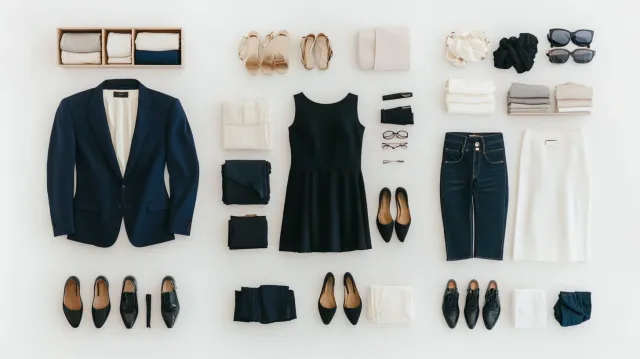
Photography Shark does pre-session consultations for portfolio builds. Reach out in advance with photos of your planned looks — flat lays or worn photos — and Chris will give specific feedback on what will work and where to adjust.
Studio is at 83 E Water Street, Rockland, MA — 35 minutes south of Boston. Book your session here or call us at (781) 312-8824.
Frequently Asked Questions
How many outfits should I bring to a model portfolio session?
For a 60–90 minute session, plan three to four distinct looks. Two is too few to show range; five or more is too many to execute well in the time available. Three well-planned looks almost always beats five hurried ones.
What colors photograph best for model portfolios?
Solid neutrals — white, cream, grey, navy, black — are the most reliable. Jewel tones photograph well if they suit your coloring. Avoid busy patterns, large logos, and heavily textured fabrics that compete with your face and expression.
Should I wear what I'd wear in real life or dress more formally?
Dress for the market you're targeting. Commercial models should have at least one 'real life' look — something relatable and genuine — alongside a more polished look. The goal is images that communicate authenticity to the people who will book you.
Does Photography Shark have a wardrobe consultation before the session?
Yes. Chris McCarthy reviews your planned looks in advance and gives specific guidance based on your target market and the images you're trying to build. Contact us at (781) 312-8824 or through our contact form to discuss your session plan.
What about shoes and accessories for model portfolio sessions?
Shoes matter in full-length shots — bring multiple pairs appropriate to your looks. Accessories should be minimal for headshot-oriented images. For fashion or editorial looks, bolder accessories can contribute to the overall image concept, but discuss this with Chris in advance.
Where is Photography Shark located for model portfolio sessions?
At 83 E Water Street, Rockland, MA 02370 — about 25 minutes south of Boston, easily accessible from Quincy, Weymouth, Hingham, Scituate, Norwell, and Marshfield.
Related Posts

You Might Also Like
About the Author
Chris McCarthy
Chris McCarthy has run Photography Shark Studios in Rockland, MA for over 10 years and 500+ sessions, with executive headshot work for Rockland Trust, Clean Harbors, M&T Bank, and McCarthy Planning; founder portraits for AI startups including Lowtouch.ai; product photography for South Shore brands like Lauren's Swim; and headshots across South Shore legal, medical, financial, and academic practices. Every session is personally shot and edited by Chris on Sony mirrorless and Godox strobe systems — no assistants, no outsourcing, no batch retouching. Galleries deliver in 3–5 business days. About photographer Chris McCarthy →
Photography Shark · Boston & South Shore MA
Ready to Book a Session?
Professional headshots, senior portraits, boudoir, and model portfolios. Studio in Rockland, MA — 25 miles south of Boston. Sessions from $395.