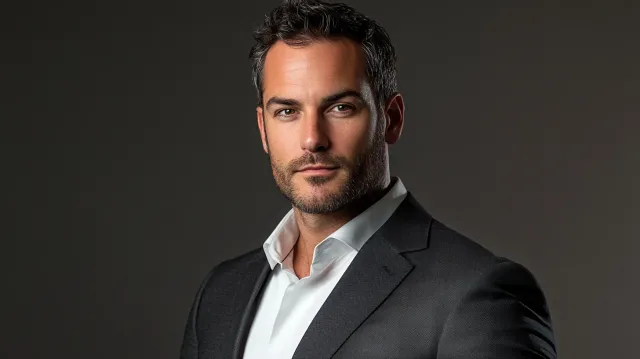
Headshots
Headshot Wardrobe Guide for Men: What to Wear and What to Avoid
A practical wardrobe guide for men getting professional headshots in Boston. What colors, patterns, and styles work — and what to leave at home.
Chris McCarthy
Professional Photographer, Photography Shark · February 11, 2026 · Updated April 23, 2026
The wardrobe you choose for a professional headshot does more than communicate how you dress. It communicates how seriously you take your professional presentation, what kind of professional you are, and whether you are someone a client or employer would be comfortable putting in front of their stakeholders.
I'm Chris McCarthy. I shoot professional headshots for men in Boston and on the South Shore from a studio in Rockland. This is a practical guide to what works.
The Core Principle: Face First
Everything about wardrobe for headshots comes down to one principle: the clothing should support the face, not compete with it. Your client or employer is looking at your face. Your wardrobe is the frame.
Anything that draws attention to itself — a bold pattern, a bright color, an interesting texture — is stealing visual attention from your face. In a headshot, that is exactly what you do not want.
Colors That Work
Navy blue — The most universally flattering dark tone for men. Reads as professional, clean, and contemporary. Works on almost every skin tone.
Charcoal gray — The second most reliable choice. Slightly more formal than navy. Excellent on fair to medium skin tones.
Dark gray — A versatile mid-range option. More casual than charcoal, more professional than light gray.
White shirt beneath a dark blazer — A reliable classic. The contrast draws the eye upward toward the face.
Deep jewel tones — Navy, forest green, deep burgundy, and similar rich colors can work well. They photograph warmly without creating noise.
Color Science: Reading Your Undertone
The reason a navy blazer makes one guy look sharp and another guy look tired comes down to skin undertone. Most men never think about this, but ten minutes spent figuring it out is the highest-leverage decision you can make for a headshot.
Cool undertones — pinkish or bluish cast in the skin, veins on the wrist read blue, silver jewelry generally looks better than gold. Cool undertones photograph cleanest in true navy, charcoal, slate gray, ice blue, deep emerald, and crisp white. Avoid orange-leaning browns, mustard, and warm camel — they fight the skin and create a slightly mismatched look that's hard to retouch out.
Warm undertones — yellow, peachy, or olive cast in the skin, wrist veins read greenish, gold jewelry sits well against the skin. Warm undertones photograph best in olive, warm browns, ivory or cream rather than stark white, deep burgundy, forest green, and warmer navies (with a slight purple lean rather than slate). Pure cool grays can read flat against warm skin in studio strobe.
Neutral undertones — most things work. The decision comes down to industry rather than tone.
A practical test: take a white piece of printer paper outside in daylight, hold it next to your jaw, and look in a mirror. If your skin reads pink-to-blue against the paper, you're cool. If it reads yellow-to-peach, you're warm. If it doesn't push either way, you're neutral. This takes thirty seconds and it changes which shirt you should be wearing in the photo that goes on your firm bio for the next four years.
Fit: Where Most Headshots Quietly Fail
A headshot crops at the chest. That means every fit problem in your shirt, blazer, or jacket is happening directly under your face, where there's no visual real estate left to hide it.
Collar shape and fit — A point collar or semi-spread is the most reliable choice for most face shapes. A wide-spread collar works on a longer, narrower face but can make a round face look wider. The collar should sit flush against the neck without gapping. If you can fit two fingers between the collar and your neck, the shirt is too big — the collar will buckle on camera.
Collar height — Tall collars (sometimes marketed as "high-band") often photograph awkwardly because they crowd the jawline. A standard collar height of about 1.5 inches is the safe range.
Shoulder seam placement — The seam where the sleeve meets the body of the jacket should sit at the edge of your actual shoulder bone, not on the upper arm and not above the shoulder. A jacket whose shoulder seam is even half an inch off looks subtly wrong in every frame. This is the single most common fit problem I see at sessions.
Sleeve length on the shirt — Roughly half an inch of cuff showing past the jacket sleeve. This rarely matters in a tight headshot crop, but it matters for a three-quarter image.
Chest fit — The blazer should close cleanly with one button. If there's an X-shaped pull when buttoned, it's too tight. If the lapel flaps loose against the chest, it's too big. Both read on camera.
Tie and collar relationship — If you're wearing a tie, the knot should fully fill the gap between collar points. A thin tie in a wide-spread collar leaves a gap that draws the eye.
If you only have time for one alteration before a headshot, get the shoulders adjusted on whatever jacket you're planning to wear. Everything else is forgiving. Shoulders are not.
Industry Calibration: Suit, Blazer, or Layered Shirt
Different industries reward different levels of formality, and a wardrobe that's right for one is conspicuously wrong for another.
Law and finance — Full suit, white or pale blue shirt, conservative tie or open collar. Solid navy or charcoal. A pocket square in finance is fine; in law it can read as costume. For partners and senior counsel, the dark suit is essentially the uniform and headshots that depart from it tend to look out of place against the firm's existing roster.
Tech and startup leadership — Blazer over a solid shirt, no tie. Sometimes the shirt alone is appropriate, especially for engineering-led companies. A suit can read as overly corporate against a tech firm's aesthetic. Charcoal blazer with a clean white or chambray shirt is the workhorse combination.
Healthcare and medical — Dress shirt under a blazer is the most versatile option. White coat is appropriate if it's how you actually present to patients. Avoid the suit-and-tie if your daily work doesn't include one — patients respond to images that match real interactions.
Real estate and sales — Blazer with shirt and optional tie. Slightly more polished than tech, slightly less formal than law. A pocket square is acceptable but optional.
Creative industries (architecture, agency, design) — A well-fitted dark shirt without a jacket can work. So can a knit polo or a fine-gauge crewneck under a blazer. The latitude is wider here, but quality of fit matters more — there's no jacket structure to bail out a rumpled shirt.
Trades, contracting, construction leadership — Skip the suit unless you're the principal of a major firm. A clean dark shirt — sometimes branded with a clean, small logo if it's your own company — reads more authentic than borrowed corporate styling.
When in doubt, default to the dark blazer over a solid shirt. It's the lowest-risk choice across more industries than any other combination.
Eyewear: Get the Coating Right
If you wear glasses every day, wear them in your headshot. A photo without your glasses creates a disconnect when clients meet you. The fix is technical, not stylistic.
Anti-reflective coating — Required. Without it, studio strobes will produce visible reflections in the lenses that have to be either retouched out (slow, sometimes imperfect) or shot around using awkward head angles that compromise the image. AR coating is a $50–$100 add-on at most optical shops and can be applied to existing frames.
Frame size relative to face — Frames should sit fully within the width of your face. If the temples extend past the outline of your face, the frames are too big. If the lenses cut across your eyebrows or rest on your cheekbones, they're too small or poorly positioned.
Frame color — Should harmonize with your hair and undertone. Tortoise and warm browns favor warm undertones; black and gunmetal favor cool. Clear and rimless frames are the safest universal choice but can read corporate-cold for some industries.
Lens tint — No tinted lenses for a professional headshot. Photochromic (transition) lenses can darken slightly under studio strobes — if yours do this aggressively, mention it before the session and we can either work around it or you can wear a non-photochromic pair.
If you're getting headshots and have been thinking about new frames anyway, getting them updated and AR-coated a week before the session is the right move.
Facial Hair: Pre-Session Prep
Facial hair is a wardrobe choice in the sense that it's part of how the face presents on camera. The decisions matter.
Clean shave — Shave the morning of, not the night before. End-of-day stubble shows up under hard studio light as patchy shadow that's distracting and looks unintentional.
Maintained beard or stubble — Trim and shape two to three days before the session, not the morning of. A freshly groomed line looks too sharp and obvious. Two days of softening makes the shape look natural.
Mustache — Trim the lip line so hairs aren't crossing into the upper lip. This is small and looks tiny in a mirror, but a tight headshot crop sees everything.
Neck and cheek lines — Defined. A beard with vague boundaries looks unkempt at headshot resolution.
No new looks the week of the session. Don't grow out a beard you've never worn or shave one off you've worn for years right before a session. Headshots should match the way clients and colleagues meet you in person.
What Not to Wear
Logos — Even small ones. They become focal points in a way you don't expect.
Stripes thinner than half an inch — Fine stripes and pinstripes create a moiré pattern (a shimmering interference effect) when photographed digitally. The image looks like the shirt is vibrating. Wider stripes can sometimes work but introduce visual rhythm that competes with the face.
Gingham, micro-checks, and fine plaids — Same moiré problem as stripes, plus added busyness.
Cheap fabric sheen — Polyester blends and shiny synthetics catch studio strobe light in a way that creates harsh hot spots on the chest and shoulders. Wool, cotton, linen, and matte-finish blends photograph cleanly. Anything that's noticeably shiny in person will be conspicuously shiny on camera.
Heavy texture (chunky knits, thick tweeds, exaggerated weaves) — Adds visual noise and can make the upper body look bulky.
Bow ties (unless you wear them daily) — They become the photo. Same with novelty ties, suspenders worn over a shirt without a jacket, and pocket squares larger than a pinch.
Ill-fitting collared shirts left unbuttoned at the top — A loose collar with no tie photographs as sloppy. Either button it or wear a different style top.
Sweaty or recently washed shirts — Wash and steam at least 24 hours before the session. Damp fabric reads on camera even after it dries.
Colors to Avoid
Neon and bright colors — They draw attention from your face and create an unprofessional impression in most contexts.
Light gray and beige — These can wash out against common light backgrounds and make the subject appear to blend into the backdrop.
White without a dark layer — A white shirt alone can blow out under studio lighting and creates no contrast with light backgrounds.
Very pale colors — Pale yellow, light pink, powder blue — these photograph weakly and read as casual rather than professional.
Patterns and Textures
Avoid bold patterns entirely. Stripes, plaids, checks, herringbone, and similar patterns create compression artifacts in digital images and visual noise that distracts from the face.
Fine textures — a subtle texture in a solid-color fabric — can add depth without creating visual noise. But when in doubt, a solid is safer.
Suits, Blazers, and Business Casual
Dark suit — The most formal option. Appropriate for attorneys, financial professionals, and corporate executives. Can read as stiff for more casual industries.
Dark blazer over a collared shirt — The most versatile combination. Works across industries from finance to tech to healthcare. Professional without being formally corporate.
Smart casual — A well-fitted solid-color dress shirt or sweater without a jacket. Appropriate for startup founders, creative professionals, and industries where a suit would look out of place. The key word is well-fitted.
Fit Matters
A perfectly colored blazer that doesn't fit well photographs poorly. Shoulders should lie flat. The chest should not pull. For a headshot, the jacket should lie smoothly across the torso. A suit that fits off-the-rack is almost always better than an expensive suit that does not fit.
Practical Session Tips
Bring two options. What looks good in your closet sometimes does not photograph the same way. Having an alternative matters.
Iron or steam everything. Wrinkles read in photos. A wrinkled shirt is a distraction.
No logos. Brand logos on clothing are a distraction and can look unintentionally casual or promotional.
Collar and neckline. For most studio headshots, a collar frames the face better than a collarless shirt. A well-fitted collar draws the eye upward.
Book Your Session
Contact the studio and mention that you need a professional headshot — full Boston headshot packages and pricing are on the investment page. Tell me your industry and what platforms the image is for — that shapes wardrobe guidance before the session.
Sessions start at $395. Studio at 83 E Water Street in Rockland. Also see: Boston Headshots for the full service overview, or Boston male modeling portfolio sessions if you're building a modeling book rather than a corporate headshot. Further reading: headshot guide for job seekers. Also relevant: what to wear for an ERAS residency photo · how to sharpen your headshot game.
Frequently Asked Questions
What is the best color to wear for a professional headshot?
Navy blue and charcoal gray are the most reliable choices for men. Both photograph cleanly, look professional, and work on most skin tones. Avoid patterns, neon colors, and very pale tones.
Should I wear a suit or a blazer for a headshot?
A dark blazer over a collared shirt is the most versatile option for most professionals. A full suit is appropriate for attorneys, executives, and formal corporate contexts. Smart casual works for tech, creative, and startup contexts.
Can I wear a patterned shirt for my headshot?
Avoid bold patterns — stripes, plaids, and checks create visual noise and distract from your face. Subtle textures in solid fabrics can work. When in doubt, go solid.
Related Posts
![What to Wear for a Professional Headshot: Complete Guide [2026]](/blog/what-to-wear-for-a-professional-headshot---boston--hero-w640.webp)
You Might Also Like
About the Author
Chris McCarthy
Chris McCarthy has run Photography Shark Studios in Rockland, MA for over 10 years and 500+ sessions, with executive headshot work for Rockland Trust, Clean Harbors, M&T Bank, and McCarthy Planning; founder portraits for AI startups including Lowtouch.ai; product photography for South Shore brands like Lauren's Swim; and headshots across South Shore legal, medical, financial, and academic practices. Every session is personally shot and edited by Chris on Sony mirrorless and Godox strobe systems — no assistants, no outsourcing, no batch retouching. Galleries deliver in 3–5 business days. About the photographer →
Photography Shark · Boston & South Shore MA
Ready to Book a Session?
Professional headshots, senior portraits, boudoir, and model portfolios. Studio in Rockland, MA — 25 miles south of Boston. Sessions from $395.