Photography Tips
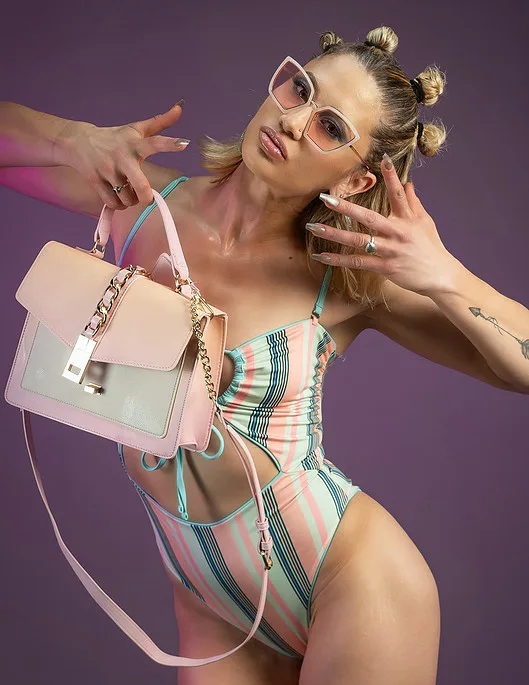
Boston Model: Kris Swan
How adult models build commercial careers in Boston — portfolio strategy, choosing a photographer, and why ongoing relationships beat one session.
Chris McCarthy
Professional Photographer, Photography Shark · December 29, 2023 · Updated May 24, 2026
Kris Swan is a Boston-based adult model who has worked with Photography Shark across multiple sessions over several years. Her career trajectory illustrates a pattern that applies broadly to adult models building commercial careers in the Boston market: the difference between a one-session portfolio and an ongoing photographer relationship, the specific challenges of the Boston commercial landscape, and what separates models who sustain bookings from those who plateau.
From a decade of professional photography at Photography Shark, I have learned that the advice that actually matters fits on one page.
The Boston commercial modeling market for adults
The Boston modeling market is smaller than New York or LA but has specific strengths. Healthcare and biotech advertising — driven by the concentration of pharma companies in Cambridge and hospitals in the Longwood Medical Area — regularly needs models in their thirties through sixties who read as real people rather than fashion aspirants. Catalog work for New England retailers and direct-to-consumer brands skews toward relatable authenticity over editorial polish. The financial services sector (Fidelity, State Street, MassMutual) uses models for annual report and marketing imagery that requires professional presence without the theatrical register of a fashion campaign.
For adult models, this market context matters: the look that books in Boston is competence, approachability, and credibility — not the high-fashion editorial aesthetic that dominates the New York market. A portfolio built for Boston commercial work should demonstrate range within that register: corporate-casual, lifestyle-relaxed, healthcare-warm, and outdoor-active. Each requires different wardrobe, expression, and body language, and the photographer needs to understand those distinctions to produce images that casting directors and ad agencies will respond to.
Why the ongoing relationship matters more than the portfolio
The most common mistake new models make is treating the portfolio as a one-time production — a single session that produces a fixed set of images to submit everywhere. In practice, a portfolio is a living tool that needs updating as the model's look evolves, as the market's visual standards shift, and as the model develops range and camera confidence that their initial session could not capture.
Kris Swan's sessions with Photography Shark span multiple years. The earliest frames documented her baseline commercial look; subsequent sessions built on that foundation with more specific editorial variations, wardrobe experiments, and posing development that came from increasing camera confidence. The improvement between session one and session four is visible in the work — not because the lighting changed (it did not) but because the model's ability to take direction and produce nuanced expression deepened with practice.
This is the argument for a standing photographer relationship: each session builds on the previous one. The photographer learns the model's angles, strengths, and development areas. The model learns the photographer's direction vocabulary and can respond faster. The resulting images are more refined and more specific than what any cold first session can produce, regardless of talent on either side.
Portfolio construction for Boston agencies
Boston's commercial agencies — Maggie Inc, Model Club Inc, and the commercial divisions of the larger talent agencies — evaluate submission portfolios quickly. The decision to bring someone in for a meeting happens in under a minute of reviewing the portfolio, which means every image needs to earn its place. The standard submission package includes:
Clean commercial headshot. Neutral background, warm natural expression, studio lighting. This is the foundational image — the one the agent looks at first. It must be technically flawless: sharp focus on the eyes, even skin tone, no distracting elements.
Full-body commercial frame. Standing, natural posture, wardrobe appropriate to the commercial register the model is targeting. This establishes proportions and body type — information the agent cannot get from a headshot alone.
Lifestyle frame. An environmental image that shows the model in a setting — coffee shop, office, outdoor urban — that demonstrates how they read in context. This is the image that helps the agent imagine the model in a specific campaign.
Editorial or range frame. One image that shows something different — stronger posing, different lighting, a more fashion-forward wardrobe — to demonstrate that the model can stretch beyond the commercial baseline.
Three to five images is sufficient for a submission. More than that dilutes the impact and suggests the model cannot self-edit. Quality and consistency beat quantity at every agency.
Session structure at Photography Shark
Model portfolio sessions at the Rockland studio are structured around production goals rather than time. Chris McCarthy discusses the target agencies, the look categories the model is pursuing, and the specific gaps in the existing portfolio before the session begins. The session itself runs through planned setups — typically three to four distinct looks (wardrobe + lighting + backdrop combinations) — with active direction on posing, expression, weight distribution, and gaze throughout.
The direction style is precise and continuous — the same approach used across all model portfolio sessions at the studio. Chris does not give vague encouragement ("look natural," "just relax") — he gives specific physical adjustments ("chin forward and down an inch," "drop the left shoulder," "shift your weight back and push the hip left") that produce measurably better frames. For models early in their career, this direction is instructional: they leave the session knowing more about how to pose than they did when they arrived. For experienced models, the direction is collaborative: fine-tuning positions the model already knows to optimize for the specific lighting setup.
Pricing and how to book a model portfolio session
Professional headshots start at $395 for 30 minutes with 10 retouched images — suitable for a clean headshot submission to accompany agency inquiries. For the full session format designed specifically for agency portfolios, see model headshot sessions in Boston. Full model portfolio packages are scoped individually based on goals, target agencies, and how many distinct looks the portfolio needs. Contact Photography Shark to discuss your specific situation. The studio is at 83 E Water Street, Rockland MA — central to the South Shore and 35 minutes south of Boston via Route 3.
Frequently Asked Questions
Does Photography Shark work with models who are adults, not just teenagers?
Yes. Chris McCarthy works with models in their twenties, thirties, forties, and beyond. Boston's commercial market has strong demand for adult models — healthcare advertising, catalog work, and lifestyle photography regularly need models who represent real people.
What should a Boston modeling portfolio contain to get agency attention?
Clean commercial headshots against simple backgrounds, commercial lifestyle images, and at least one editorial look demonstrating range. Every image needs professional technical quality — soft or poorly lit images are dismissed regardless of how good the model is.
How much does a model portfolio session cost at Photography Shark?
Professional headshots that double as agency submission images start at $395 for 30 minutes with 10 images. Full model portfolio sessions are scoped and priced based on your goals — contact Chris at the Rockland studio (83 E Water Street) to discuss.
Why does Chris McCarthy recommend ongoing photography relationships rather than one portfolio session?
A portfolio is a living document. As your skills develop and your look changes, images need updating. Regular sessions also build the camera comfort and posing skills that translate directly to better casting performance.
How does Photography Shark approach direction during a model portfolio session?
Direction is specific and continuous: exact body positioning, head angles, weight distribution, eye direction. Chris does not give vague encouragement — he gives precise adjustments that create a direct feedback loop between physical action and photographic result.
How soon will I receive my model portfolio gallery?
Edited galleries are delivered within 3–5 business days for headshots and studio sessions. For models with agency submission deadlines, contact Chris to discuss expedited delivery.
Related Posts
You Might Also Like
About the Author
Chris McCarthy
Chris McCarthy has run Photography Shark Studios in Rockland, MA for over 10 years and 500+ sessions, with executive headshot work for Rockland Trust, Clean Harbors, M&T Bank, and McCarthy Planning; founder portraits for AI startups including Lowtouch.ai; product photography for South Shore brands like Lauren's Swim; and headshots across South Shore legal, medical, financial, and academic practices. Every session is personally shot and edited by Chris on Sony mirrorless and Godox strobe systems — no assistants, no outsourcing, no batch retouching. Galleries deliver in 3–5 business days. More about the photographer →
Photography Shark · Boston & South Shore MA
Ready to Book a Session?
Professional headshots, senior portraits, boudoir, and model portfolios. Studio in Rockland, MA — 25 miles south of Boston. Sessions from $395.