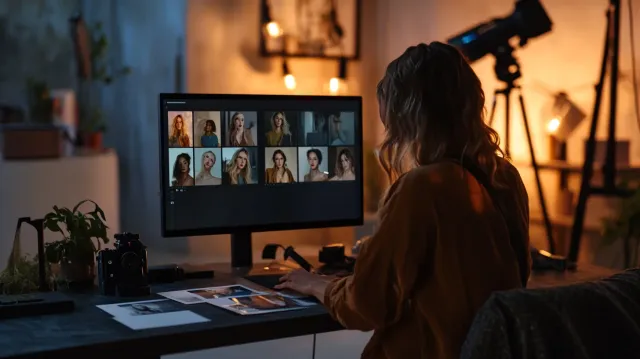
Photography Tips
Commercial vs. Editorial Model Portfolios
How commercial and editorial modeling portfolios differ, which applies to you, and how Photography Shark in Rockland, MA builds both for the Boston market.
Chris McCarthy
Professional Photographer, Photography Shark · March 5, 2026 · Updated March 21, 2026
The two most fundamental categories in modeling are commercial and editorial. They require different images, attract different clients, and lead to different careers. Understanding the distinction — and building your portfolio accordingly — is one of the most important decisions an aspiring model makes.
What Commercial Modeling Actually Is
Commercial modeling is work for brands, companies, and advertisers communicating messages to consumers. The model in a commercial image is serving the message — they're making a product, service, or brand feeling accessible, aspirational, or relatable to the target audience.
Examples in the Boston market:
- A healthcare system advertising a new patient experience
- A financial services firm showing their advisors and clients
- A retail brand's seasonal catalog photography (the production side of which is covered in our Boston clothing and lookbook photography guide)
- A technology company's website and sales materials
- A lifestyle product's digital advertising
The dominant quality of successful commercial images is authentic relatability. The model looks like a real person the target consumer can identify with — not a stylized fashion fantasy, but a grounded, genuine human presence.
This doesn't mean commercial images are boring. The best commercial photography is technically excellent, carefully directed, and visually polished — but the visual polish serves believability rather than fantasy.
What Commercial Portfolios Look Like
Commercial portfolios are full of images that look like they could appear in actual advertising:
- A business-attired figure in a professional environment
- A smiling, approachable person in a lifestyle context
- A family or couple in a genuinely warm moment
- An active, health-conscious person in an outdoor or fitness setting
The range of looks, ages, and types who work commercially is wide. Commercial modeling in Boston is not primarily a young-and-thin-only world — clients need models who represent their actual customer base.
What Editorial Modeling Actually Is
Editorial modeling is work for publications, fashion brands, and creative campaigns where the model is serving an artistic or fashion vision rather than a direct commercial message. The images are more stylized, often more conceptual, and prioritize creative impact over relatability.
Examples:
- Magazine fashion spreads
- Designer lookbooks and campaign photography
- Fashion week documentation
- Artistic portfolio work for photographers
The dominant quality of successful editorial images is creative collaboration — the model is a creative contributor to a visual concept, not just a relatable human presence.
What Editorial Portfolios Look Like
Editorial images often have:
- Stronger, more directional lighting setups
- More dramatic or fashion-forward styling
- More conceptual props or environments
- Expression and body language that communicates mood or narrative
- More creative camera angles and compositional choices
The visual impact is usually immediate and arresting — editorial images are designed to stop a reader turning a page.
The Boston Market Reality
The honest assessment of the Boston market for aspiring models:
Commercial has substantially more work and more career sustainability. Boston is a strong commercial photography market — the region's concentration of healthcare, biotech, financial services, technology, education, and consumer brands means there is consistent, ongoing demand for commercial models. This work is bookable, recurring, and doesn't require runway measurements.
Editorial work in Boston is real but limited. There are fashion photographers, boutique designers, and creative campaigns in the Boston market that require editorial work. But the volume is smaller, the rates are often lower than commercial, and for models who want to build an editorial career at the highest levels, the path ultimately leads to New York.
Most Boston models should build commercial-primary portfolios with editorial range. This means: a portfolio that speaks clearly to commercial clients as its core, with two or three editorial images that demonstrate creative versatility and range. The commercial images get you booked; the editorial images demonstrate depth.
How to Build a Portfolio That Covers Both
The practical approach for most models is to structure a portfolio session with explicit coverage for both categories:
Commercial images (3–5 images)
- A clean professional headshot
- At least one full-body commercial lifestyle image
- One or two additional commercial context images
Editorial images (2–3 images)
- At least one image with stronger styling and more creative direction
- One image that demonstrates creative range — a different expression register, a more dramatic setup, or a clearly fashion-forward choice
This isn't 50/50 coverage. It's a commercially-weighted portfolio with editorial depth — which is what most Boston agencies and clients actually want to see.
Side-by-Side Breakdown: How the Two Categories Differ in Practice
Talking about commercial and editorial in the abstract obscures how concretely they differ on the studio floor. Here's the comparison spelled out:
Lighting. Commercial work runs heavily on soft, broad, even-shadow lighting — large modifiers, fill on both sides, natural-feeling light direction. The goal is to make the subject look real, healthy, approachable. Editorial work runs harder. Smaller modifiers, more direction, more shadow, sometimes hard light. The image is allowed to be visually stylized.
Wardrobe. Commercial wardrobe is what your target customer actually wears — fitted, accessible, neutral-to-mid-color, current but not trend-chasing. Editorial wardrobe is what's on the runway or coming off it — elevated, conceptual, sometimes uncomfortable, often impractical. A commercial model brings their own clothes to a portfolio session. An editorial session usually involves a stylist and pulled wardrobe.
Expression. Commercial expression is positive and genuine — warmth, openness, a real smile. The face is doing the work of saying "I'm a person you'd want to interact with." Editorial expression is broader: detached, intense, sullen, ambiguous. The face is allowed to be a creative element rather than a relatable one.
Pose. Commercial poses are grounded, centered, and natural-feeling. Body language is open and confident without being theatrical. Editorial poses can be extreme — angular, asymmetric, pose-as-graphic. A commercial model standing in third position with hands in pockets reads correctly. An editorial pose in third position would read as flat.
Crop and framing. Commercial work uses standard crops — head and shoulders, three-quarter, full-length — without aggressive framing experiments. Editorial work plays with crops: extreme close-ups, wide environmental, awkward asymmetric framing, off-center compositions, deliberately tight or loose crops that draw attention to the framing decision itself.
Retouching. Commercial retouching is conservative — clean skin without removing texture, restored color, no dramatic shape changes. The image needs to look like the actual person could walk on set and match the photo. Editorial retouching is more permissive — high-end skin work, color grading, more aggressive shape and shadow work. The image is acknowledged as constructed.
Agency Expectations and the Comp Card Question
Most aspiring models don't realize that agencies evaluate commercial and editorial portfolios using completely different rubrics, and that the comp card — the printed marketing card every represented model has — is structured differently for the two categories.
A commercial comp card has a clean headshot on the front and four to six commercial lifestyle images on the back. The back images cover wardrobe range, age range (looking younger vs. age-matched vs. slightly older), and category coverage (corporate, casual, active, family). The card is organized to let casting directors quickly answer "can this person book my specific job?"
An editorial comp card has a stronger lead image on the front — sometimes with no headshot orientation at all, sometimes a close beauty crop, sometimes a wider editorial frame. The back is fewer images (often three or four) but each is more visually distinctive. The card answers a different question: "is this person interesting enough to put in a magazine?"
When agencies evaluate a submission, they're matching the comp card to the kinds of jobs they have. A heavily commercial Boston agency reading a heavy-editorial book often passes — not because the work is bad, but because the model is targeted at jobs the agency doesn't book. The same submission to a New York editorial-leaning agency might result in immediate signing. Targeting matters as much as quality.
For models in Boston specifically, this means: build commercial first. The Boston agencies that sign new models are casting for the Boston commercial market. Start with what books locally, then add editorial range as you're ready to submit to out-of-town agencies for the work that doesn't exist here.
The Look-Range Question
A useful diagnostic for figuring out which category fits you best is what's called "look range" — how many distinct visual identities you can credibly present on camera.
Commercial work doesn't require an extreme range. It requires consistent, reliable presence across a small set of registers: friendly professional, warm casual, healthy active. A commercial model who can deliver "approachable financial advisor," "warm parent at home," and "energetic outdoor person" is set. Three or four registers, executed convincingly, build a working commercial career.
Editorial work demands more. The expectation is that an editorial model can transform — high-fashion intensity one minute, vulnerable softness the next, sharp-edged style the minute after that. The face has to read in dramatically different lighting and styling without looking like the same person dressed up. This is partly genetic (some faces have the structural range, others don't) and partly trained (acting training, modeling agency development, time in front of cameras).
Most working models are commercial. The editorial track is narrower because the look-range bar is higher and because the volume of editorial work is smaller. There's no shame in being a commercial model — most successful careers are commercial careers.
Photography Shark's Approach to Both
Photography Shark builds portfolios for both commercial and editorial use from the Rockland, MA studio. Chris McCarthy directs sessions with the specific end use in mind — commercial images are lit and directed to produce that genuine, relatable quality that works in advertising; editorial images are built with more creative direction and visual ambition.
Packages start at $395 for a single-look session and scale to the 90-minute package for full portfolio builds covering both categories. Studio is at 83 E Water Street, Rockland — 35 minutes south of Boston.
Contact us to discuss which portfolio build is right for where you are in your modeling career. Related: pageant submission headshots.
Frequently Asked Questions
What is the difference between commercial and editorial modeling?
Commercial modeling is work for advertising, retail, healthcare, corporate, and lifestyle brands — the model is communicating the client's message to real consumers. Editorial modeling is work for magazines, fashion publications, and artistic campaigns — the model is serving a creative or artistic vision, often more stylized and conceptual.
Which type of modeling has more work in Boston?
Commercial modeling has significantly more ongoing work in the Boston market than editorial. Boston's strengths — healthcare, financial services, technology, retail, and lifestyle — are all commercial categories. True editorial fashion work in Boston is limited; that market ultimately runs through New York.
Should my portfolio include both commercial and editorial images?
Yes, for most models. A commercially-weighted portfolio with two or three editorial images demonstrates range without misrepresenting your primary market. A portfolio that's entirely editorial without commercial coverage limits your booking potential in Boston significantly.
Does Photography Shark shoot both commercial and editorial portfolio work?
Yes. Photography Shark in Rockland, MA builds portfolios across commercial, editorial, and lifestyle categories. Chris McCarthy has been photographing models for both the commercial Boston market and editorial clients for over a decade.
How do I know which type of portfolio I need?
Identify what you want to book. If you want to appear in advertising, corporate campaigns, healthcare materials, or retail photography — build commercial. If you want to appear in fashion magazines, lookbooks, or artistic campaigns — build editorial. Most Boston models need a commercial-primary portfolio with editorial range.
Where is Photography Shark located for model portfolio sessions?
83 E Water Street, Rockland, MA 02370 — 35 minutes south of Boston, serving models from Quincy, Braintree, Hingham, Plymouth, Scituate, and across the South Shore and Greater Boston area.
Related Posts


You Might Also Like
About the Author
Chris McCarthy
Chris McCarthy has run Photography Shark Studios in Rockland, MA for over 10 years and 500+ sessions, with executive headshot work for Rockland Trust, Clean Harbors, M&T Bank, and McCarthy Planning; founder portraits for AI startups including Lowtouch.ai; product photography for South Shore brands like Lauren's Swim; and headshots across South Shore legal, medical, financial, and academic practices. Every session is personally shot and edited by Chris on Sony mirrorless and Godox strobe systems — no assistants, no outsourcing, no batch retouching. Galleries deliver in 3–5 business days. About Chris McCarthy →
Photography Shark · Boston & South Shore MA
Ready to Book a Session?
Professional headshots, senior portraits, boudoir, and model portfolios. Studio in Rockland, MA — 25 miles south of Boston. Sessions from $395.