Senior Portraits
How to Make Your Graduation Photos Stand Out at MIT or Tufts
MIT and Tufts graduation photo guide — campus locations, timing for Killian Court and Stata, wardrobe, and why a pro session matters for LinkedIn.

Chris McCarthy
Professional Photographer, Photography Shark · October 31, 2024 · Updated May 24, 2026
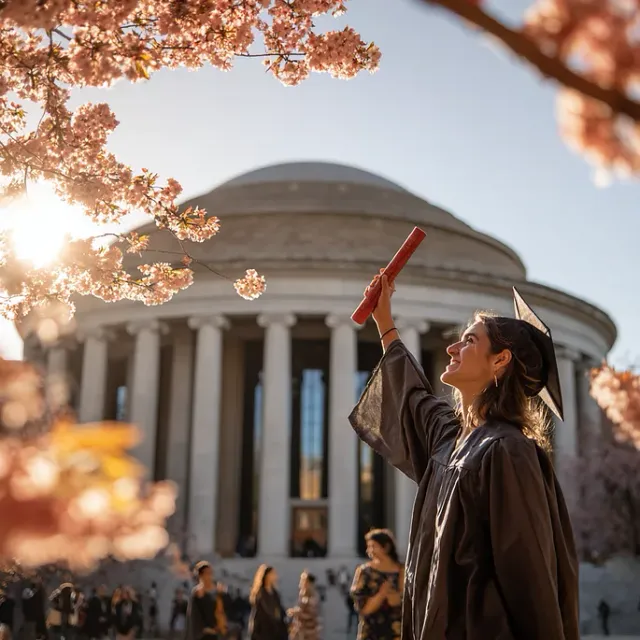
MIT and Tufts are two of the most architecturally distinctive campuses in Greater Boston, and their graduation portrait potential is dramatically underused. Most graduates settle for phone photos on commencement day — rushed, crowded, flat-lit — and use those as their permanent records of the milestone. A dedicated portrait session one to two weeks before or after commencement, at the right locations and the right time of day, produces images that are qualitatively different from anything the ceremony itself can deliver.
Photography Shark shoots graduation portraits at both campuses. Chris McCarthy brings a portable strobe and prime lens kit for the controlled-light precision these campus environments demand.
MIT campus locations
Killian Court and the Great Dome. The single most recognizable MIT image: a graduate in regalia framed by the neoclassical columns with the Great Dome behind. The challenge is that every MIT graduate has the same idea, and on commencement weekend the court is packed. The fix is timing — schedule the portrait session for a weekday morning one to two weeks before or after commencement. At 7:00 AM on a Tuesday, Killian Court is nearly empty. The early light rakes across the columns at a low angle that adds dramatic dimension, and the absence of crowds lets Chris compose with the architecture rather than around it.
The Stata Center (Building 32). Frank Gehry's deconstructivist masterpiece is one of the most photogenic buildings in New England — angular titanium panels, asymmetric volumes, unexpected cantilevers. For graduates in engineering or computer science, the Stata Center provides a backdrop that signals their field without requiring a prop. The north-facing walls produce excellent open-shade light on overcast days and dramatic shadow play on clear days. The interior atrium, with its soaring ceilings and steel stairways, works for rainy-day backup sessions.
Charles River Embankment. The walk along the Charles between the Longfellow Bridge and the Harvard Bridge offers a distinctive Boston skyline perspective — Beacon Hill, Back Bay, and the Hancock/Prudential towers reflected in the river. Golden-hour sessions here produce the warm, atmospheric portraits that perform well on LinkedIn and graduate school applications. The embankment is publicly accessible and does not require permits. Wind off the river can be a factor — advise graduates to secure any loose elements of their regalia.
The Infinite Corridor (Building 7–10). MIT's signature 251-meter hallway is an interior option when weather does not cooperate. The perspective lines converge dramatically, and the corridor's consistent overhead fluorescent lighting can be supplemented with a portable strobe for skin-tone correction. Sessions in the Infinite Corridor are best on weekday mornings before foot traffic peaks.
Tufts campus locations
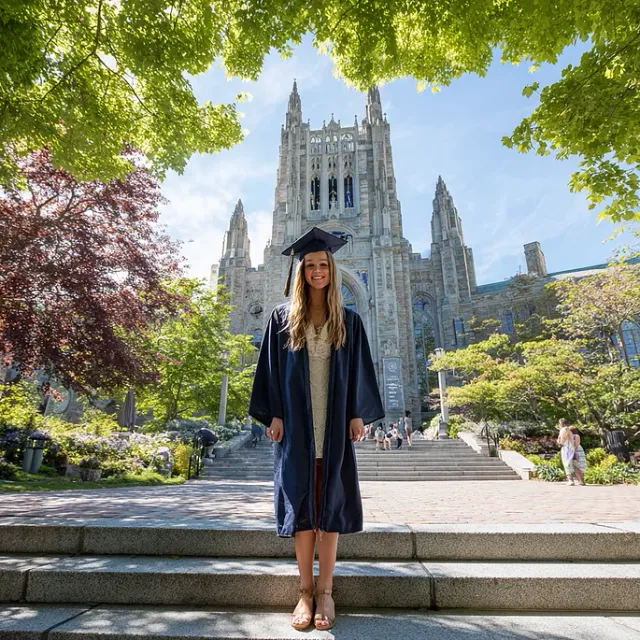
Memorial Steps and Goddard Chapel. The broad stone staircase leading up to Goddard Chapel is the central gathering point of the Medford campus and the most traditional Tufts graduation portrait location. The chapel's Romanesque architecture anchors the image, and the steps provide natural posing variation — standing, seated, walking up or down. Early morning or late afternoon light from the east or west creates directional shadow that adds depth to what is otherwise a flat stone facade.
The Mayer Campus Center and Library Roof. The Tisch Library observation area and the adjacent green spaces offer elevated views toward Boston. On clear days, the downtown skyline is visible beyond the campus — a composition that is uniquely Tufts and not replicable from any other campus in the region. These elevated spots are excellent for environmental portraits where the graduate is framed against the broader city context.
The Granoff Music Center. For graduates in arts, music, or theater, the Granoff Center's contemporary glass-and-steel architecture provides a modern, less traditional backdrop. The interior concert hall and the exterior reflecting pool are both photographable, and the building's west orientation produces dramatic sunset light.
Academic regalia and wardrobe
Every graduate needs at least two looks: formal regalia (cap, gown, hood, sash) and a professional outfit for the non-regalia frames. The professional outfit is the one that performs on LinkedIn and in job applications — a well-fitted suit, blazer, or professional dress that signals "I am entering the workforce" rather than "I am at a ceremony." Chris typically shoots the regalia frames first (while the graduate is fresh) and the professional frames second (when the posing confidence has built up through the session).
If the graduate has multiple degrees or honors sashes, bring all of them — different combinations can be photographed for different audiences (the academic department wants the departmental hood; LinkedIn wants the clean professional frame without any regalia).
Why a pro session beats commencement-day photos
The lighting on commencement day is typically the worst lighting of the academic year for portraits. Midday sun creates harsh overhead shadows under the cap brim, the crowds make it impossible to compose against architecture, and the graduate is managing logistics (family coordination, ceremony prep, emotions) rather than focusing on being photographed. A dedicated session eliminates all of these constraints: Chris controls the light, the location is scouted and composed in advance, the graduate's only job is to be present and responsive to direction.
The images from a professional graduation session become permanent career assets. The LinkedIn headshot, the graduate school application photo, the family print, the framed wall portrait — these are images that represent a major life milestone for decades. The cost of a professional session measured against the lifespan of the images is negligible.
Booking a graduation portrait session
On-location sessions at MIT and Tufts start at $495 — see graduation portrait pricing for the full package breakdown. The session includes pre-shoot location scouting via discussion (Chris will recommend specific spots based on the graduate's department, aesthetic preference, and time of day), 45–90 minutes of shooting, and 10+ retouched images delivered in 3–5 business days with full commercial-use licensing.
Schedule one to two weeks before or after commencement to avoid crowds. Contact Photography Shark or call (781) 312-8824 to reserve a date. The studio is at 83 E Water Street, Rockland MA — for graduates who also want formal studio headshots, a studio session can be combined with the campus session at a package rate. For local high school seniors on the South Shore, the A parent's guide to senior pictures covers the studio and outdoor options closer to home.
Frequently Asked Questions
Does Photography Shark photograph graduation portraits at MIT and Tufts campuses?
Yes. Chris McCarthy shoots graduation portrait sessions at MIT and Tufts, as well as other Greater Boston campuses. Sessions are available on-campus or at the Photography Shark studio at 83 E Water Street, Rockland MA.
How much does a graduation portrait session cost?
Four senior portrait packages: The Mini $495 (30–45 min, 1 outfit, yearbook image + 15 edited images), The Classic $645 (60–90 min, 2 outfits, 40 edited images + planning consult — most popular), The Heirloom $1,195 (2 hours, 3 outfits, 50 edited images + 10×10" layflat heirloom album), and The Collection $1,795 (half-day, unlimited outfits, 60 edited images, heirloom album + $500 wall-art credit). Most graduation sessions are 45–90 minutes to allow for multiple campus locations.
What are the best locations at MIT for graduation photos?
Killian Court with the Great Dome backdrop is the most recognizable MIT location. The Stata Center provides striking architectural context, and the Charles River embankment at golden hour gives a distinctive skyline perspective. Timing at each matters — early morning on weekends avoids crowds.
What about Tufts — what locations work best for graduation portraits there?
Tufts offers strong architectural variety from its Medford campus with views toward Boston. The post covers specific Tufts location strategies — contact Photography Shark to discuss which settings match the look you want.
When should I schedule my graduation portrait session relative to commencement?
Schedule 1–2 weeks before or after commencement weekend to avoid crowds at key campus locations and to ensure your images are delivered before you need them for LinkedIn or family announcements.
How long until I receive my edited graduation photos?
Edited graduation portraits from Photography Shark are delivered within 3–5 business days for headshots and studio sessions.
Related Posts

You Might Also Like
About the Author
Chris McCarthy
Chris McCarthy has run Photography Shark Studios in Rockland, MA for over 10 years and 500+ sessions, with executive headshot work for Rockland Trust, Clean Harbors, M&T Bank, and McCarthy Planning; founder portraits for AI startups including Lowtouch.ai; product photography for South Shore brands like Lauren's Swim; and headshots across South Shore legal, medical, financial, and academic practices. Every session is personally shot and edited by Chris on Sony mirrorless and Godox strobe systems — no assistants, no outsourcing, no batch retouching. Galleries deliver in 3–5 business days. About Chris McCarthy →
Photography Shark · Boston & South Shore MA
Ready to Book a Session?
Professional headshots, senior portraits, boudoir, and model portfolios. Studio in Rockland, MA — 25 miles south of Boston. Sessions from $395.