Photography Tips
How to Style Your Graduation Shoot at Emerson or Suffolk
Graduation portrait guide for Emerson and Suffolk grads — best campus locations, wardrobe tips, and timing from a South Shore photographer with 10+ years.

Chris McCarthy
Professional Photographer, Photography Shark · November 20, 2024 · Updated April 27, 2026
Graduation portraits are different from every other kind of portrait session you'll ever book. The location is predetermined by where you spent the past four years. The marker — finishing a degree, completing a program, closing a chapter — is specific and unrepeatable. The emotional stakes are high. And unlike a headshot session or a family portrait, there's no "let's schedule a reshoot" if the photos don't work out.
As a South Shore photographer who has shot graduation sessions at Emerson College, Suffolk University, Boston University, and UMass Boston, among others, I know what makes the difference between photos that end up in a drawer and photos that go on the wall. It comes down to three things: location strategy, wardrobe, and timing. Here's how to get all three right.
Understanding the Visual Assets of Each Campus
Every campus has specific locations that photograph beautifully and others that look cluttered, institutional, or simply flat on camera. Knowing the difference before your session day is essential — you won't have time to wander and discover during the shoot itself.
Emerson College: The Boylston Street Corridor
Emerson's physical plant is compact and urban, concentrated along Boylston Street in the Theatre District. The visual assets are architectural rather than natural.
The Colonial Theatre entrance on Boylston provides classical, ornate detail that frames the subject beautifully. It photographs with enormous depth and visual richness — ideal for theatrical and performing arts students who want imagery that speaks to their industry.
The Little Building facade has strong horizontal lines and the classic Boston brownstone texture that reads as unmistakably city. For students who want urban energy in their portraits, this is the shot.
The Piano Row Block — the stretch of Boylston between Tremont and Charles Street South — provides a clean, pedestrian-scale streetscape backdrop without the chaos of heavier traffic corridors. Golden hour here in May and June produces warm light against the stone and brick facades.
For Emerson graduates, I often recommend starting at the Little Building for an iconic campus anchor shot, then moving a block or two down Boylston for variety, then ending in the Public Garden if time and light permit. The walk takes 15 minutes; the location variety is substantial.
Suffolk University: The Beacon Hill Setting
Suffolk's location on Beacon Hill gives you access to some of the most photographically rich urban scenery in New England. The challenge is that the campus itself blends into the surrounding neighborhood — but that's actually an advantage for photography, because you can roam.
The State House steps are a classic Suffolk graduation backdrop — the gold dome visible, the white granite steps providing clean geometry, the sense of institutional gravity appropriate for law and public policy graduates. Note: State House grounds are public; no permit is required for personal portrait sessions.
Ashburton Park directly behind the State House provides a green, manicured space with mature trees and benches that offer a softer counterpoint to the hard surfaces of the surrounding architecture.
The Beacon Hill streetscape — particularly on Beacon Street between Tremont and Bowdoin — gives you the Federal-style rowhouses and brick sidewalks of one of Boston's most picturesque neighborhoods. These streets look extraordinary in late afternoon light from April through October.
The Boston Common and Public Garden are accessible on foot from Suffolk in under five minutes. The Public Garden's suspension bridge, seasonal flower plantings, and mature tree canopy are consistently beautiful for portraits regardless of season.
Choosing Your Wardrobe
The most common graduation portrait wardrobe mistake is wearing something formal that doesn't feel like you. The second most common is treating the session as an afterthought and wearing whatever you'd put on for a nice dinner.
The goal is to look like the best version of who you actually are — dressed deliberately, but authentically.
Wearing Academic Regalia
Cap and gown photos are expected, but they don't have to be boring. A few things that make the difference:
- Ironed gown. Graduation gowns are stored folded and emerge with creases. Hanging yours for 48 hours before your session minimizes wrinkles; steaming it the morning of eliminates them. Creases in regalia photograph as laziness, not circumstances.
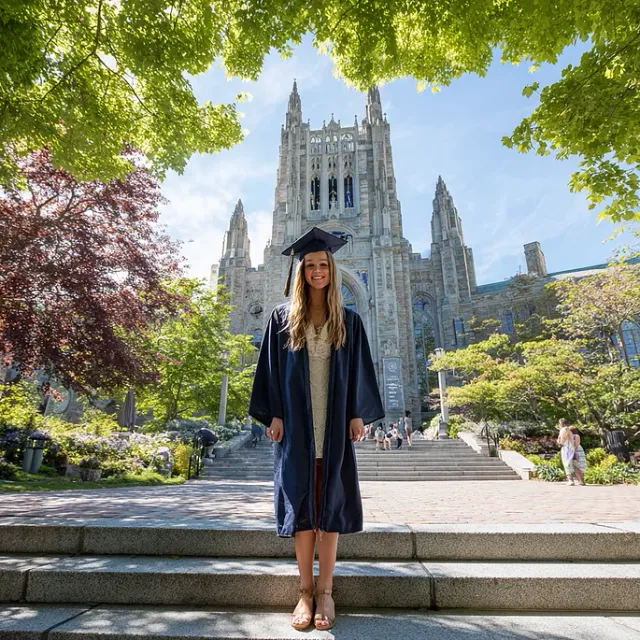
- Cap positioning. The mortarboard should sit level, typically about an inch above the eyebrow line. Tilted or pushed back looks casual and tends to shadow the face.
- What's underneath. Dress shoes, fitted trousers or a dress, a tailored shirt or blouse under the gown. This matters most when the gown is open or the wind lifts it, and it determines the overall visual register of the portrait.
- Tassel side. Traditionally, tassels move from right to left at the conferral of the degree. In portrait photos, the tassel position is a personal decision — just be consistent across the session.
Casual/Non-Regalia Looks
Most graduation sessions include at least one look without academic regalia — a chance to show who you are apart from the institutional markers. This is often the most personalized and visually interesting part of the session.
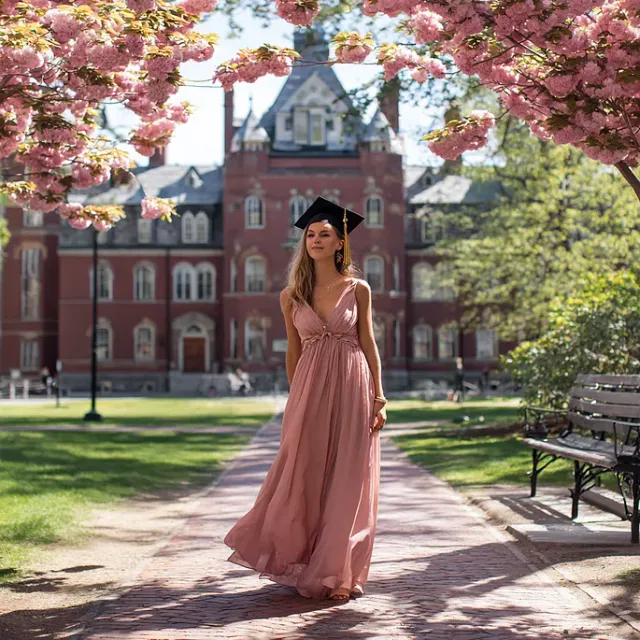
- Choose colors that work against your chosen location's palette. Warm tones (rust, camel, burgundy) photograph beautifully against brick and stone urban backdrops. Soft, muted tones (sage, cream, dusty rose) work well in the Public Garden's greens and pinks. Jewel tones look strong in both contexts.
- Dress one level above how you'd dress for your typical day. Not a gala look, but deliberate and polished.
- Comfort allows movement, and movement makes photos look alive. Avoid anything that restricts your gait, requires constant adjustment, or makes you self-conscious about bending or turning.
A Note on Shoes
Graduation portraits involve significant walking on city sidewalks and cobblestone paths. Heels that work beautifully in photos can be miserable on uneven brick pavement for two hours. Either plan for a wardrobe change from walking shoes into heels for specific shots, or choose shoes that are both photogenic and functional.
Timing and Light
The camera doesn't care about your graduation date. It cares about the sun.
In Boston in late May and early June — when most graduation seasons occur — the sun sets around 8:00–8:15 PM. Golden hour begins approximately 90 minutes before sunset: roughly 6:30–7:00 PM. This is the ideal window for outdoor graduation portraits in the city.
Midday light (11 AM–2 PM) on urban hardscape is harsh, creates deep eye shadows, and washes out the warmth of brick and stone facades. If your only scheduling flexibility is midday, look for locations in open shade: the north side of a building, under a large tree canopy, in a covered arcade.
For Emerson and Suffolk students finishing their spring semester, I recommend scheduling your session for a Tuesday or Wednesday evening in May — after your last exam but before commencement weekend when Boston is at its most crowded. A 6:30 PM start gives you the golden window and the benefit of lighter pedestrian traffic in the Theatre District and Beacon Hill.
Posing and Expression
Most people aren't comfortable in front of a camera. This is normal and expected, and a good photographer accounts for it.
A few things that help:
Move. The most natural-looking photos come from subjects who are doing something rather than holding still for a pose. Walking toward the camera, looking back over a shoulder, adjusting the gown — these transitional moments produce more authentic expressions than static poses.
Look toward the light, not away from it. This is a simple rule that your photographer will handle in real time, but knowing it helps you understand why your photographer might ask you to turn or reposition multiple times.
Genuine smiles use the eyes. The difference between a performed smile and a real one is visible in the eyes. Think about something that makes you genuinely happy or proud — your accomplishment, the people who supported you, what comes next. That internal state creates the expression the camera needs.
Bring a friend. Especially for candid shots, having a friend at the session to make you laugh genuinely, remind you of a shared memory, or simply be there with you produces interactions the camera catches in ways that solo sessions can't fully replicate.
What to Do if the Weather Doesn't Cooperate
Boston in May can be beautiful or cold and grey. If your graduation session encounters overcast skies, that's not necessarily a problem — overcast light is actually very flattering for portraits because it's soft, even, and eliminates harsh shadows. The challenge is keeping color palette and backdrop interesting when the sky isn't doing any visual work.
In overcast conditions:
- Urban locations with strong architectural detail (the State House, the Beacon Hill streetscape) perform better than open plazas where the grey sky dominates the frame
- Warmer, richer clothing colors compensate visually for the subdued sky
- The Public Garden's seasonal plantings often remain vibrant enough to provide warm backdrop color even under grey skies
If it rains, we reschedule. Boston's graduation season is long enough that rescheduling by one or two weeks usually doesn't create problems with cap and gown access or travel plans.
How to Work With Your Photographer
I work with a lot of first-time portrait clients who aren't sure what to expect from a professional session. A few things to know:
- Communicate your priorities in advance. If you definitely want a specific shot at a specific location, say so at the start of the session rather than at the end.
- Review images during the session, not just afterward. Seeing a few frames after the first ten minutes tells you whether the direction is working and gives us time to adjust.
- Tell me when something doesn't feel right. If a pose is uncomfortable or an expression isn't landing, say so. I'd rather know mid-session than have you see it in the gallery.
Our senior portraits packages are designed with the flexibility to accommodate both campus portrait sessions and studio portrait work, depending on what you need.
Beyond the Cap and Gown: Making the Session Personal
The most memorable graduation portraits do more than document a degree. They say something specific about who you are and what this four years meant.
Consider bringing one or two meaningful objects: a journal, an instrument, a piece of work you're proud of, a book that shaped you during school. These props give images context and make them feel specific to your story rather than generic graduation photos.
Talk to your photographer about what you want to remember from this chapter. The best photographers are collaborators — the conversation before the camera comes out shapes everything that happens after.
Ready to Book Your Session?
Photography Shark Studios photographs graduation sessions at Boston campuses and on the South Shore year-round. Whether you're finishing at Emerson, Suffolk, or another institution, we know how to find the light and the locations that produce portraits worth keeping.
Contact us to book your graduation portrait session and let's plan something that marks this moment the way it deserves.
Frequently Asked Questions
Does Photography Shark shoot graduation portraits at Boston colleges like Emerson and Suffolk?
Yes. Chris McCarthy has shot graduation sessions at Emerson College, Suffolk University, Boston University, and UMass Boston, among others. Sessions can be booked from our studio in Rockland, MA.
How much do graduation portrait sessions cost?
Senior and graduation portrait Packages start at $495. Contact Photography Shark at 83 E Water Street, Rockland MA 02370 to discuss your specific campus and needs.
What are the best locations for Emerson graduation photos?
The Colonial Theatre entrance on Boylston Street, the Little Building facade, and the Piano Row block are strong anchors. The Public Garden is a 15-minute walk and adds variety.
What are the best spots for Suffolk graduation portraits?
The State House steps and dome, Ashburton Park, and the Beacon Hill streetscape on Beacon Street are the top choices. The Public Garden is under five minutes on foot.
When is the best time of day to shoot graduation portraits in Boston?
Golden hour — roughly two hours before sunset — produces warm, flattering light on Boston's stone and brick facades. In May and June that runs from about 6:30 to 8:00 PM.
How long after my graduation session will I receive my photos?
Edited galleries are typically delivered within 1–2 weeks of your session date.
Related Posts
You Might Also Like
About the Author
Chris McCarthy
Chris McCarthy has run Photography Shark Studios in Rockland, MA for over 10 years and 500+ sessions, with executive headshot work for Rockland Trust, Clean Harbors, M&T Bank, and McCarthy Planning; founder portraits for AI startups including Lowtouch.ai; product photography for South Shore brands like Lauren's Swim; and headshots across South Shore legal, medical, financial, and academic practices. Every session is personally shot and edited by Chris on Sony mirrorless and Godox strobe systems — no assistants, no outsourcing, no batch retouching. Galleries deliver in 3–5 business days. About Chris McCarthy →
Photography Shark · Boston & South Shore MA
Ready to Book a Session?
Professional headshots, senior portraits, boudoir, and model portfolios. Studio in Rockland, MA — 25 miles south of Boston. Sessions from $395.