Photography Tips
The Art of Framing in Photography
How framing adds depth to South Shore portraits — natural arches, granite rocks, and doorways used at Duxbury Beach, Minot Beach, and World's End sessions.

Chris McCarthy
Professional Photographer, Photography Shark · January 8, 2025 · Updated March 27, 2026
Framing is one of the most versatile and underutilized compositional tools in portrait photography. Most photographers understand it in the abstract — using elements in the scene to create a frame around the subject — but using it with genuine fluency, in real sessions in actual locations, requires a different kind of knowledge. It requires the habit of looking past the subject to the scene around them, identifying framing possibilities, and then making the positioning decisions that activate those possibilities.
I have worked through this question with clients at my Rockland studio more times than I can count, and the answer is more straightforward than most people expect.
At Photography Shark in Rockland, MA, framing is a consistent element in how we approach portrait sessions across the South Shore. Whether it is the arch of a dune grass hillside at Duxbury Beach, the granite rocks framing a senior portrait at Minot Beach in Scituate, or the branches of a mature oak above a family at World's End in Hingham, we are constantly looking for the natural and architectural elements that can be used to give portraits depth, context, and visual specificity.
This guide covers framing comprehensively — what it is, why it works, the types of frames available in different shooting environments, and the specific technical adjustments required to use frames effectively.
What Framing Does for a Photograph
Before getting into technique, it is worth being specific about what framing actually accomplishes for an image. The benefits are several, and they operate at different levels of the viewing experience.
Directing Visual Attention
The primary function of framing is to direct the viewer's eye toward the main subject. When a frame is present in a composition — archway, branches, rocks, doorway — it acts as a visual signpost: "The thing in the middle of this frame is what you are supposed to look at." The viewer's eye naturally follows enclosed shapes toward their center. A subject placed within a clearly defined frame commands attention more efficiently than a subject placed against an open background.
This is particularly useful in complex, busy environments where there are many competing elements. At an outdoor location with multiple visual distractions — foot traffic, signage, varied background elements — a natural or architectural frame can filter the scene down to a single, clearly defined subject against a controlled background.
Creating Depth and Spatial Layers
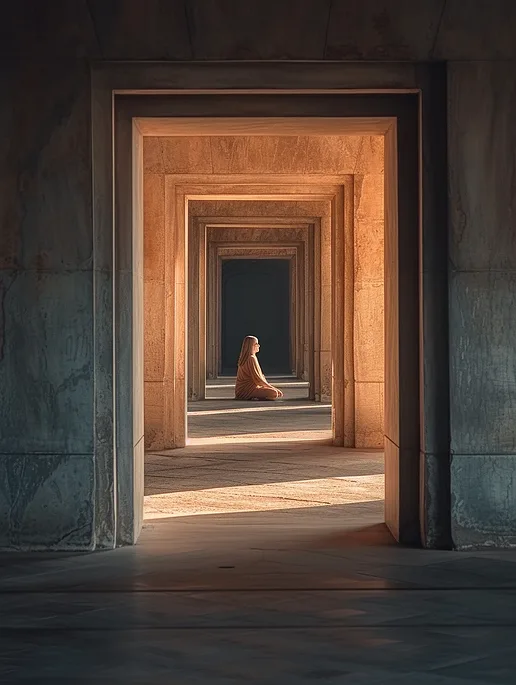
A frame is by definition a foreground element — it exists in front of the subject. This automatically creates a spatial layer structure in the photograph: foreground (the frame), middle ground (the subject), and often background (the environment visible beyond the subject). Three-layer spatial structure is one of the primary tools for creating a sense of depth in two-dimensional images.
At Minot Beach in Scituate, a senior portrait photographed through the gap between two granite boulders in the immediate foreground creates this three-layer structure automatically. The boulders are slightly out of focus (foreground layer), the subject is sharply focused (middle ground), and the ocean and sky are visible beyond the subject (background). The result is an image with considerable spatial depth that the same composition without the foreground rocks would entirely lack.
Establishing Context and Narrative
Frames frequently carry their own visual information about place and context. An arched doorway in the historic center of Hingham tells a story about where you are. A weathered wooden window frame at an old Cape Cod house places the subject within a specific New England vernacular. The rocky coastline framing a portrait at Scituate communicates the character of the South Shore in a way that a flat, undifferentiated beach background does not.
In portrait photography, this contextual information enriches the image beyond the pure visual record of the subject's face. The viewer understands not just what the subject looks like but where they are, which deepens the narrative quality of the photograph.
Adding Scale and Proportion
Large frames — rock formations, architectural arches, mature tree canopies — establish the scale of the subject by contrast. A person standing within an opening in a granite cliff face appears small against the rock, which conveys the scale of the landscape. A family positioned under a canopy of century-old oaks appears intimate and sheltered, which conveys a different kind of relationship between people and place.
Both of these are emotionally useful in portrait work. The choice of frame size and distance relative to the subject is itself an expressive decision.
Types of Frames Available on the South Shore
Different shooting environments offer different types of frames. Understanding what is available at specific locations — and knowing those locations well enough to find the frames before the session begins — is essential to using framing effectively.
Natural Frames
Rock formations: The South Shore coastline, particularly in Scituate and Cohasset, offers granite rock formations that create natural frames at the water's edge. The gap between two boulders, the arch of a low rock outcropping, the window-like opening in a cliff face — these are all usable frames that carry the specific visual character of this coastline.
Dune grass and beach vegetation: At Duxbury Beach and Rexhame Beach in Marshfield, the dune grass grows in dense masses that create natural foreground frames when used properly. Positioning the camera low, in the grass, and the subject beyond the grass line creates a frame through the vegetation. The shallow depth of field needed to keep the subject in focus blurs the grass into a soft, textured foreground layer.
Tree branches and canopies: Wooded areas throughout the South Shore — Wompatuck State Park in Hingham, the trails near the North River in Marshfield, the mature oak and maple forest at World's End — offer overhead branch structure that can frame subjects from above. A low camera angle emphasizes this overhead framing; looking up through a canopy of branches at a subject who occupies the space within the canopy frame can produce images with unusual beauty.
Water and tidal pools: At low tide, shallow tidal pools create reflective frames when the camera is positioned at water level. The subject, positioned beyond the pool, appears within a frame created by the still water surface. This is a technically demanding shot — the camera must be extremely low and the depth of field must cover both the water surface and the subject — but the results can be striking.
Architectural Frames
The South Shore's towns offer a range of architectural elements that function as portrait frames.
Doorways and windows: Historic buildings in Hingham, Cohasset, and Scituate have doorways and windows with strong architectural character — wide trim, paned glass, weathered wood — that create defined frames with specific historical character. A senior portrait photographed within an old doorframe in downtown Hingham communicates a sense of place that a beach session cannot replicate.
Bridges and harbor structures: The harbor bridges in Scituate Harbor and Green Harbor, Marshfield, create arched frames over the water. The structural elements of fishing shacks, boat storage buildings, and harbor infrastructure provide industrial framing that contrasts effectively with the natural character of the subjects photographed within them.
Stone walls: New England stone walls — running through the fields and woodlands of Norwell, Cohasset, and the inland portions of Hingham — create low, horizontal frames that work well for wide shots where the wall forms a natural foreground boundary.
Technical Considerations for Effective Framing
Using frames effectively requires specific technical adjustments that differ from standard portrait setup.
Aperture and Depth of Field Management
The central technical challenge of framing is managing depth of field across multiple spatial layers: you want the frame element to read clearly as a distinct layer without being sharp enough to compete with the subject. This requires a wide aperture — typically f/1.8 to f/2.8 — and careful attention to focus.
At f/1.8 with a 50mm or 85mm lens, a foreground rock positioned 2 to 3 feet from the camera will be significantly out of focus when the subject is at 8 to 10 feet. The rock is visible, has shape and texture, but does not demand attention. The subject, at the focus point, is sharp and clear.
At f/8, the same configuration may render both the foreground rock and the subject at adequate sharpness, which eliminates the depth differentiation that makes the framing effective. The rock becomes a distracting foreground element rather than a compositional frame.
Sony mirrorless cameras, which Chris uses throughout his portrait work, perform exceptionally well in this regard. The autofocus system handles the selective focus required for framed compositions reliably, and the image stabilization in the lens and body allows for handheld shooting at the low camera positions often required to activate foreground frames effectively.
Camera Position and Angle
Many of the most effective framing opportunities on the South Shore require unconventional camera positions. Framing through the gap in rocks at Minot Beach requires a low camera angle — possibly kneeling or lying on the rock surface. Framing through foreground dune grass at Duxbury requires the camera to be within or just above the grass level. Framing through overhead branches requires shooting from ground level looking upward.
Being willing to get into these positions — rather than defaulting to standing at eye level for every shot — is one of the clearest ways to distinguish work that engages seriously with framing from work that simply mentions it as a technique.
Perspective and Subject Placement Within the Frame
Once you have identified a potential frame, the placement of the subject within that frame significantly affects the outcome. A subject centered exactly within a symmetric frame produces a formal, static composition. A subject positioned off-center within the frame — using the rule of thirds even within the frame element — produces a more dynamic, visually interesting result.
The subject's relationship to the frame edges also matters. A subject who is clearly enclosed by the frame, with space between the subject and the frame edges on all sides, reads as contained and protected. A subject who overlaps or partially breaks through the frame edges creates visual tension that can be useful for certain aesthetic goals.
Working with Multiple Frame Layers
The most sophisticated framing compositions use multiple elements at different depths: a foreground frame (rocks, grass, branches), the subject in the middle ground, and a secondary frame element or strong environmental element in the background. This three-stage framing creates a complex, layered spatial structure that rewards close looking.
At a location like the North River in Marshfield, this might mean: marsh grass in the foreground (blurred frame), subject in the middle distance, and the river and far bank visible in the background through the opening created by the foreground grass. Each layer adds information and depth to the image.
Framing in Different Portrait Session Types
The application of framing varies across the different kinds of portrait sessions Photography Shark conducts on the South Shore.
Family Portrait Framing
For family photo sessions, framing serves a particularly useful function in creating separation between different groupings or individuals within a large group. When photographing a family of five at World's End in Hingham, a composition that uses a large tree as a backdrop frame allows the family to be seen as a cohesive group against the single environmental element. This unifies what might otherwise be a scattered, visually busy composition.
For individual children within a family session, the scale effect of large natural frames is especially appealing — a small child photographed within a gap in the dunes at Duxbury Beach, with the vast beach and ocean visible in the background, creates a powerful image of smallness and wonder that a standard portrait setup would not achieve.
Senior Portrait Framing
High school senior portrait sessions benefit from framing that places the subject within a specifically South Shore context. A senior photographed through the opening in the rocks at Minot Beach is irrevocably placed in this particular coastal landscape — the image could not have been made anywhere else. For students who have grown up on the South Shore, that specificity is often exactly what makes the portrait meaningful.
Headshot Framing
For professional headshots, framing is generally used more sparingly and with more restraint than in environmental portrait work. Clean, minimal headshots for business and corporate use typically do not benefit from complex framing — the priority is a clear, unambiguous image of the subject's face without visual complexity competing for attention.
That said, an environmental headshot — one that places a professional within their work context — can use framing effectively. A headshot of a maritime attorney taken through the window of a harbor office, or a tech professional framed by the architectural elements of their workplace, places the subject in a context that a plain studio background cannot convey.
Common Framing Mistakes
Several errors come up consistently when photographers are learning to use framing effectively.
Using frames that are too sharp: As discussed above, foreground frames that are rendered too sharply at narrow apertures become distracting rather than compositional. Open your aperture.
Subject placement too central: Placing the subject exactly at the center of a symmetric frame produces a static, formal image that often feels more like a specimen in a display case than a portrait. Move the subject to a rule-of-thirds position within the frame.
Frames that overwhelm the subject: A very dominant, high-contrast foreground frame can overpower the subject rather than support them. The frame should have lower visual weight than the subject — achieved through selective focus and by choosing frames that are tonally similar to or darker than the subject.
Ignoring the background within the frame: The environment visible through the frame, beyond the subject, is part of the composition. A distracting or ugly background seen through a beautiful architectural arch undermines the composition. Always look through the frame — at what is visible at the back of the frame opening — when evaluating a potential framing composition.
Developing a Framing Habit
Like all compositional skills, effective framing requires practice to become instinctive. The practical development path is straightforward: make a deliberate habit of looking for frames at the start of every session, before the clients arrive and before you are managing the logistics of directing people and chasing light.
When you arrive at a location early — as a good photographer should, to evaluate the light conditions — spend 10 to 15 minutes walking the location specifically looking for framing opportunities. Identify three to five potential frame compositions and mark them mentally. When the session begins and the clients are there, you have a ready inventory of locations to use rather than trying to identify frames under time pressure.
Over time, this deliberate scanning habit becomes automatic. The eye begins to find frames without effort, the way an experienced painter finds the basic shapes in a scene without consciously searching for them.
Ready to Book Your Session?
Photography Shark serves clients throughout the South Shore — from Scituate and Cohasset to Duxbury, Plymouth, and Hingham — for family portraits, high school senior portraits, and professional headshots. Our studio is at 83 E Water Street in Rockland, MA. We bring this level of compositional attention to every session we photograph.
Contact Photography Shark to book your portrait session.
Headshot pricing · Professional headshots in Hingham · Scituate, MA headshot studio · Marshfield headshots
Building Frames On Purpose
In a studio every element in the frame is there because you put it there, which makes it the cleanest place to practise framing. Studio rental in Rockland is $55/hour, two-hour minimum, free parking 35 minutes south of Boston.
Frequently Asked Questions
What outdoor locations near Rockland does Photography Shark use for portrait sessions?
Chris McCarthy regularly shoots at Minot Beach in Scituate, Duxbury Beach, World's End in Hingham, and various South Shore coastal and woodland spots. Location scouting is part of session planning for senior and family packages.
How much do family portrait sessions cost at Photography Shark?
Family portrait sessions start at $395 for a 30-minute session with 10 edited images. Contact Photography Shark to discuss session length, number of people, and location options for your family.
Do senior portrait sessions include outdoor locations?
Yes. Senior portrait packages start at $495 and include outdoor South Shore locations. Chris scouts the location in advance and uses natural framing elements like rock formations, dune grass, and tree canopies to add depth.
How far in advance should I book a senior portrait session?
Booking 4–6 weeks in advance is recommended for senior portraits, especially for spring and fall sessions when natural light and foliage are at their best on the South Shore.
Can I choose my outdoor location, or does Photography Shark select it?
You can suggest a location or let Chris recommend one based on your goals and style preferences. Chris will scout the specific spot and plan around framing opportunities and the best light times for that location.
Where is the Photography Shark studio located?
The studio is at 83 E Water Street, Rockland MA 02370, about 25 minutes south of Boston. Studio sessions are available for headshots, studio portraits, and boudoir photography.
Related Posts






You Might Also Like
About the Author
Chris McCarthy
Chris McCarthy has run Photography Shark Studios in Rockland, MA for over 10 years and 500+ sessions, with executive headshot work for Rockland Trust, Clean Harbors, M&T Bank, and McCarthy Planning; founder portraits for AI startups including Lowtouch.ai; product photography for South Shore brands like Lauren's Swim; and headshots across South Shore legal, medical, financial, and academic practices. Every session is personally shot and edited by Chris on Sony mirrorless and Godox strobe systems — no assistants, no outsourcing, no batch retouching. Galleries deliver in 3–5 business days. About Chris McCarthy →
Photography Shark · Boston & South Shore MA
Ready to Book a Session?
Professional headshots, senior portraits, boudoir, and model portfolios. Studio in Rockland, MA — 25 miles south of Boston. Sessions from $395.