Headshots
Professional Headshot Poses: A Guide for Business Professionals
How to pose for a professional headshot — head tilt, shoulder turn, hand placement, and expression.
Chris McCarthy
Professional Photographer, Photography Shark · April 21, 2026 · Updated September 6, 2026
Posing anxiety is one of the most common pre-session concerns for professional headshot clients. The fear is some version of "I don't know what to do with my body or face." The honest answer: you don't need to. Posing direction is continuous throughout a professional session — the photographer adjusts your position, head angle, shoulder turn, and expression in real time, frame by frame. That said, having a general sense of what works can reduce pre-session nerves. This guide covers the recurring posing patterns that produce strong professional headshots, distinct from the more dynamic posing used for modeling headshots.
After more than a decade and 500-plus headshot sessions at my Rockland studio, the patterns are consistent.
Why Professional Poses Differ from Modeling Poses
Professional headshots and modeling headshots use different posing vocabularies for different reasons:
Modeling headshots are showcasing range, movement, and expression for casting directors and agents. Poses are more dynamic, more varied across the session, and often more theatrical.
Professional headshots are establishing trust and competence at a glance. Poses are more controlled, more conservative, and converge on a smaller set of reliable patterns.
A modeling pose that reads as "alive" and "in motion" might read as "unprofessional" on a LinkedIn profile. The two genres need different direction and produce different results.
The Reliable Default Pose
The single most reliable professional headshot pose:
- Body angled. One shoulder closer to the camera than the other, roughly 15-30 degrees of rotation. Square-on-to-camera looks stiff and adds visual width.
- Head straight. Looking back toward the camera, even though the body is angled. A subtle tilt toward the higher shoulder can soften the look.
- Jaw forward and slightly down. Counterintuitive, but this counters the natural tendency to lift the chin. Pulling the jaw forward defines the jawline; lowering it slightly removes the "looking-down-at-people" tilt.
- Eyes engaged. Direct eye contact with the camera lens, with a sense of being present rather than performing.
- Controlled expression. Either a composed neutral (slight engagement in the eyes, mouth relaxed) or a controlled warm smile (lips together or slightly parted, smile reaching the eyes).
- Weight distributed. Most weight on the back foot, allowing the front shoulder to drop slightly. Don't lock knees.
This pose is the default for ~70% of professional headshot frames. The variations below build on it.
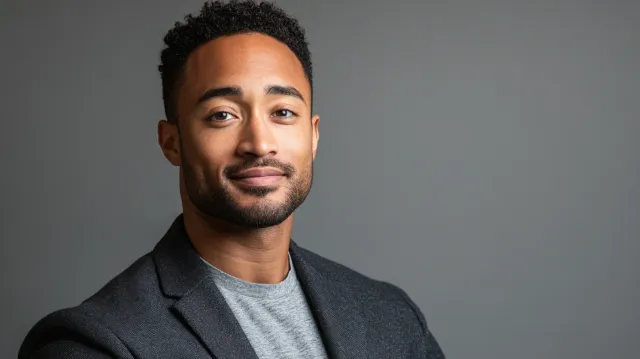 The default in practice: shoulders rotated off-axis, head returned to the lens. Square-on to the camera is the single most common self-taken mistake.
Variations by Use Case
LinkedIn Primary Photo
LinkedIn-specific posing leans warmer and more open than a generic professional pose:
- Slightly more body rotation (toward 25-30 degrees)
- Open shoulders (less hunched, less defensive)
- Controlled warm smile usually outperforms neutral
- Tighter head crop (LinkedIn thumbnail is small, so face needs to fill more of the frame)
For LinkedIn headshots Boston, the smile is typically the dominant choice.
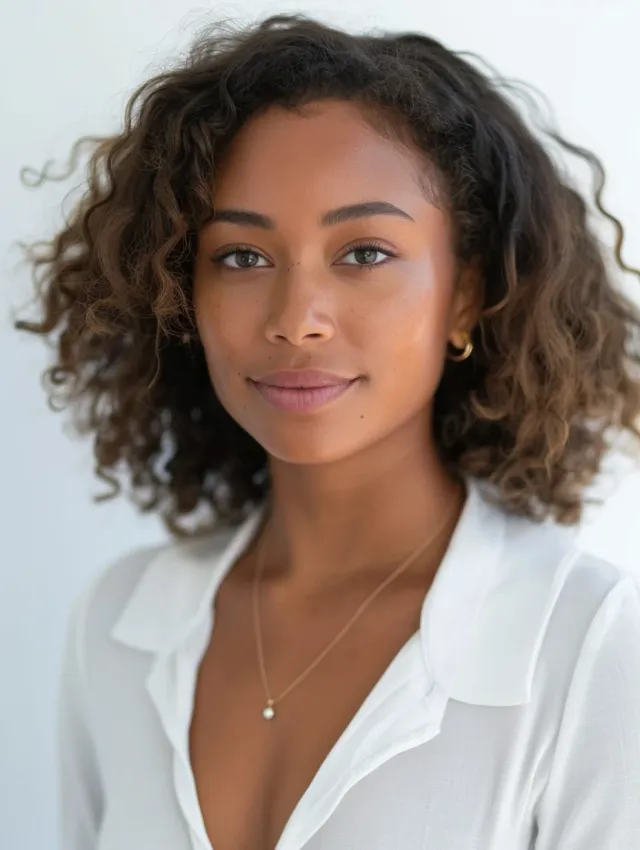 A tighter crop and a closed-lip smile that reaches the eyes — what reads best at LinkedIn's thumbnail size.
Executive & Corporate
Executive headshots emphasize stability. The pose runs more controlled:
- Less body rotation (closer to 15-20 degrees)
- Squarer shoulders (suggests authority)
- Composed neutral or restrained smile (rarely a full warm smile)
- Direct eye contact, slightly more intense
- For executive headshots Boston, expression range is narrower than modeling but more controlled than LinkedIn-casual
Legal
Lawyer headshots run even more controlled:
- Body rotation minimal (~15 degrees)
- Squared shoulders
- Composed neutral expression — occasional restrained smile, never full warm
- Direct, steady eye contact
- Conservative, almost still, posture
Lawyer headshots Boston covers the format expectations.
Healthcare
Healthcare poses balance approachability with professionalism:
- Moderate body rotation (~20 degrees)
- Open shoulders
- Warm smile dominates — patients need to feel comfortable
- Direct eye contact with engaged eyes
- Slightly relaxed posture (not as formal as legal)
For medical headshots Boston and therapist headshots Boston, warmth is the primary signal.
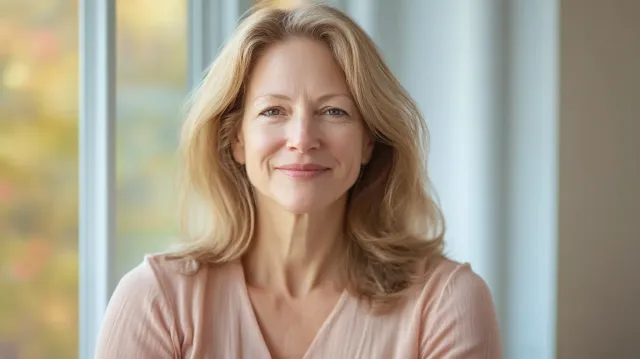 Open shoulders, softer light, an unforced smile — the approachability a patient-facing role needs before anything else.
Tech & Startup
Tech founder headshots have shifted toward more relaxed posing:
- More body rotation (often 30 degrees+)
- Sometimes a slight forward lean (suggests engagement, energy)
- Warm smile dominant
- Direct eye contact, sometimes off-camera variants for press kits
- Casual posture — not slumped, but not formal-still
See entrepreneur headshots Boston.
Head Position Details
Three head-position variables that matter for professional headshots:
Chin Position
The most common posing failure. Two failure modes:
- Chin too high (the "looking down at the camera" effect) — projects arrogance, can produce unflattering nostril visibility.
- Chin too low (the "double chin" effect) — minimizes neck definition, reads as defensive.
The fix is "jaw forward and slightly down" — push the jaw toward the camera while lowering the chin slightly. Counterintuitive, but produces the strongest jawline in most subjects.
Head Tilt
Subtle tilts work; dramatic tilts don't.
- Slight tilt toward the higher shoulder softens the pose. Particularly effective for warmer use cases (LinkedIn, healthcare).
- No tilt works for executive and legal — straighter reads as more authoritative.
- Dramatic tilt (more than 5-10 degrees) reads as unprofessional or trying-too-hard.
Eye Direction
Almost always direct camera eye contact for professional headshots. Variations:
- Direct contact, eyes slightly squinted (the "smize") — engaged and confident.
- Direct contact, eyes wide — suggests friendliness but can read as startled.
- Off-camera at a fixed point just past the lens — used for editorial variants and press kit alternates.
Shoulder and Body Position
Shoulder Rotation
The body angle determines silhouette and adds dimension:
- 0° (square to camera) — flattens body, reads stiff. Avoid for most headshots.
- 15-20° — subtle, professional, conservative. Default for executive, legal, finance.
- 25-30° — open, modern, approachable. Default for LinkedIn, healthcare, tech.
- 45°+ — strong dimension but leans editorial. Use for personal brand, speaker work, occasional corporate.
Shoulder Height
Both shoulders should be at roughly the same height — but if one is naturally higher (true for most people), don't force them level. Photograph the higher-shoulder side toward the camera if possible; lighting can manage the rest.
Posture
- Spine straight, not stiff. "Lengthen through the crown of the head."
- Shoulders down and back. Counter the tendency to hunch forward when nervous.
- Chest open. Don't physically pull shoulders back, but don't roll them forward either.
Hand Position (When Hands Are in Frame)
Most true headshots crop above the hands. When the framing is broader (chest-up portrait), hand placement matters:
- Crossed arms — corporate confident, slightly defensive. Common for executive and legal.
- One hand in pocket — relaxed casual. Common for tech and creative.
- Hands clasped at waist — formal composed. Common for legal and finance.
- Hands behind back — formal authoritative. Common for executive and military.
- Holding a prop (laptop, book, coffee) — environmental, less common in true headshot work.
Avoid: hands hanging stiffly at sides (reads as awkward), hands clasped tightly (reads as nervous), hands flat on a surface (reads as posed).
Expression Calibration
Three primary expression categories for professional headshots:
Composed Neutral
- Mouth closed, lips relaxed
- Slight engagement in the eyes (not blank)
- Used for: legal, executive, finance, formal contexts
- Common failure: looks dead-eyed or angry
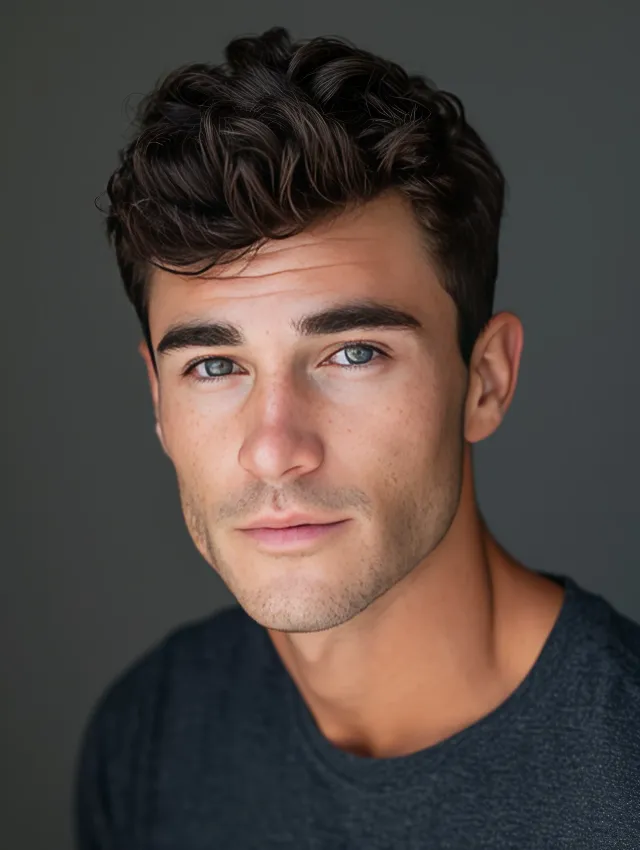 Composed neutral done correctly — the mouth is at rest but the eyes are still engaged. That engagement is the whole difference between composed and blank.
Controlled Warm Smile
- Lips together or slightly parted
- Smile reaches the eyes (not just the mouth)
- Used for: LinkedIn, healthcare, real estate, hospitality, modern professional
- Common failure: over-rehearsed teeth-out grin
Engaged Confidence
- Slight asymmetry in the smile (real smiles are slightly asymmetric)
- Eyes engaged, slightly squinted ("smize")
- Used for: speakers, authors, tech founders, personal brand
- Common failure: trying too hard
A strong session typically captures all three across the deliverables, so you can pick the one that matches each use case.
While posing drives the body language in the frame, the backdrop behind you shapes the overall tone. A charcoal seamless reads very differently than a white one, and matching the two is part of the session planning. The professional headshot backgrounds guide covers which options pair best with each industry context.
What Posing Direction Sounds Like in the Room
To give a realistic sense of what session direction sounds like, here are recurring micro-cues a professional headshot photographer uses:
- "Bring your jaw forward and just slightly down. There — hold."
- "Roll your weight onto the back foot. Drop the front shoulder a little."
- "Look at me like you're about to ask a question."
- "Big breath in, soft exhale, eyes back to me as you exhale."
- "Same expression, but soften the smile by 20%."
- "Chin out toward me, then a little down. Yes."
- "Head straight, eyes to me, body still angled."
Most of the session sounds like that. There is no expectation that you arrive knowing how to pose. Direction is the primary tool the photographer uses.
Practical Pre-Session Prep
You don't need to rehearse. If you want to prepare:
Practice the jaw-forward, chin-slightly-down tilt in a mirror. This is the single most reliable correction and feels weird the first time. Knowing how it feels reduces the in-session "this feels wrong" reaction.
Notice your default expression. Look in a mirror and see what your face does when you're not consciously expressing. If it reads as flat or tense, expression direction during the session is doing more work and you should expect more cues.
Don't practice smiling. Practiced smiles look practiced. Real smiles in the session come from real direction (verbal cues that produce genuine reactions), not from rehearsal.
Eat before the session. Hangry expressions photograph badly. Light meal an hour before is ideal.
Arrive 5–10 minutes early. Rushed energy shows up in the first 5–10 frames. The buffer time settles you.
Ready to Book?
Get in touch to schedule. Photography Shark is in Rockland, MA — 25 minutes south of Boston. Pose direction is built into every session.
Related reading: What is a headshot? · Professional headshot examples · Tips for professional headshots · Headshot poses for men · Headshot poses for women · How to avoid a double chin in photos
Frequently Asked Questions
How should I pose for a professional headshot?
The reliable default for a professional headshot is a slight body angle (one shoulder closer to the camera than the other), head straight or with a very subtle tilt toward the higher shoulder, jaw slightly forward and down, controlled smile or composed neutral expression, weight on the back foot. The photographer guides this in real time during the session — you don't need to memorize anything.
Should I smile in my professional headshot?
It depends on use case. LinkedIn, healthcare, real estate, hospitality, and most modern professional contexts favor a controlled warm smile. Legal, finance, and executive contexts often favor a composed neutral with the smile reserved for the eyes. A strong session captures both ranges so you can pick the one that matches each use context.
What do I do with my hands in a headshot?
For most headshots, hands are out of frame because the crop ends at mid-chest. When hands are in frame (waist-up portrait crop), common placements are crossed-arms (corporate confident), one hand in pocket (relaxed casual), or hands clasped in front (formal composed). Avoid hands at sides hanging stiffly. Your photographer guides this; you don't need to plan in advance.
Should I look directly at the camera?
Direct camera eye contact is the dominant choice for professional headshots. It creates engagement and works at thumbnail scale. Some sessions also capture off-camera looks (looking just past the lens at a fixed point) for variety, especially for actor or speaker work. For LinkedIn primary photos, eye contact is almost always the strongest choice.
How do I look natural in a professional headshot?
Natural look comes from the photographer's direction, not from the subject's posing knowledge. Things that help: arrive on time so you are not rushed, breathe normally during the session (don't hold breath while being photographed), respond to direction without overthinking, and trust that the photographer is checking what is working in real time. Tension shows in the photographs; relaxation reads as natural.
Related Posts
![What to Wear for a Professional Headshot: Complete Guide [2026]](/blog/what-to-wear-for-a-professional-headshot---boston--hero-w640.webp)
You Might Also Like
About the Author
Chris McCarthy
Chris McCarthy has run Photography Shark Studios in Rockland, MA for over 10 years and 500+ sessions, with executive headshot work for Rockland Trust, Clean Harbors, M&T Bank, and McCarthy Planning; founder portraits for AI startups including Lowtouch.ai; product photography for South Shore brands like Lauren's Swim; and headshots across South Shore legal, medical, financial, and academic practices. Every session is personally shot and edited by Chris on Sony mirrorless and Godox strobe systems — no assistants, no outsourcing, no batch retouching. Galleries deliver in 3–5 business days. About the photographer →
Photography Shark · Boston & South Shore MA
Ready to Book a Session?
Professional headshots, senior portraits, boudoir, and model portfolios. Studio in Rockland, MA — 25 miles south of Boston. Sessions from $395.