Photography Tips
How to Use Event Photos for Social Media and Marketing
How to turn event photos into weeks of social media and marketing content — shot lists, platform sizing, repurposing, and post timing.
Chris McCarthy
Professional Photographer, Photography Shark · November 29, 2024 · Updated February 17, 2026
An event takes months to plan, hours to execute, and days to recover from. And when it's over, most organizations post a few blurry phone photos to Instagram, tag a dozen people who were there, and move on. That's a significant missed opportunity.
In my experience working with clients across Boston and the South Shore, the biggest gains come from the simplest adjustments.
Professional event photography produces a content library you can draw from for weeks or months. Done right, event photos do specific marketing work: they build social proof, demonstrate organizational capability, humanize your brand, and create shareable content that extends your event's reach far beyond the people who attended.
Chris McCarthy has photographed corporate and association events across Boston and the South Shore through Photography Shark since 2019 — corporate conferences in Quincy, fundraising galas in Hingham, product launches in Boston's Seaport, professional association dinners in Braintree — and the pattern of organizations using their event photos brilliantly versus squandering them is consistent enough to write down. Here's the practical guide to getting real marketing value from your event photography.
Start With a Shot List Before the Event
The single best thing you can do to maximize the marketing value of your event photos is to tell your photographer exactly what you need before the event starts. A good shot list ensures that the images that matter most to your marketing strategy are captured deliberately, not left to chance.
Standard event shot list categories:
- Pre-event setup: Clean shots of the space before guests arrive — table settings, signage, branded elements, food displays, AV equipment. These detail shots are gold for Instagram and LinkedIn content about your event production capabilities.
- Arrivals and registration: The energy of guests arriving, check-in interactions, name tags being exchanged. These document participation and attendance without requiring formal poses.
- Speaker and presentation coverage: Speakers at the podium from multiple angles, audience reactions, Q&A moments, panel discussions. These shots are essential for speaker promotion and educational content.
- Sponsor and partner visibility: If your event has sponsors, your photographer needs a list of branded elements that require deliberate coverage. Logos in the background of shots, sponsor displays, co-branded materials.
- Candid networking and conversation: Genuine interactions between attendees — the conversations, the handshakes, the laughter. These humanize your organization and show the community value of your events.
- Key individuals: If there are VIPs, board members, award recipients, or notable attendees who need to appear in the coverage, provide their names to the photographer in advance.
- Group shots: Any organized group photos — board photos, award winner groups, cohort photos — need to be planned and scheduled within the event program, not improvised.
Share this shot list with your photographer three to five days before the event. A photographer receiving the shot list five minutes before guests arrive cannot properly execute it.
Brief Your Photographer on Your Brand
Your event photographer needs to understand your organization's visual identity before they show up. This isn't about micromanaging — it's about providing context that allows better decisions in the field.
Things to communicate before your event:
- Your brand color palette and visual style (bold and contemporary? traditional and formal? warm and community-focused?)
- Key messages this event is designed to communicate (professional excellence? community connection? innovation and growth?)
- Platforms where these photos will primarily be used (LinkedIn? Instagram? a gala report? a press release?)
- Any sensitivities (attendees who should not be prominently featured, confidential material that should not be visible in the background)
- Previous event photos you've liked and why
This briefing takes 15 minutes and meaningfully improves the alignment between what gets photographed and what you actually need.
Capture the Real Moments, Not Just the Staged Ones
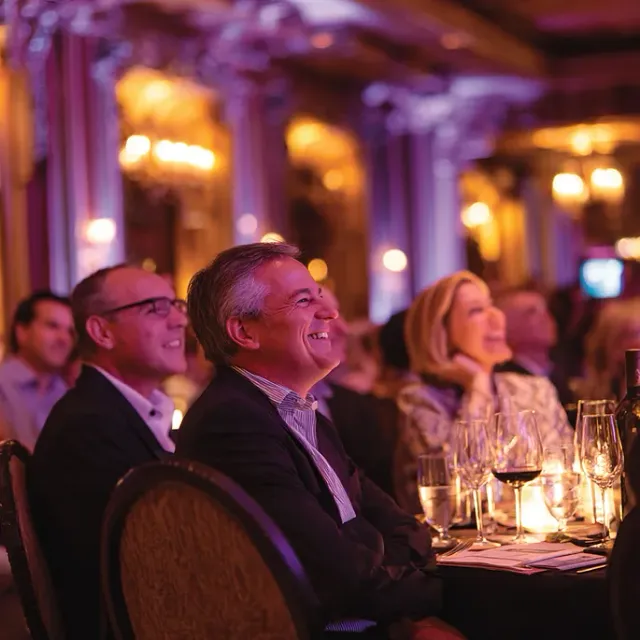
The event photos that perform best on social media — that get the most engagement, the most shares, the most "I wish I'd been there" comments — are not the posed group shots. They're the candid moments: the keynote speaker making the crowd laugh, the two attendees clearly deep in an important conversation, the first bite of a spectacular dish, the award recipient's expression the moment their name is called.
Staged photos have their place. You need formal speaker portraits, organized group shots, and clean documentation of branded elements. But if your photographer spends the entire event shooting posed content, you'll leave with a gallery of competent documentation and no content that makes people feel anything.
The best event photography gives roughly equal weight to staged documentation and genuine candid coverage. Brief your photographer on both categories explicitly.
What Makes a Candid Photo Work
- Emotional truth: A photo where something real is happening — laughter, surprise, connection, concentration — outperforms a staged version of the same moment every time.
- Environmental context: Including enough background that viewers understand where and what — a room full of engaged attendees behind a speaker, the branded step-and-repeat visible behind a group — gives the photo marketing utility beyond just looking good.
- Clean backgrounds: Even in candid coverage, backgrounds matter. A great candid expression in front of a messy service area, a cluttered table, or a poorly lit corner is hard to use. Good photographers read backgrounds constantly and reposition to keep them clean.
Optimize Photos for Each Platform
A photo that performs well on Instagram is not necessarily the same photo that performs well on LinkedIn. Understanding platform-specific visual norms lets you curate and deploy your event library more effectively.
LinkedIn: Professional-leaning content performs best here. Speaker coverage, panel discussions, award presentations, organized group shots, and content that demonstrates industry engagement all align with what LinkedIn users are looking for. Horizontal/landscape format works well for feed posts. Personal stories attached to event photos ("What I learned from yesterday's discussion about...") significantly outperform caption-free photo dumps.
Instagram: More editorial, more emotive, more visual variety. The setup shots (beautiful tablescapes, detail work), genuine candid interaction moments, and environmental shots showing the full event space work well here. Story-format content (multiple frames in sequence) performs particularly well for event coverage on Instagram. Square and vertical formats dominate.
Facebook: Full-album posting is native to Facebook in a way it isn't to other platforms. For organizations with Facebook-based communities, a well-curated full event album can generate significant engagement, particularly if attendees are tagged.
Website and email: Press-release-style horizontal images with clean composition. Speaker photos with clean backgrounds. Group shots of specific committees or cohorts. High-resolution versions for print applications.
Build a Posting Schedule, Not a Dump
The most common social media mistake after a well-photographed event is posting everything immediately in a single album. This approach burns your entire content library in one day and leaves you with nothing to draw from in the weeks that follow.
A better approach is to sequence your event coverage:
- Day of / Day after: One or two strong hero shots — the speaker at the podium, the crowd at peak energy, the award moment. These announce the event happened and establish the visual tone.
- Day two to three: A curated set of six to eight candid moments — the conversations, the details, the human moments. These build the fuller story.
- Week two: Speaker and panelist highlights, pulled as individual posts with relevant context. ("Three things we took away from [speaker name]'s talk on...")
- Week three onward: Longer-form content using event photos as supporting visual material — post-event recaps, blog content about themes that emerged, follow-up on discussions that began at the event.
This approach extends your event's marketing lifespan from one day to four to six weeks, dramatically increasing the return on your event photography investment.
Write Captions That Do Real Work
A great photo with a weak caption is a wasted opportunity. Captions do work that images can't: they provide context, drive action, and create the connection between visual content and your organization's voice.
What good event captions do:
- Tell a specific story about the moment captured rather than describing it generically ("700 attendees heard about...") rather than ("Great event!")
- Include a call to action: Register for next year. Read the recap. Download the resource from the link in bio. Tell us what you thought in the comments.
- Tag relevant people and organizations: The speaker, the sponsor, the award recipient. Tags extend the reach of your post into their networks.
- Use targeted hashtags: Industry-specific and location-specific hashtags — not just generic #eventphography — bring your content to relevant audiences who weren't at the event.
Leverage User-Generated Content
If your event was well-attended and well-received, attendees are posting their own photos and content. This user-generated content is social proof with credibility that branded content doesn't have — it's independent confirmation that your event was worth being at.
How to encourage and leverage UGC:
- Create a memorable, specific event hashtag and promote it before and during the event (not just on your materials — have your emcee announce it from the stage)
- Feature UGC in your stories and reposts, crediting the original creator
- Request permission explicitly before incorporating UGC into branded marketing materials
Measure What Works
After your event photo content runs, measure which pieces performed. Which individual photos generated the most engagement? Did your candid shots outperform your staged documentation, or vice versa? Did posts with personal narrative captions outperform straightforward event announcement captions?
These measurements inform your briefing for the next event. Over time, you build a clear picture of what your specific audience responds to, and your event photography becomes progressively more targeted and effective.
Why Professional Event Photography Matters for This Strategy
All of the above assumes photographs of sufficient technical quality to hold up in multiple deployment contexts. A photo that's fine at thumbnail size on a phone screen may fall apart at full size on a LinkedIn post or in print in a post-event report.
Professional event photography brings the technical quality — sharp focus in low-light conditions, accurate color rendering, clean composition — that allows your content to perform wherever you use it. It also provides variety: a professional event photographer produces a gallery of thousands of images from which you can curate dozens of specifically useful frames. A well-meaning colleague with a phone camera produces fifty photos of similar subjects from similar angles.
Our event photography packages cover corporate events, galas, fundraisers, and professional association events across Boston and the South Shore. We work from detailed shot lists and deliver edited galleries designed to be deployed directly into your marketing workflow.
Ready to Book Your Session?
Photography Shark Studios provides professional event photography for organizations across the South Shore and Boston metro area. Whether you're planning a conference, gala, product launch, or association dinner, we'll document it in a way that gives your marketing team a genuine content library to work from.
Contact us to discuss your event photography needs and let's talk through how to get maximum value from your event coverage.
Frequently Asked Questions
How do I brief my event photographer to get marketing-ready photos?
Send a shot list 3–5 days before the event covering branded signage, speakers, key individuals, networking moments, and group shots. Photography Shark reviews this list with every corporate client before the event.
What types of event images perform best on LinkedIn and Instagram?
Speaker-audience interaction shots, genuine networking candids, and clean detail images of branded elements perform well. Photography Shark edits event galleries with social media use in mind.
Does Photography Shark deliver photos quickly enough for same-week social posting?
Standard delivery is 1–2 weeks. If you need images within 48–72 hours for a social campaign, request expedited turnaround when booking — Chris can prioritize a subset of images for fast delivery.
Can I use event photos in email marketing and annual reports?
Yes. All delivered images are full-resolution and licensed for your organization's marketing use, including email campaigns, reports, presentations, and website content.
Does Photography Shark photograph events outside the South Shore?
Yes. Chris covers events across greater Boston — Seaport, Quincy, Hingham, Braintree — and the broader South Shore. The studio is based at 83 E Water Street, Rockland MA.
How do I get a quote for event photography?
Contact Photography Shark through the website or visit the Rockland studio. Pricing is customized based on event length, coverage needs, and number of deliverables.
Related Posts
You Might Also Like
About the Author
Chris McCarthy
Chris McCarthy has run Photography Shark Studios in Rockland, MA for over 10 years and 500+ sessions, with executive headshot work for Rockland Trust, Clean Harbors, M&T Bank, and McCarthy Planning; founder portraits for AI startups including Lowtouch.ai; product photography for South Shore brands like Lauren's Swim; and headshots across South Shore legal, medical, financial, and academic practices. Every session is personally shot and edited by Chris on Sony mirrorless and Godox strobe systems — no assistants, no outsourcing, no batch retouching. Galleries deliver in 3–5 business days. About the photographer →
Photography Shark · Boston & South Shore MA
Ready to Book a Session?
Professional headshots, senior portraits, boudoir, and model portfolios. Studio in Rockland, MA — 25 miles south of Boston. Sessions from $395.