Photography Tips
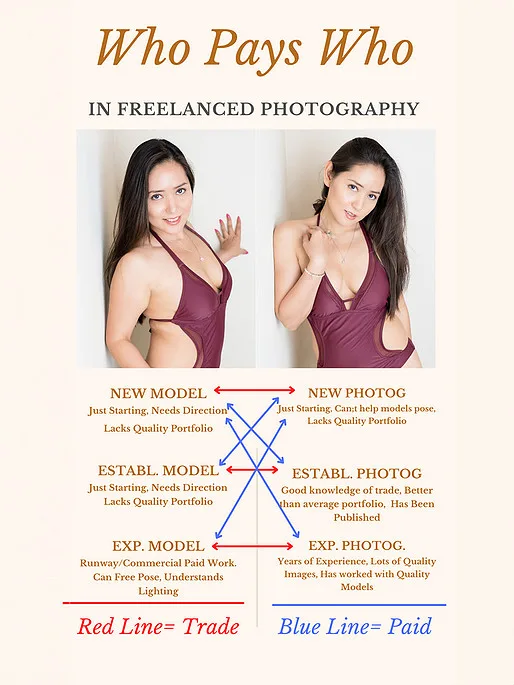
Who Pays Who in Freelance Modeling — TFP Explained
When models pay photographers, when photographers pay models, and when TFP makes sense — a clear breakdown of payment in freelance modeling for the Boston and South Shore market.
Chris McCarthy
Professional Photographer, Photography Shark · November 8, 2025 · Updated May 25, 2026
Every week I get the same question from someone just starting out: "Am I supposed to pay the photographer, or are they supposed to pay me?" The confusion is understandable. Freelance modeling operates on three completely different payment structures, and which one applies depends entirely on who benefits most from the session. Get this wrong and you either overpay for something you should receive for free, work for free when you deserve compensation, or enter an arrangement that wastes everyone's time.
I have been shooting model portfolios, headshots, and commercial work at my Rockland, MA studio for over a decade. In that time I have watched hundreds of photographer–model transactions play out — some fair, some exploitative, many just poorly structured because neither party understood the economics. This guide lays out the three payment models plainly so you can identify which one applies to your situation and negotiate accordingly.
Three Payment Structures, Three Different Relationships
The freelance modeling economy runs on three transaction types. Each one creates a different relationship between the photographer and the model, and each one is appropriate under specific conditions.
Structure 1: The Model Pays the Photographer
The model pays when the model is the primary beneficiary. The most common scenario is portfolio development — an aspiring model needs professional images to submit to agencies, land casting calls, or build an online presence that attracts bookings.
In this arrangement the photographer is providing a professional service. They bring the camera system, the lighting, the studio space, the post-production skill, and the ability to direct someone who may never have been in front of a professional lens before. The resulting images become a business asset the model will use to generate income. That service has a cost, the same way hiring a graphic designer to build your website or a lawyer to review a contract has a cost.
Portfolio sessions in the Greater Boston market typically run $300 to $900 depending on session length, number of looks, retouching scope, and the photographer's experience level. That range is not arbitrary — it reflects real differences in what you receive. A $300 session from a part-time photographer shooting in a rented space with one light produces different work than a $700 session in a dedicated studio with professional lighting, a wardrobe consultation, and 10+ years of agency-submission experience behind the camera.
The investment is worth making correctly. A model portfolio is not a vanity project — it is the single tool that determines whether agencies respond to your submissions, whether casting directors call you back, and whether clients perceive you as professional talent or an enthusiastic amateur. Cheap portfolio images rarely save money in the long run because they usually need to be reshot within months.
Structure 2: The Photographer Pays the Model
The photographer pays when the photographer is the primary beneficiary — specifically, when they have a paid commercial assignment that requires a model to complete.
A brand hires a photographer to shoot a product campaign. A hospital needs lifestyle images for their website featuring people who look like patients and staff. A real estate developer wants aspirational photos of people living in their new condos. In all of these cases the photographer is earning a fee from a client, and the model is a production cost — hired talent whose time, likeness, and physical presence make the project possible.
Commercial model rates in the Boston market depend on several variables: the model's experience and representation status, the scope of usage rights (social media only versus national print versus broadcast), exclusivity windows, and session duration. Day rates for non-union commercial work in this region typically fall between $250 and $1,200, with usage licensing negotiated separately for larger campaigns.
The principle is simple: if someone is making money from the photographs, everyone in front of the camera should be compensated. A model who appears in images that generate revenue for a photographer's client is performing labor, full stop.
Photographers also sometimes pay models for personal portfolio projects — when a photographer wants to develop a specific concept, test a new lighting technique, or build out a genre they have not shot before. In these cases the photographer is the one building their portfolio, so they bear the cost.
Structure 3: TFP (Time for Print)
TFP means neither party pays cash. Both contribute their time and skill, and both walk away with images they can use. The arrangement works when the value exchange is genuinely balanced — when both the photographer and the model have something concrete to gain from the collaboration and neither party is obviously subsidizing the other.
A legitimate TFP scenario looks like this: a photographer who shoots corporate headshots wants to add editorial fashion work to their portfolio. They need a model who fits a specific concept. A model who has strong commercial images but nothing editorial wants to diversify their book. Both parties invest their time, both receive images that fill a real gap in their respective portfolios, and neither could have gotten what they needed without the other's participation.
TFP becomes illegitimate when the value flows in only one direction. The most common version: a photographer with a large Instagram following offers "free shoots" to aspiring models. The photographer gets fresh content for their feed and the ego gratification of shooting attractive people. The model gets images that may or may not be professionally useful, shot by someone who may or may not have the skill to produce agency-quality work. The photographer benefits regardless; the model only benefits if the images are actually good enough to use professionally.
How to Evaluate Which Structure Applies to You
Forget the labels for a moment. Ask yourself one question: who walks away from this session with a more valuable portfolio or a paid deliverable?
If the answer is primarily you (the model), you should expect to pay for the photographer's time. If the answer is primarily the photographer — because they have a client paying for the project, or because they are building their own portfolio with your help — they should be paying you. If the answer is genuinely both of you in roughly equal measure, TFP can work, but only with a written agreement that specifies what each party receives.
This framework cuts through every confusing scenario I have encountered in a decade of working in this market. It does not matter what the photographer calls the arrangement, how they frame it on social media, or what discount they claim to be offering. Follow the value.
The Real Cost of "Free" Portfolio Shoots
I want to address this directly because it is the single most expensive mistake aspiring models make in the Greater Boston market: accepting free or near-free portfolio sessions from photographers who cannot produce work that meets professional standards.
The cost is not the session fee you saved. The cost is the six months you spend submitting substandard images to agencies, receiving rejections or silence, and concluding that modeling is not going to work for you — when the actual problem was never your potential but the quality of your presentation materials.
I have re-shot portfolios for models who came to me after a year of using images from a free TFP session with a hobbyist photographer. The images looked fine on Instagram. They did not look fine to the casting director at a Boston agency who evaluates 50 submissions a week and can identify amateur lighting, inconsistent skin tones, and poor direction in under three seconds. For specific numbers on what portfolio sessions actually cost in this market, see model portfolio pricing in Boston.
A professional portfolio session is an investment in your career infrastructure. It is not an expense to minimize — it is a tool to optimize.
What a Written Agreement Should Cover
Every photographer–model transaction, regardless of which direction money flows, should be documented in writing before the session begins. The agreement does not need to be drafted by a lawyer for a single session, but it does need to cover the terms that generate disputes when left unspoken. A model release form handles the image-usage half of this; the standards every ethical photographer should follow cover the rest.
Usage rights. Who can use the images, for what purposes, and for how long? A model paying for portfolio images typically receives unlimited personal and agency-submission use while the photographer retains copyright and portfolio display rights. A photographer paying a model for commercial work specifies exact usage scope — web only, regional print, national broadcast — because broader rights cost more.
Delivery timeline and format. How many images, in what resolution, delivered by what date? The single most common source of conflict between photographers and models is mismatched delivery expectations. Put the number and the deadline in writing.
Content boundaries. What categories of imagery are included or excluded? If the session involves anything the model would not want a future employer, family member, or client to see, that boundary must be established before the camera turns on — not negotiated after the images exist.
Cancellation terms. What happens if either party needs to reschedule? Is there a cancellation fee? How much notice is required?
For TFP specifically: the agreement should state explicitly that no money is being exchanged, describe what each party contributes, and define what each party receives. The most frequent TFP dispute is one party feeling retroactively that the exchange was unequal. A written record of the agreed terms on day one resolves that conversation before it starts.
Warning Signs That the Arrangement Is Not What It Seems
After thousands of bookings and conversations with models at every career stage, certain patterns reliably predict a bad outcome. Any one of these in isolation might be benign. Two or more together is the signal.
The photographer's portfolio is almost entirely TFP work with no paid commercial credits. A photographer who does not charge clients for their work is not operating as a professional, regardless of their self-description. Their TFP offer to you is not a generous collaboration — it is the only way they acquire subjects. For a deeper catalog of modeling scams and red flags, including the six recurring fraud patterns in the Boston market, see that dedicated guide.
The conversation starts in Instagram DMs rather than through a booking form, professional email, or agency referral. Professional photographers have professional intake processes. They do not cold-message potential subjects on social media.
The proposed location is the photographer's home rather than a commercial studio. There are legitimate home-studio setups, but a first session with a photographer you have never worked with should happen in a professional or commercial space, ideally with an assistant or companion present.
The pitch emphasizes the artistic or intimate nature of the content without addressing your specific portfolio goals. A professional photographer asks what you need the images for before proposing what to shoot. A hobbyist proposes what they want to shoot and frames it as beneficial to you after the fact.
The timeline is compressed. "Can you shoot this weekend?" from a photographer you have never spoken to before is not urgency — it is pressure designed to prevent you from researching them or asking the questions you should be asking.
There is no contract, no model release, and resistance when you ask for one. Every professional photographer uses written agreements because written agreements protect both parties. Resistance to documentation is resistance to accountability.
The Greater Boston and South Shore Market Specifically
Boston supports a real commercial photography market. Healthcare, biotech, higher education, financial services, and lifestyle brands all hire local photographers and models on a regular basis. The modeling agencies based here — Maggie Inc, Model Club Inc, and the Boston offices of national agencies — represent real commercial talent and place models in real paid work.
The South Shore corridor from Quincy through Plymouth has a smaller but active commercial scene plus significant demand for portrait and personal branding photography. For aspiring models in towns like Hingham, Scituate, Hanover, Norwell, Duxbury, Marshfield, and Rockland, the path to professional modeling runs through these Boston-area agencies, and getting signed requires a portfolio that meets agency submission standards.
That portfolio does not come from free sessions with hobbyist photographers on Model Mayhem. It comes from working with a photographer who understands what Boston agencies are evaluating, who can direct posing and expression for commercial viability, and who produces technically clean work on professional equipment in a controlled studio environment. For a step-by-step walkthrough of that process, see how to find a reputable model photographer in Boston.
At Photography Shark, that is specifically what we do. Our studio at 83 E Water Street in Rockland is built for this work — controlled lighting, multiple backdrop options, and a decade of experience translating what agencies need into images that get models signed. We charge for our work because it is professional work, and we believe that clear, fair payment in both directions is the foundation of every productive photographer–model relationship.
Ready to Book Your Session?
If you are building a modeling portfolio, updating your existing book, or exploring professional photography for the first time, Photography Shark is ready to help you do it right.
Our studio is at 83 E Water Street in Rockland, MA. We serve clients from across the South Shore and Greater Boston.
Contact us at our booking page to discuss your goals and schedule a session.
What headshots cost in Boston · Studio headshots near Rockland, MA
Frequently Asked Questions
What does Photography Shark charge for a model portfolio session?
Studio photo shoots for portfolio development are available at our Rockland, MA studio at 83 E Water Street. Contact us for current pricing — we tailor sessions based on what the portfolio needs to accomplish.
How do I know if a photographer is truly professional before paying them?
Look for consistent paid client work (not just TFP sessions), a professional website, written contracts, defined delivery timelines, and verifiable reviews on Google. Photography Shark has 10-plus years in the South Shore and Greater Boston market.
What's included in a Photography Shark portfolio session?
Sessions include a pre-session consultation, the full studio shoot with Chris McCarthy, a gallery of edited selects, and delivery of retouched final images suitable for agency submission and online casting platforms.
Is TFP ever a legitimate option for building a modeling portfolio?
Only when both parties genuinely benefit equally. A TFP arrangement is appropriate when a photographer is also building their portfolio in a new genre and the model gets images they couldn't otherwise afford. It's not appropriate when the benefit clearly flows one way.
When should a photographer pay a model?
Any time the photographer is receiving client compensation for a commercial project that requires a model. If a client is paying for the shoot, the model is a production expense and should be paid accordingly.
Where is Photography Shark located?
Our studio is at 83 E Water Street, Rockland, MA 02370 — serving models and photographers across the South Shore and Greater Boston area.
Related Posts




You Might Also Like
About the Author
Chris McCarthy
Chris McCarthy has run Photography Shark Studios in Rockland, MA for over 10 years and 500+ sessions, with executive headshot work for Rockland Trust, Clean Harbors, M&T Bank, and McCarthy Planning; founder portraits for AI startups including Lowtouch.ai; product photography for South Shore brands like Lauren's Swim; and headshots across South Shore legal, medical, financial, and academic practices. Every session is personally shot and edited by Chris on Sony mirrorless and Godox strobe systems — no assistants, no outsourcing, no batch retouching. Galleries deliver in 3–5 business days. About the photographer →
Photography Shark · Boston & South Shore MA
Ready to Book a Session?
Professional headshots, senior portraits, boudoir, and model portfolios. Studio in Rockland, MA — 25 miles south of Boston. Sessions from $395.