Photography Tips
Why I Stuck With Sony Over Canon Mirrorless
Why Chris McCarthy chose Sony over Canon RF after hands-on testing — autofocus, skin tones, battery life, and real-world results on Boston headshots.
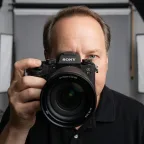
Chris McCarthy
Professional Photographer, Photography Shark · December 7, 2025 · Updated May 24, 2026
I tested the Canon R6 Mark II for three weeks in late 2025 with the intention of switching systems. Canon's RF glass has matured rapidly, the color science is gorgeous, and the R6 II's autofocus improvements closed what had been a meaningful gap with Sony. I brought it through a full headshot day, an outdoor senior session, an evening event, and a studio boudoir session. At the end of three weeks I packed it back up and stayed with Sony. This is why.
Eye autofocus in mixed light
Sony's real-time eye AF has been the best in the industry since the A7R IV, and on the A7V it is functionally perfect in controlled studio light. Both systems lock eyes reliably when the light is clean. The separation happened in mixed and marginal conditions — the specific situations a working photographer encounters at events and outdoor sessions. At a dimly lit corporate event in a Quincy hotel ballroom, the Sony held eye lock through a face partially obscured by a wine glass, through a subject turning 45 degrees mid-conversation, and through a backlit doorway transition. The Canon hunted. Not always, and not catastrophically — it recovered within a second — but in event photography a second of hunting means a missed expression. Over 500 frames at that event, the Sony's keeper rate was approximately 15% higher than what the Canon delivered the following week at a comparable function. That margin compounds across a year of shooting.
Skin tone rendering
Canon has historically had the edge in skin-tone accuracy straight out of camera. The Canon R6 II produces warm, slightly saturated skin tones that look beautiful with minimal editing. Sony's default skin rendering is cooler and slightly less saturated — closer to accurate but less immediately flattering. The difference is real, and if I were starting from scratch I might prefer Canon's color pipeline.
But I am not starting from scratch. I have five years of Lightroom presets, color profiles, and editing workflows built around Sony's color output. My headshot editing workflow — the one that produces consistent results across thousands of sessions — is calibrated to Sony's specific shade of neutral. Rebuilding that calibration for Canon's warmer starting point would take months and risk inconsistency across the archive. For a photographer who delivers 30–50 sessions a month, workflow continuity is worth more than a marginal color-science advantage.
The lens ecosystem question
Canon's RF mount is excellent but still catching up to Sony's E-mount in one critical area: affordable third-party glass. Sigma, Tamron, and Samyang have been producing native-mount E-mount lenses for years, and the options at the $300–$800 price tier are mature and battle-tested. Canon's RF mount has been more restrictive with licensing, and while native Canon RF glass is superb, the backup and specialty lens options are narrower and more expensive. I carry a Sigma 135mm f/1.8 Art as my secondary portrait lens — there is no Canon RF equivalent from Sigma at this time, and Canon's native 135mm f/1.8 is nearly twice the price.
For a studio that depends on prime lenses across four focal lengths, the cost and availability of the full lens kit matters. The Sony system gives me the full prime lineup I need at a price point that makes economic sense.
Battery and dual-card reliability
Sony's NP-FZ100 battery is rated for approximately 740 shots on the A7V in EVF mode. In practice, with the EVF and autofocus running continuously during a 90-minute senior portrait session, I finish with 30–40% remaining. The Canon R6 II's LP-E6NH is rated for approximately 580 shots — workable, but tighter. For an event that runs three to four hours, I carry two Sony batteries and typically use 1.5. With Canon I would carry three and still watch the meter more closely.
Both cameras support dual card slots (one CFexpress, one SD). Both are configured for redundant backup writes. This is non-negotiable — losing a session to a card failure is not a recoverable professional situation. The implementation is equivalent.
Godox X-system strobe integration
The Rockland studio runs Godox AD600 and AD400 strobes — the same system detailed in the Rembrandt lighting guide — triggered by the Godox X2T wireless system. The X2T-S (Sony) trigger has been stable through thousands of sessions — reliable sync, no misfires, consistent flash-to-flash power delivery. The X2T-C (Canon) worked correctly in testing but represents a system switch on the flash-trigger side that introduces one more variable in a production environment I have already validated. This is not a technical objection — the Canon trigger works fine — it is a pragmatic one. When the lighting system is working, do not introduce change unless the gain justifies the risk.
The bottom line
This is not a recommendation that Sony is better than Canon. Both systems produce professional-grade images. Canon's color science and ergonomics have genuine advantages. The decision was specific to my situation: an established Sony workflow, a lens ecosystem that fits my needs, an eye-AF reliability margin that matters in mixed-light conditions, and a lighting system already validated. For a photographer starting fresh in 2026, the Canon R6 III or R5 II would be a perfectly defensible choice. For Photography Shark — with five years of Sony infrastructure and a production workflow calibrated to the system — staying was the right call.
All headshot, portrait, boudoir, and event sessions at Photography Shark are shot on the Sony A7V with native and Sigma prime lenses. The same bodies and fast primes carry over to concert and live music photography, where clean high-ISO performance and silent electronic shutter are non-negotiable. The studio is at 83 E Water Street, Rockland MA — sessions start at $395.
Frequently Asked Questions
What Sony camera does Photography Shark currently use?
Chris McCarthy has shot Sony since the A7 III and currently works with the A7V for portrait sessions, headshots, boudoir, and events. The Sony system is used for all work at 83 E Water Street, Rockland MA and on South Shore location sessions.
Does the camera brand affect how my headshots will look?
Not directly — composition, lighting, and direction matter more. What Sony's system delivers is reliable eye-detection autofocus and consistent skin tone rendering, which contribute to the technical quality behind Photography Shark's headshot results.
Why did Photography Shark choose Sony over Canon for portrait work?
After hands-on testing of the Canon R6, Chris found Sony's real-time eye autofocus more reliable across the range of work — headshots, family sessions with moving children, low-light boudoir, and events. Sony's skin tone rendering in studio also matched Chris's editing workflow better.
What headshot packages does Photography Shark offer?
Headshot packages: $395 for 30 minutes with 10 edited images, Studio headshot sessions are $395 for 30 minutes with 10 fully retouched images. On-location sessions are $495. Add-ons: additional session time $100 (extra 30 min), outfit change $100, additional person $200, group shot $100. Turnaround is 3-5 business days.. All sessions are at the Rockland studio at 83 E Water Street, Rockland MA 02370.
Does Photography Shark offer boudoir photography?
Yes. Boudoir sessions are available at the Rockland studio. Contact Photography Shark directly for boudoir pricing and to discuss the session format, wardrobe, and privacy considerations.
How does Photography Shark handle high-ISO situations at events?
Sony's full-frame sensors perform cleanly at high ISO settings, which is critical for event photography in venues with limited or mixed lighting. Chris selects exposure settings based on the venue and prioritizes sharpness and noise management across the event.
Related Posts


You Might Also Like
About the Author
Chris McCarthy
Chris McCarthy has run Photography Shark Studios in Rockland, MA for over 10 years and 500+ sessions, with executive headshot work for Rockland Trust, Clean Harbors, M&T Bank, and McCarthy Planning; founder portraits for AI startups including Lowtouch.ai; product photography for South Shore brands like Lauren's Swim; and headshots across South Shore legal, medical, financial, and academic practices. Every session is personally shot and edited by Chris on Sony mirrorless and Godox strobe systems — no assistants, no outsourcing, no batch retouching. Galleries deliver in 3–5 business days. About the photographer →
Photography Shark · Boston & South Shore MA
Ready to Book a Session?
Professional headshots, senior portraits, boudoir, and model portfolios. Studio in Rockland, MA — 25 miles south of Boston. Sessions from $395.