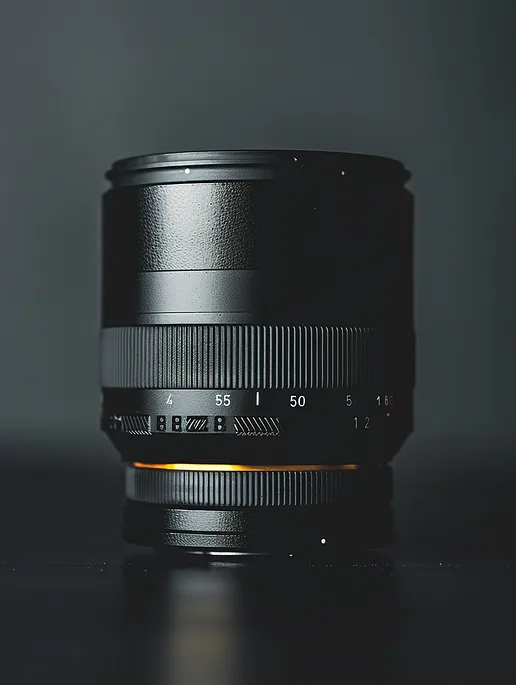
Photography Tips
Benefits of Using Prime Lenses
Why prime lenses beat zooms for portraits — aperture, bokeh, focal lengths, and which primes Chris McCarthy uses for headshots and seniors.
Chris McCarthy
Professional Photographer, Photography Shark · October 30, 2023 · Updated May 24, 2026
Every lens is a set of trade-offs, but in portrait photography the trade-offs of prime lenses consistently favor the final image over convenience. A prime lens is a fixed-focal-length lens — 35mm, 50mm, 85mm, 135mm — that cannot zoom. What it loses in versatility it gains in optical performance: sharper resolving power, wider maximum apertures, smoother out-of-focus rendering, and a clarity that zoom lenses at the same price point cannot match. For headshot and portrait work, those optical advantages translate directly into image quality the viewer can feel even if they cannot articulate why.
I have worked through this question with clients at my Rockland studio more times than I can count, and the answer is more straightforward than most people expect.
Photography Shark uses prime lenses for all studio and outdoor portrait work — headshots, senior portraits, model portfolios, boudoir, and personal branding sessions. The choice is deliberate and based on real-world results across thousands of sessions at the Rockland studio.
Aperture and subject separation
The single biggest advantage of a prime lens for portraiture is maximum aperture. A professional prime at 85mm opens to f/1.4 or f/1.2. A comparable 70–200mm zoom opens to f/2.8 at best. The difference is not abstract. At f/1.4, the plane of sharp focus is so thin that the background dissolves into smooth, undifferentiated color gradients. The subject's eyes are tack-sharp while the backdrop — whether studio seamless or an outdoor environment — falls completely away. This separation is what gives professional portraits their dimensional, three-dimensional quality. It cannot be replicated in post-processing. It cannot be faked with software blur tools. It is an optical property of fast glass at wide apertures, and it is one of the defining characteristics of the work Photography Shark delivers.
At f/2.8, which is the maximum a zoom offers, the background softens but does not dissolve. Elements remain partially legible — tree branches, buildings, signs, other people in the frame. For some environmental or editorial work this context is desirable. For headshots and studio portraits, where the goal is the face and nothing else, it competes with the subject. The difference between f/1.4 and f/2.8 is two full stops of aperture, and in portrait photography those two stops represent a qualitative boundary.
Focal length choices and what each one does
Different focal lengths produce visibly different portraits, independent of aperture. The 85mm is the workhorse headshot focal length — it compresses facial features very slightly in a way that is universally flattering, creates comfortable working distance between photographer and subject (roughly eight feet), and produces creamy bokeh at wide apertures. When clients see the difference between an 85mm prime headshot and a 50mm headshot, the 85mm consistently reads as more polished and less casual. Most of the headshots at Photography Shark are shot on the 85mm.
The 135mm compresses further. Faces appear flatter in a way that is sometimes more flattering for subjects with prominent noses or strong jaw angles. The working distance increases to twelve feet or more, which can make self-conscious subjects feel less crowded by the camera. The 135mm is particularly effective for actor and model headshots where the expression needs to feel unguarded rather than directed — the extra distance helps.
The 50mm is the environmental portrait lens. It includes more of the scene — shoulders, torso, room context — without the barrel distortion of wider lenses. For personal branding photography, where the subject needs to be in a recognizable environment, the 50mm captures both the person and their workspace at natural proportions.
The 35mm is the widest prime in regular portrait use. It introduces slight perspective distortion if the subject fills the frame, so it works best for three-quarter and full-body compositions where some environmental context is part of the story. Outdoor senior portrait sessions on the South Shore — World's End in Hingham, Duxbury Beach, the harbor walks — often use the 35mm for establishing frames before switching to the 85mm for close portraits.
Sharpness where it matters
Modern zooms are excellent general-purpose lenses, and the gap in absolute resolving power between a $2,500 zoom and a $1,800 prime has narrowed. But prime lenses still hold an edge in the specific rendering characteristics that matter for portraiture: contrast across the focus plane, the transition gradient between in-focus and out-of-focus areas, and micro-contrast on fine detail like eyelashes, skin texture, and fabric weave. These differences are subtle at normal viewing sizes but become meaningful in two situations: large-format printing (canvas, gallery, annual report) and the kind of zoomed-in pixel-level examination that casting directors, art directors, and agency contacts perform when evaluating headshots.
The optical simplicity of a prime — fewer glass elements, fewer air-to-glass surfaces, fewer compromises in the design — means more of the light reaching the sensor is clean signal rather than scatter. The practical result is images that feel crisp and present without artificial sharpening, and that hold up at larger reproduction sizes without degrading.
When zooms still make sense
Primes are not universally better. Event photography — galas, corporate functions, concerts — requires the flexibility to compose from a fixed position without switching lenses. A 24–70mm or 70–200mm zoom covers that range without missed moments. Action and sports photography similarly needs the rapid reframing a zoom provides. Photography Shark uses zooms for event photography and fast-moving session types where the technical ceiling of the zoom is less important than the ability to adapt in real time. But for every session where the subject is holding still and the photographer controls the framing — which is the entirety of headshot, portrait, boudoir, and studio work — primes produce measurably better results.
The bottom line for clients
Clients do not need to know or care which lens was used. The point is the result: sharper focus on the eyes, smoother backgrounds, richer dimensional quality, and the indefinable sense that the photograph was made with precision rather than convenience. Prime lenses are one of the reasons Photography Shark's portraits look the way they do, and they are a deliberate, permanent part of the studio's production standard. Sessions start at $395 for studio headshots — contact us at (781) 312-8824 or through the session inquiry form.
Trying Primes in Controlled Light
A prime shows what it can do when the light is not fighting you. If you want to test glass properly, studio space in Rockland is $55/hour — strobes, modifiers, backdrops and paper included, two-hour minimum, free parking.
Frequently Asked Questions
What lenses does Photography Shark use for portrait sessions?
Chris McCarthy shoots on Sony full-frame mirrorless bodies and uses prime lenses as the core of his portrait kit. For headshots, he primarily uses 85mm and 135mm primes. For senior and family sessions requiring more environmental context, he adds the 35mm and 50mm primes.
Why do prime lenses produce better portraits than zoom lenses?
Prime lenses are designed for one focal length, so every element of the optical formula can be optimized for that distance. The result is sharper focus at the plane of the eyes, smoother out-of-focus gradients in the background, and wider maximum apertures — typically f/1.4 or f/1.2 versus f/2.8 for comparable zooms.
What does shooting at f/1.4 do for a portrait?
At f/1.4, the background separates from the subject completely — blurring into smooth, creamy gradients that focus the viewer's eye directly on the face. This separation does not happen at f/4 or f/5.6. It is one of the defining visual characteristics of professional portrait photography and requires a fast prime to achieve.
What focal length is best for headshots?
The 85mm is the classic headshot focal length — it compresses facial features slightly in a flattering way, creates natural working distance from the subject, and produces excellent bokeh at f/1.4. The 135mm compresses further and allows more distance, which some subjects find makes them more relaxed and natural in front of the camera.
Does Photography Shark use prime lenses for outdoor South Shore sessions?
Yes. For outdoor sessions at locations like World's End in Hingham or Duxbury Beach at golden hour, the 35mm and 85mm primes are the primary working lenses. The 35mm captures wide environmental context while the 85mm delivers the tight, subject-isolating portraits that define the final gallery.
Related Posts


You Might Also Like
About the Author
Chris McCarthy
Chris McCarthy has run Photography Shark Studios in Rockland, MA for over 10 years and 500+ sessions, with executive headshot work for Rockland Trust, Clean Harbors, M&T Bank, and McCarthy Planning; founder portraits for AI startups including Lowtouch.ai; product photography for South Shore brands like Lauren's Swim; and headshots across South Shore legal, medical, financial, and academic practices. Every session is personally shot and edited by Chris on Sony mirrorless and Godox strobe systems — no assistants, no outsourcing, no batch retouching. Galleries deliver in 3–5 business days. More about the photographer →
Photography Shark · Boston & South Shore MA
Ready to Book a Session?
Professional headshots, senior portraits, boudoir, and model portfolios. Studio in Rockland, MA — 25 miles south of Boston. Sessions from $395.