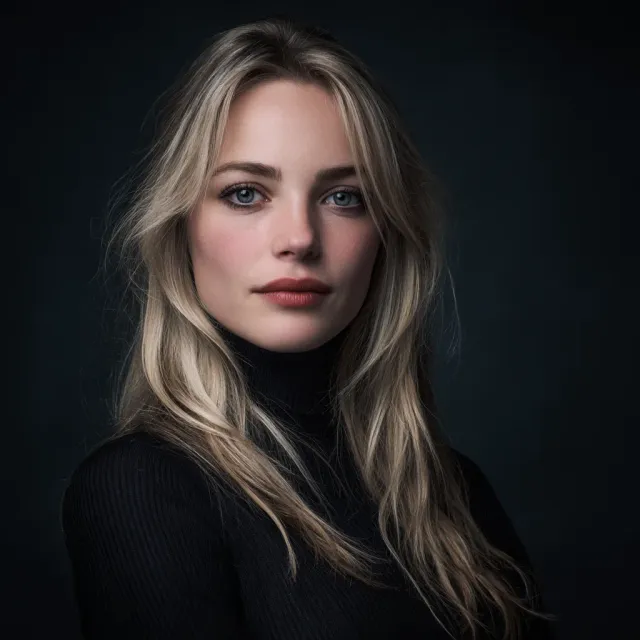
Actor Headshots
How to Choose the Right Photographer for Your Acting Headshots
What to look for in an actor headshot photographer's portfolio, pricing, and experience — markers that separate specialists from generalists.
Chris McCarthy
Professional Photographer, Photography Shark · April 5, 2026 · Updated April 8, 2026
A casting director sees hundreds of headshots before they see a single actor in person. In that context, your headshot is doing something critical: it's making an argument that you're worth the time of an in-person audition. It needs to communicate not just what you look like but who you are — your type, your energy, your potential range — in a single frame.
At Photography Shark, I've built the headshot side of my practice around one central principle: a headshot that doesn't look like you isn't useful to you. Not a more polished version of you, not you under theatrical lighting designed to obscure rather than reveal — actually you, presented in a way that's honest and technically excellent. That's the standard I work toward in every session. (For context: I'm Chris McCarthy, the photographer behind Photography Shark, and the studio has specialized in actor and corporate headshots out of Rockland since 2019.)
Why Actor Headshots Are Different from Portrait Photography
This is a question worth addressing directly, because a lot of actors — particularly those newer to the industry — treat headshots like any other professional portrait. They're not the same.
A corporate headshot needs to communicate competence, approachability, and professional credibility. The target audience is broad: potential clients, professional contacts, LinkedIn connections. The goal is general positive impression.
An actor headshot has a more specific job. It needs to communicate castability — the immediate, intuitive sense a casting director gets from your photo about what roles you'd fit, what energy you'd bring to a room, what age range and type you naturally occupy. The target audience is narrow: casting directors and agents who look at thousands of headshots and develop a practiced, fairly ruthless eye for what's authentic versus what's performed.
The difference matters because many portrait photographers, including technically excellent ones, optimize for the wrong thing when shooting actors. They optimize for attractive, when they should be optimizing for authentic. They optimize for polished, when they should be optimizing for present.
What I'm Actually Looking for When I Shoot Headshots
When I'm working with an actor, I'm watching for a specific quality in the eyes and the face: the moment when they stop performing for the camera and actually become present. That's the frame I want. Everything else in the session — the lighting setup, the posing guidance, the wardrobe, the conversation — is designed to create the conditions where that moment can happen.
It doesn't always happen immediately. Sometimes it takes twenty or thirty frames for a client to settle in, to stop thinking about how they look and start engaging with something real. That's fine. That's part of the session. I keep the camera moving and I keep the conversation going until the quality I'm looking for shows up.
When it does, it's obvious. The eyes engage differently. The face relaxes into something specific rather than performing something general. That's the headshot.
The Session Structure at Photography Shark
Our Boston headshots sessions are structured around giving you enough time to build variety without rushing any single look.
Before the session, I recommend sending wardrobe options in advance so we can discuss what makes sense for your type and your goals. The goal is usually three to four distinct looks that each communicate something different about your range — your most natural type, a more dramatic or formal version of yourself, something more casual or character-driven. The session itself typically runs 90 minutes to two hours.
When you arrive, we spend the first few minutes talking — about your career goals, the types of roles you're pursuing, your recent experience, and anything specific you want these headshots to accomplish. That conversation accomplishes two things: it gives me information I need to direct the session, and it gets you comfortable with the process before the camera comes out.
The shooting itself is collaborative. I'll give you direction, but I'll also give you freedom — the best frames often come from moments where you're responding to something real rather than executing a pose. I shoot a lot of frames and I keep the energy moving. Stasis is the enemy of a good headshot session.
Wardrobe: The Decisions That Matter Before You Arrive
Wardrobe is one of the most significant variables in headshot quality, and it's entirely within your control. The choices you make before you walk in the door will shape the session.
Solid colors over patterns. A bold stripe or a busy print creates visual noise that competes with your face. Casting directors should be looking at your eyes, not your shirt. Solid colors keep the visual focus where it belongs.
Colors that work with your skin tone. Warm tones — burgundy, terracotta, warm olive — tend to work well with warmer skin tones. Cool tones — navy, slate blue, grey — work well with cooler complexions. Jewel tones are generally excellent. Bright neon does not work well in headshots regardless of skin tone — it overwhelms everything else in the frame.
Clothing that fits. A jacket that pulls across the shoulders or a shirt that gaps at the button tells a story you don't want to tell. Bring clothing that actually fits your current body. If you've had significant physical changes since your last headshot session, factor that into your wardrobe selection.
Clean, pressed, no visible wear. Run everything through the laundry before the session. Check for loose threads, missing buttons, and wear at the collar and cuffs. These things show up in photographs.
Necklines that open toward your face. V-necks and open collars draw the eye upward. High, closed necklines can feel constricting and create visual mass that pushes the eye down. Most headshot professionals recommend something open at the neck.
Lighting Philosophy for Actor Headshots
The lighting I use for actor headshots is designed to reveal, not dramatize. I want three-dimensional light that creates depth and dimension in the face without creating shadows so dramatic that they obscure expression or create unflattering contrast.
For most actors, a modified three-point setup with a large, soft key light, a reflective fill, and a separation light on the background produces the right quality. The light should feel natural — like you're standing near a large window — even though it's technically produced in a studio environment.
I adjust this approach based on the actor's specific face and the type of roles they're pursuing. Actors going for more dramatic, intense roles can benefit from slightly harder, more directional light. Commercial actors and those pursuing warmer, more accessible roles benefit from softer, more even illumination.
I'll also shoot some looks outdoors when the light is right — particularly in the fall and spring, when late afternoon light on the South Shore has a quality that studio light struggles to replicate. If you're open to outdoor components in your session, mention it when you book.
The Retouching Standard
My retouching philosophy is simple: I'll remove anything that's not permanently part of your face, and I won't change anything that is.
That means: yes to removing a blemish that appeared the week before your session. Yes to removing undereye shadows from a night of bad sleep before a session that couldn't be rescheduled. Yes to managing flyaway hair and adjusting tones and contrast.
No to reshaping your nose. No to removing the crinkle lines around your eyes that show up when you smile genuinely. No to whitening your teeth beyond what they'd look like after a professional cleaning. No to removing the character from your face.
The reason for this standard is practical: casting directors will meet you. They will compare you to your headshot. If those two things are significantly different, that creates a moment of uncertainty and distraction in an already high-stakes interaction. Your headshot's job is to get you in the room, not to misrepresent what you'll look like when you're there.
Building Your Actor Portfolio
A single headshot isn't a portfolio. Most working actors need multiple looks that collectively communicate their range to casting directors.
The typical working portfolio has two to four distinct headshots:
Your primary type headshot. This is you at your most castable — the roles you'd book most naturally right now, presented in the most honest and compelling way possible. This is the image on top of your submission.
A secondary type headshot. A different register — perhaps more dramatic if your primary is accessible, or more character-driven if your primary is leading. This gives casting directors a second window into your range.
A theatrical or dramatic headshot. Even commercial actors benefit from having at least one image with more depth and intensity. These register differently from the accessible commercial looks and open different doors.
A character or specific-type headshot. If you have a specific niche — period work, character roles, a particular demographic or setting — a headshot that communicates that specifically can be valuable alongside the more general looks.
We can build all of these in a single session with good advance planning, or spread the work across multiple sessions as your career develops.
Who I Work With
I work with actors at every stage of their career — from high schoolers pursuing their first set of headshots for community theater and regional auditions, through working regional actors maintaining current portfolios, to professional performers serving Boston's active theater and commercial markets.
The South Shore has a genuine local acting community. The North River Theatre in Norwell, the South Shore Music Circus in Cohasset, the South Shore Art Center, and the broader connection to Boston's theater scene through the Greenbush Line — there's real artistic activity in this region, and the actors who are part of it need headshots that do their work justice.
I'm based in Rockland at 83 E Water Street, which puts me convenient to Quincy, Hingham, Scituate, Norwell, Cohasset, Duxbury, Plymouth, and the other South Shore communities where actors live and work.
Ready to Book Your Session?
If you're an actor on the South Shore or in the Boston area who needs headshots that actually serve your career, reach out through the contact page and let's talk through what your session should look like. Bring your type awareness, your wardrobe questions, and your career goals — that's everything we need to start planning something useful.
Actor headshots in Boston · Actor headshots pricing
Team & company headshots · Headshot pricing · Professional headshots in Norwell · Scituate headshots · Studio headshots near Rockland, MA
Frequently Asked Questions
What does an actor headshot session cost at Photography Shark?
Studio headshot sessions are $395 for 30 minutes with 10 fully retouched images. On-location sessions are $495. Add-ons for actors needing more time: additional session time $100 (extra 30 min for more looks), outfit change $150, group shot $100. Actors typically book standard studio session plus one add-on for theatrical + commercial coverage in one booking.
Where is Photography Shark located and who is nearby?
The studio is at 83 E Water Street, Rockland, MA 02370 — convenient to actors in Quincy, Hingham, Norwell, Cohasset, Scituate, Duxbury, Plymouth, and the greater Boston area.
How should I prepare my wardrobe for an actor headshot session?
Send wardrobe options to Chris before your session for feedback. Aim for three to four looks in solid colors — jewel tones, navy, burgundy, or warm olive — with open necklines that draw the eye to your face. Avoid busy patterns.
Does Photography Shark shoot outdoor as well as studio headshots?
Yes. Chris shoots outdoor looks when the light is right — especially fall and spring afternoons on the South Shore. Let him know you're open to outdoor components when you book.
What is Photography Shark's retouching policy for actor headshots?
Temporary blemishes, flyaways, and undereye shadows are removed. Permanent features — smile lines, bone structure, facial shape — are not altered. Casting directors will meet you in person, so the headshot needs to match your actual appearance.
How quickly will I receive my finished headshots?
Finished, retouched images are delivered within 3–5 business days for headshots and studio sessions, 7–10 days for outdoor sessions.
Related Posts
You Might Also Like
About the Author
Chris McCarthy
Chris McCarthy has run Photography Shark Studios in Rockland, MA for over 10 years and 500+ sessions, with executive headshot work for Rockland Trust, Clean Harbors, M&T Bank, and McCarthy Planning; founder portraits for AI startups including Lowtouch.ai; product photography for South Shore brands like Lauren's Swim; and headshots across South Shore legal, medical, financial, and academic practices. Every session is personally shot and edited by Chris on Sony mirrorless and Godox strobe systems — no assistants, no outsourcing, no batch retouching. Galleries deliver in 3–5 business days. More about the photographer →
Photography Shark · Boston & South Shore MA
Ready to Book a Session?
Professional headshots, senior portraits, boudoir, and model portfolios. Studio in Rockland, MA — 25 miles south of Boston. Sessions from $395.