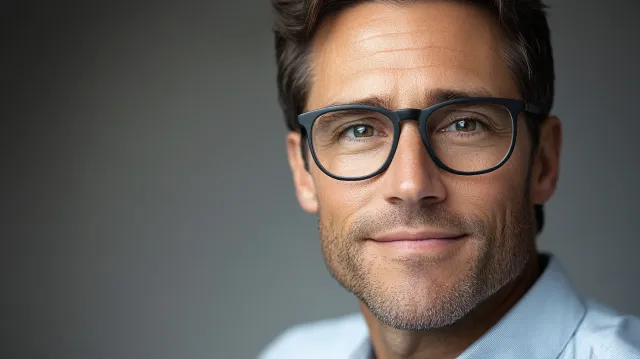
Headshots
Headshots With Glasses: How to Avoid Glare and Look Your Best
A practical guide to professional headshots if you wear glasses — how photographers kill lens glare, which frames photograph best, whether to use anti-reflective lenses or empty frames, and how to prep for your session.
Chris McCarthy
Professional Photographer, Photography Shark · June 9, 2026
If you wear glasses every day, your professional headshot should have them on — that's how people recognize you, and a glasses-free photo of a glasses-wearer reads as subtly off the moment they meet you in person. The only real challenge is lens glare, and the good news is that glare is a solved problem for any competent studio photographer. This guide explains how photographers kill reflections, which frames and lenses photograph best, when (if ever) to go without, and how to prep so your glasses headshot comes out clean and sharp. I shoot a lot of professional headshots for glasses-wearers in my Rockland studio, and it's almost never the obstacle people fear it will be.
Wear Them — Here's Why
Start with the default: if glasses are part of your everyday face, keep them on. Your LinkedIn headshot, your company bio photo, your corporate headshot — all of them work as recognition tools. When a client, a recruiter, or a new colleague meets you, the photo should match the person. Take the glasses off "for a cleaner photo" and you've made a version of yourself that doesn't exist in real life.
There are only a few exceptions, covered below. For the large majority of glasses-wearers, the answer is simply: wear them, and let the photographer handle the glare.
How Glare Actually Gets Eliminated
The thing most people don't realize: lens glare is controlled in the lighting, not in Photoshop. Editing out glare is a last resort for a small residual highlight — it's not the primary fix, because heavily painting over a reflection can erase the eye behind it.
Here's what a photographer is actually doing when they manage glasses:
- Raising the main light. Glare is a reflection, and reflections follow the law of angles — light hits the lens and bounces at the mirror-image angle. By moving the light higher and slightly to the side, the photographer aims that bounce down and away from the camera instead of straight into it.
- Small head tilts. Tipping your chin or turning your head a few degrees shifts the reflection off the lens. During the session, when I ask you to "drop your chin a touch," that micro-adjustment is often me chasing a reflection out of your lenses in real time.
- Angling the frames. Gently pushing the temple arms (the parts over your ears) up a hair tilts the lenses forward at the bottom, redirecting reflections. It's invisible in the final photo but makes a real difference.
- Controlling the environment. A studio is a controlled box — the photographer knows exactly where every light is. That's a huge advantage over an outdoor or on-location shoot, where the sky and surroundings throw uncontrolled reflections onto your lenses.
This is exactly why a controlled studio environment is ideal for glasses-wearers: every reflection has a known source that can be moved. None of it requires you to do anything except take direction.
Frames: What Photographs Well
Your everyday frames are usually the right choice — they're what people know you in. A few things that help them photograph cleanly:
- Fit matters more than style. Frames should sit straight, not slide down your nose, and not perch so high they hide your eyebrows or so low they clip across your eyes. Well-fitted frames keep the focus on your eyes, which is where every headshot lives.
- Weight affects emphasis. Thin and mid-weight frames keep attention on your face. Very heavy, dark frames can start to dominate the photo — fine if that's your signature look, worth knowing if it isn't.
- Clean them first. Smudges, dust, and fingerprints show up clearly in a sharp studio image. Wipe your lenses right before the session.
- Adjust them if they're crooked. If your frames have drifted out of alignment, a quick visit to any optical shop to have them straightened (usually free) means they'll sit level in the photo.
You don't need to buy special frames for a headshot. The ones you wear daily, clean and properly fitted, are almost always the best choice.
Lenses: The Glare Variable
Frames affect style; lenses affect glare. This is where a little planning pays off.
Anti-reflective (AR) coating is the single biggest help. AR lenses are designed to cut reflections — that's their whole purpose — which makes them far easier to light cleanly and also reduces the distracting glare on your lenses in everyday video calls. If you're due for new lenses anyway, it's worth requesting AR coating for both reasons. If your current lenses don't have it, don't worry — your photographer can still control glare through angles; AR just makes it easier.
Photochromic / transition lenses are the real watch-out. These darken in response to light, and studio strobes can trigger them to tint, leaving you with shaded or partly-darkened lenses that hide your eyes — the opposite of what a headshot needs. If you wear transitions, the best move is to bring a clear-lens backup pair, or talk to your optician about a dedicated clear pair for photos and video.
Heavily tinted or mirrored lenses obviously don't work for a professional headshot — the eyes have to be visible. If those are your only glasses, plan for a clear or empty-frame alternative.
When to Consider Empty Frames or No Glasses
For a small number of cases, the cleanest solution is a backup option:
- Empty (lens-free) frames. Some glasses-wearers bring an identical frame with the lenses popped out, giving the look of their glasses with zero glare risk. This works well if your prescription lenses are highly reflective and you want guaranteed-clean frames. The frames still read as "you," just without any reflection to manage.
- A few frames without glasses. Even committed glasses-wearers sometimes like having a handful of no-glasses frames as an alternate. It's easy to shoot both during one session — glasses on for the primary set, a few off for options — so you're not locked into one or the other.
My usual approach: shoot the real glasses as the primary (because that's the recognizable you), and grab a few alternates if you want them. You leave with choices.
How to Prep for a Glasses Headshot
A short checklist so your session runs clean:
- ✅ Clean your lenses right before the shoot — bring a microfiber cloth.
- ✅ Straighten crooked frames at an optical shop beforehand (usually free).
- ✅ Bring a clear-lens pair if you normally wear transitions or heavy tints.
- ✅ Consider an empty-frame backup if your lenses are very reflective.
- ✅ Wear your everyday glasses — the ones people know you in.
- ✅ Trust the direction — the small head and chin adjustments your photographer asks for are usually glare management in real time.
That's genuinely it. Glasses are one of the most routine things a studio photographer handles, and with AR lenses or basic lighting technique, your headshot will look clean, sharp, and unmistakably you.
Free download: our headshot prep guide for glasses wearers and everyone else, with what to wear, posing and photo sizes.
Ready to Book?
Whether you wear glasses every day or want both options, we'll get a clean, glare-free result. Get in touch to book a session at Photography Shark in Rockland, MA — controlled studio lighting that handles reflections, multiple backdrops, and free parking, an easy drive from Boston and across the South Shore. Sessions start at $395 with fully retouched, licensed files.
Related reading: Boston headshot sessions · LinkedIn headshots Boston · Corporate headshots · What to wear for a professional headshot · Professional headshot examples by industry
Frequently Asked Questions
How do photographers avoid glare on glasses in headshots?
Photographers eliminate lens glare mainly by adjusting the angle of the light relative to the glasses, not by editing afterward. Raising the main light and moving it slightly to the side changes the reflection's angle so it bounces away from the camera instead of into it. Small tilts of the subject's head and a slight push of the temple arms to angle the lenses down also help. Anti-reflective lens coatings make it dramatically easier. Any residual glare is cleaned up in retouching.
Should I wear my glasses in my professional headshot?
Yes — if you wear your glasses every day, wear them in your headshot so the photo matches how people actually recognize you. The exception is if your lenses are heavily tinted, photochromic (transition) lenses that darken under studio lights, or so reflective that glare can't be controlled. In those cases, ask your optician about clear or anti-reflective lenses, or shoot a few frames with empty frames or no glasses as a backup.
Do anti-reflective glasses help in photos?
Significantly. Anti-reflective (AR) coatings cut the reflections that cause most lens glare, making a glasses headshot far easier to light cleanly. If you're due for new lenses anyway, AR coating is worth it for both photos and everyday screen use. If not, your photographer can still manage glare through lighting angles and minor retouching.
What glasses frames photograph best for headshots?
Frames that fit your face well and don't sit so high they cover your eyebrows or so low they cut across your eyes photograph best. Thinner or mid-weight frames keep attention on your eyes; very heavy frames can dominate. Make sure the frames are clean, sit straight, and aren't sliding down your nose. Anti-glare lenses help more than any specific frame style.
Related Posts
![What to Wear for a Professional Headshot: Complete Guide [2026]](/blog/what-to-wear-for-a-professional-headshot---boston--hero-w640.webp)


You Might Also Like
About the Author
Chris McCarthy
Chris McCarthy has run Photography Shark Studios in Rockland, MA for over 10 years and 500+ sessions, with executive headshot work for Rockland Trust, Clean Harbors, M&T Bank, and McCarthy Planning; founder portraits for AI startups including Lowtouch.ai; product photography for South Shore brands like Lauren's Swim; and headshots across South Shore legal, medical, financial, and academic practices. Every session is personally shot and edited by Chris on Sony mirrorless and Godox strobe systems — no assistants, no outsourcing, no batch retouching. Galleries deliver in 3–5 business days. About Photography Shark →
Photography Shark · Boston & South Shore MA
Ready to Book a Session?
Professional headshots, senior portraits, boudoir, and model portfolios. Studio in Rockland, MA — 25 miles south of Boston. Sessions from $395.