Headshots
Hockey Recruiting Photos: What Goes in the Profile Besides the Video
What photo a hockey recruiting profile actually needs, how it differs from rink action shots and senior pictures, what to wear, and when to book it around the Massachusetts season.
Chris McCarthy
Professional Photographer, Photography Shark · September 12, 2026
A hockey recruiting profile is won on footage and lost on nothing, but it is presented through a photo. Coaches and advisors move through a lot of profiles; the headshot is the thing attached to the player's name in their notes, on the platform, and in whatever spreadsheet the programme keeps. It does not evaluate anything. It makes the player identifiable and the profile look finished.
This covers what that photo actually needs to be, why rink footage does not substitute, and when to book it around a Massachusetts season.
The Helmet Problem
The instinct is to use a great action shot. It rarely works as the primary profile photo, for a reason that has nothing to do with photographic quality: the helmet.
Game photography is shot at distance, under arena lighting, through glass, with the face obscured by a cage or mask. As evidence of how a player skates, handles, and competes, it is valuable. As an identifier — which is what the profile photo is for — it fails at the one job.
So a complete profile generally carries both: game frames or footage that show the play, and a clean headshot that shows the player. They are different photographs doing different work, and substituting one for the other leaves a gap.
What the Headshot Needs to Be
Narrow brief, same as any submission photo:
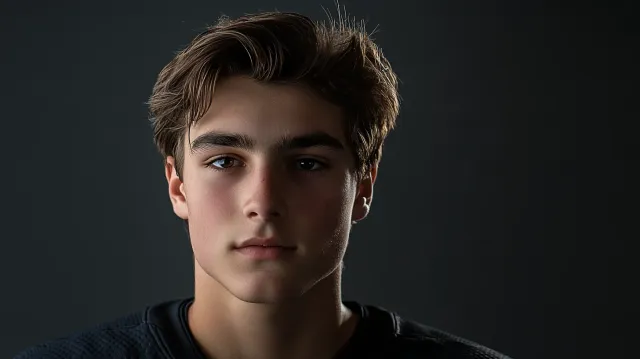
- Face forward, clearly lit, neutral background. Nothing competing, nothing dramatic.
- Current. A photo from two seasons ago on a fifteen-year-old is a different person.
- Readable at thumbnail size. Profile avatars are small. Composition has to survive that.
- Accurate. The coach who meets this player at a showcase should recognise them.
The standard is essentially identical to a dance audition headshot or an ERAS application photo — different world, same underlying job: connect a document to a person reliably.
Jersey or Collar
Both get used, and which matters depends on where the photo is going.
Team jersey. Signals the current programme instantly, reads as a hockey photo at a glance, and is the common choice for recruiting platform profiles. If the player has a club and a school programme, ask which the submission is for.
Collared shirt or programme jacket. More formal, sits better beside academic material, and is often the better choice for prep school applications and anything a school's admissions office will see alongside transcripts.
Bringing both costs five minutes in the session and covers every submission a player is likely to face over a season. Beyond that, the usual rules apply: solid over busy, well-fitted over new, and hair as it normally looks rather than styled into something unfamiliar.
Crops Worth Having
Recruiting platforms, programme roster pages, and printed showcase programmes all want different shapes. Ask for:
- Square — platform profile avatars
- Vertical — roster pages and printed programmes
- Full resolution — anything printed or enlarged
Every gallery from a session here includes all three, because discovering the requirement at upload time is the avoidable version of this problem.
Timing It Around a Massachusetts Season
Hockey in this state fills the calendar from autumn through spring, with showcases and travel eating weekends. That makes the practical booking window late summer to early autumn, before the season closes it.
A profile built in September gets used for the whole recruiting year. A profile finished in February has already missed most of the window it existed for. The photo is a small piece of that, but it is the piece that is easiest to do early and easiest to leave until it is too late.
Team and Programme Sessions
For a club or school programme, shooting the roster in one session is the only way to get headshots that match — one lighting setup, one grading pass, a team page that reads as a programme rather than twenty unrelated photographs of varying quality.
It is also cheaper per player than individual bookings and removes the administrative problem of chasing twenty families for photos of inconsistent quality. Team days produce group frames for programme use as well, which individual sessions never generate.
Not a Senior Portrait
Worth separating, because families often assume one covers the other. A senior portrait session is about the player's senior year and can absolutely include hockey gear as one of several looks — it is meant to be enjoyed and displayed. A recruiting headshot is a submission document with a deadline attached and a specification to satisfy.
Plenty of families book both. Booking one expecting the other is the mistake.
Booking
The studio is at 83 E Water Street in Rockland, MA — 25 minutes south of Boston via Route 3, with free on-site parking and ground-floor access, which matters when a session sits between school and a rink slot.
Individual sessions start at $395 and include the headshot, a full-length frame, 10 hand-retouched images, and every crop above. Team and programme days start at $1,495. Full formats are on the dance and audition headshot page, which covers athletic recruiting sessions under the same structure.
Ready to book? Get in touch with the player's programme, what the photo is being submitted to, and your season timing.
Related reading: Cheer and gymnastics headshots · The complete dance headshot guide · Headshot sizes and submission specs
Frequently Asked Questions
What photo does a hockey recruiting profile need?
A clean, current, face-forward headshot that identifies the player at thumbnail size, alongside the game footage that does the actual evaluating. Coaches and advisors work through large numbers of profiles, and the photo is the identifier attached to the name in their notes. Action shots from the rink are useful elsewhere in a profile but rarely work as the primary photo — helmets, distance, and arena lighting all work against identification.
Should a hockey player wear a jersey or a jacket for the headshot?
Both get used. The team jersey signals the current programme immediately and is the common choice for recruiting profiles; a collared shirt or programme jacket reads more formal and suits prep school applications and anything that will sit beside academic material. Bringing both takes five extra minutes and covers every submission the player is likely to face.
Why not just use a photo from a game?
Because a helmet defeats the entire purpose. Game photography shows how a player moves and competes, which matters enormously — but it is shot at distance under arena light, and the face is usually obscured or too small to read. The two photo types do different jobs, and a profile generally wants both rather than one standing in for the other.
When should a hockey family book recruiting photos?
Before the season rather than during it. In Massachusetts the practical window is late summer and early autumn, ahead of the point where games, travel, and showcases fill every weekend. Profiles built early get used all season; profiles finished in February have already missed most of their value.
Can a whole team be photographed in one session?
Yes, and for a programme it is the only way to get a roster that matches. One lighting setup, one session, consistent grading — which is what makes a team page read as a programme rather than a collection of unrelated snapshots. Team days also produce group frames for programme use.
How much do hockey recruiting photos cost?
Individual sessions start at $395 and include the headshot, a full-length frame, 10 hand-retouched images, and crops sized for recruiting platforms, rosters, and print. Team and programme days start at $1,495 for matched headshots across a roster plus group frames. Turnaround is 3-5 business days.
Related Posts
Headshots
Band Press Photos: How to Stage a Group So It Reads as One Identity
Headshots
Cheer and Gymnastics Headshots: Tryouts, Recruiting, and Team Rosters
Headshots
EPK Photos: What Bookers and Press Actually Need From You
Headshots
The MBA Application Photo: What Committees See and What Trips People Up
Headshots
Ballet Headshots: What Classical Companies and Schools Expect
Headshots
Commercial Dance Headshots: What Agents and Casting Want
About the Author
Chris McCarthy
Chris McCarthy has run Photography Shark Studios in Rockland, MA for over 10 years and 500+ sessions, with executive headshot work for Rockland Trust, Clean Harbors, M&T Bank, and McCarthy Planning; founder portraits for AI startups including Lowtouch.ai; product photography for South Shore brands like Lauren's Swim; and headshots across South Shore legal, medical, financial, and academic practices. Every session is personally shot and edited by Chris on Sony mirrorless and Godox strobe systems — no assistants, no outsourcing, no batch retouching. Galleries deliver in 3–5 business days. About Chris McCarthy →
Photography Shark · Boston & South Shore MA
Ready to Book a Session?
Professional headshots, senior portraits, boudoir, and model portfolios. Studio in Rockland, MA — 25 miles south of Boston. Sessions from $395.