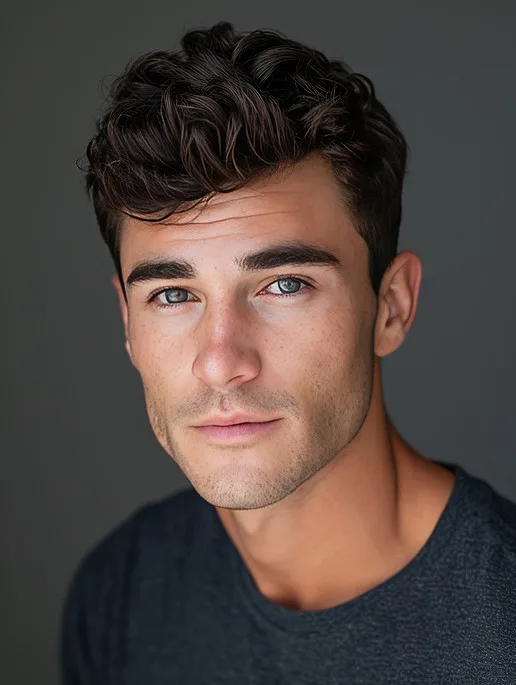
Actor Headshots
What to Wear for Actor Headshots: A Casting Director's Guide
Color choices, patterns, necklines, and layering decisions for actor headshots — calibrated to land roles, not distract from the actor's face.
Chris McCarthy
Professional Photographer, Photography Shark · April 4, 2026 · Updated April 13, 2026
Your actor headshot is not a glamour photo. It's a professional tool — the first thing a casting director sees when your name comes up for a role — and it has one job: to communicate who you are as an actor and what roles you're right for. Wardrobe is where most actors make their biggest mistakes, either overthinking it into something generic or under-thinking it into something that actively hurts their chances.
This guide breaks down the wardrobe decisions that matter most for actor headshots, with specific guidance for the Boston and South Shore theater and film community where Photography Shark works regularly.
The Central Principle: Dress the Part You Want to Be Cast In
Before you open your closet, answer this question: what roles do you want? Not what roles have you played — what roles do you want casting directors to think of you for?
Your wardrobe should make that answer obvious without stating it. A working actor who wants to be cast as a Boston PD detective dresses differently for headshots than one going after romantic lead roles in indie films, and differently again from someone targeting the regional theater Shakespeare circuit. Casting directors look at hundreds of headshots. The ones that work are the ones where the actor's type is communicated instantly and the face is what lingers.
Photography Shark works with actors at all career stages across the Boston, South Shore, and Greater New England market. Chris has shot headshots for community theater performers, union actors, film extras working their way up, and emerging leads in regional productions. The wardrobe conversation happens before every session because it matters that much.
Boston headshot packages start at $395 and include a pre-session consultation that covers wardrobe specifically.
Building Your Headshot Wardrobe Selections
How Many Looks to Bring
Bring three to four distinct looks for a professional headshot session. This is not excessive — it gives you range in the final gallery and insures against one look that simply doesn't read the way you expected on camera.
Structure your looks around your primary type and two to three adjacent types:
- Look 1: Your main type. The outfit that most directly communicates the roles you're primarily seeking.
- Look 2: A more casual version of your type. If Look 1 is polished professional, Look 2 might be off-duty professional.
- Look 3: A stretch or contrast look. Something that shows range — slightly edgier, slightly warmer, whatever represents the second string of your range.
- Look 4 (optional): A theatrical or specialty look if you actively work in that space.
Neckline is the Most Critical Decision
The camera frames you from roughly chest to top of head. What happens at the neckline — the collar, the V, the crew neck — is prominent in every single frame. Get this wrong and it distracts from your face constantly.
V-necks and open collars create a natural triangle that leads the eye to the face. They work well for most types because they're clean without reading as over-dressed.
Crew necks and turtlenecks frame the face differently, creating a closed, contained look. These work for character actors and anyone whose type runs toward intellectual, introspective, or intense. They can feel claustrophobic on camera if the fabric sits too close to the jaw.
Collared shirts (button-down, Oxford) read as professional and approachable simultaneously. In a Boston market where a lot of corporate training films, educational content, and regional commercial work exists, a clean collared shirt is often the strongest primary look.
Avoid: Deep scoops that pull the eye down, anything that shows chest skin prominently (unless that's specifically the role), and frills or embellishments at the neckline.
Color Selection for Boston and South Shore Markets
What Works
Boston and South Shore casting skews toward realistic, grounded aesthetics in local film and theater productions. The color palette that reads most naturally in this market runs toward:
Navy blue is the single most reliable color for professional and commercial headshots. It reads as trustworthy, serious, and confident. It photographs cleanly against most backgrounds and doesn't create unwanted color cast on skin.
Medium gray functions similarly — versatile, professional, easy to combine with other elements. A charcoal gray with a slight texture (herringbone, subtle check) adds visual interest without distraction.
Burgundy and deep wine tones photograph beautifully and communicate warmth and approachability. These work well for actors targeting warmer character types.
Olive and earthy greens are strong for actors working in more naturalistic genres — independent film, regional drama, intimate theater. They also photograph particularly well against the outdoor settings available at Photography Shark's South Shore locations.
White works in small doses as a layer — a white shirt under a blazer, for example — but all-white clothing against a light background creates contrast problems. If you want white, pair it with a jacket.
What to Avoid
Bright saturated colors — neons, bright reds, orange — jump out of headshot galleries in a way that draws attention to the outfit rather than the face. Casting directors notice the color before they notice you.
Black on its own can read as flat against darker studio backgrounds and sometimes makes it harder to distinguish shoulder and neck from background. Black works when it's combined with a lighter layer — an open black jacket over a lighter shirt, for example.
Patterns are a specific risk. A subtle texture (light herringbone, micro-check, fine stripe) adds visual depth without distraction. Larger patterns, bold stripes, or complex prints will fight your face constantly. The camera's eye goes to pattern before it goes to the person.
Fit: Why It Matters More Than Budget
A $400 blazer that fits poorly will look worse in your headshots than a $60 thrift store find that fits perfectly. The camera is unforgiving about fit because it collapses three-dimensional space into two dimensions and exaggerates any irregularity.
What Correct Fit Looks Like
Shoulders are the most important structural element of any jacket, blazer, or shirt. The shoulder seam should sit at the edge of your actual shoulder, not hanging off or pulled tight. If you can only fix one thing about an item of clothing before a headshot session, have the shoulders tailored correctly.
Sleeves should show the collar of a shirt, if worn, with roughly half an inch visible below a jacket sleeve. Sleeves that are too long swallow the hands; too short and the look becomes awkward.
Chest and torso should fit close enough to read clearly on camera but not so tight that there's pulling across the chest or back. If a shirt buttons and pulls at the buttonholes, it's too small.
Collar should sit flat against the neck without gaping or pulling. A gaping collar reads as poorly fitted even when everything else is correct.
Get your headshot wardrobe on at least a week before the session, take photos in a mirror and look at them critically. If you're uncertain about fit, bring an objective friend. It's much easier to address fit issues before the session than to notice them in the gallery afterward.
Layers, Texture, and Visual Depth
The Power of a Well-Fitted Jacket
A blazer or structured jacket is one of the most useful pieces in an actor headshot wardrobe because it gives you a natural way to create visual variety without fully changing outfits. Shoot a series of frames with the jacket on and several with it off, collar open — and you have two distinctly different looks with minimal transition time.
The jacket also has a structural quality that reads as professional and intentional. For actors in the commercial and corporate content market in Boston, a clean blazer communicates "I can be cast as the expert in this insurance commercial" without stating it.
Texture as a Tool
Solid color fabric with no texture can read as flat in headshots, particularly under studio lighting. A subtle texture — a linen weave, fine herringbone, ribbed cotton — creates dimension and visual interest in close crops. This doesn't mean wearing a wildly textured garment; a fine cable-knit sweater or a cotton Oxford shirt with a woven texture gives you enough visual depth without crossing into distraction.
Grooming and Preparation
Hair
Hair should look like your natural hair, styled. Not more dramatic than usual, not significantly different from how you typically look. Casting directors need to recognize you from your headshot — if the hair in the photo is notably different from how you show up to auditions, you've created a disconnect.
Get a haircut one to two weeks before your session, not the day before. Fresh haircuts sometimes look slightly off in photos; a week of natural settling gives it the right look.
Skin Preparation
Drink adequate water for the two days before your session. Dehydrated skin reads differently on camera than properly hydrated skin — texture, minor blemishes, and under-eye circles are all more pronounced when you're not well-hydrated.
Get adequate sleep the night before. This is not a cliché — the area under and around your eyes communicates energy level very clearly in photographs, and no retouching fully replaces what proper sleep delivers.
Makeup for Headshots
For women, headshot makeup should be polished and intentional but closer to everyday than to performance or event makeup. The goal is to look like the best version of yourself in natural conditions, not to look made up. A matte foundation that controls shine, well-defined brows, clean mascara, and a lip that reads as natural and healthy on camera covers most situations.
For men, light powder to control shine is appropriate and many photographers recommend it. Photography Shark shoots with studio lighting that can amplify forehead and nose shine — a light application of translucent powder prevents the need for significant retouching.
What Not to Bring
Perfume, cologne, or scented lotions are not relevant to the photos themselves but are relevant to the session experience. Strong scents in a confined studio space are distracting for everyone. Keep fragrance minimal on session day.
Jewelry should be minimal unless it's a specific character element. Earrings that are visible in headshot framing should be clean and simple. Large statement pieces compete with the face.
Outdoor vs. Studio Headshots in Boston
Photography Shark offers both studio sessions in Rockland and outdoor on-location sessions for actors who want that option. The Boston market supports both, though the use case differs.
Studio headshots give you clean, neutral backgrounds with fully controlled lighting. They read as professional and are appropriate for commercial submissions, theatrical union submissions, and casting director files. The controlled environment means every variable is consistent across the session.
Outdoor headshots in locations along the South Shore — South Boston waterfront, downtown Plymouth, Cohasset harbor, scenic parks in Hingham or Norwell — can produce images with a naturalistic quality that works well for indie film submissions, more casual commercial work, and personal branding. The trade-off is variable light, which requires a photographer comfortable working in changing outdoor conditions.
Many actors book a session that includes both — 45 minutes of studio work for clean, reliable submissions, and 45 minutes of outdoor work for the more personality-forward looks in the portfolio.
The Session Process at Photography Shark
What to Expect
Sessions begin with a brief warm-up period to let you settle into the environment and start relaxing in front of the camera. Chris provides specific direction on posing and angle throughout — actor headshots have specific requirements around head tilt, chin position, and eye direction that differ from portrait photography.
You'll shoot each look in multiple variations: different angles, different expressions, adjustments to framing. The goal is a gallery with genuine options rather than a gallery full of similar frames with minor variations.
Sessions run 30 minutes ($395) for one look, or 60 minutes ($495) for two looks. Retouched galleries are delivered within 3–5 business days.
Reviewing Your Gallery
When the gallery arrives, review it critically but not harshly. The question to ask for each image is not "do I love how I look?" but "would a casting director for the type of roles I want read me correctly from this photo?" Those are different questions, and the second one is the one that matters.
Have a trusted industry colleague review the gallery with you if possible. Someone who knows both you and the market will give you better feedback than a supportive friend or family member.
Internal Links for Further Reading
- Boston headshot services and pricing
- Studio photo shoot options
- Family portrait sessions for actors who want family imagery alongside professional work
Ready to Book Your Session?
Actor headshot sessions at Photography Shark are designed to deliver a gallery that actually works in the Boston and New England market — not generic portrait photography repackaged as headshots. If you're ready to invest in professional headshots that serve your career, let's schedule your session.
Contact Photography Shark to book your actor headshot session and we'll start with a wardrobe and concept consultation before the camera is ever involved.
Frequently Asked Questions
How many outfits should I bring to an actor headshot session?
Bring three to four distinct looks structured around your primary type and two to three adjacent types. This gives you enough range in the final gallery without making the session feel rushed. Photography Shark headshot packages include time for multiple changes.
What colors photograph best for actor headshots in the Boston market?
Navy blue is the single most reliable color for Boston and South Shore casting — trustworthy, serious, and clean against most backgrounds. Deep burgundy, medium gray, and forest green also work well. Avoid very bright saturated colors and pure white in studio settings.
What neckline works best for actor headshots?
V-necks and open collars are the most versatile — they draw the eye to the face and work for most types. Crew necks work for character and intellectual types. Collared button-downs are strong choices for commercial and professional Boston casting work.
Does Photography Shark include a wardrobe consultation?
Yes. Every booking at Photography Shark includes a pre-session consultation that covers wardrobe specifically. Chris recommends sending wardrobe photos in advance so adjustments can be made before your session day.
What should actors absolutely avoid wearing for headshots?
Avoid bold patterns, small repeating prints (they strobe on camera), visible logos or graphic text, and multiple competing colors in one look. Jewelry that catches light should be minimal or avoided.
How much do actor headshot sessions cost at Photography Shark?
Packages start at $395 and include pre-session wardrobe consultation. The studio is at 83 E Water Street, Rockland, MA, convenient to South Shore towns including Hingham, Norwell, Quincy, and Plymouth.
Related Posts
You Might Also Like
About the Author
Chris McCarthy
Chris McCarthy has run Photography Shark Studios in Rockland, MA for over 10 years and 500+ sessions, with executive headshot work for Rockland Trust, Clean Harbors, M&T Bank, and McCarthy Planning; founder portraits for AI startups including Lowtouch.ai; product photography for South Shore brands like Lauren's Swim; and headshots across South Shore legal, medical, financial, and academic practices. Every session is personally shot and edited by Chris on Sony mirrorless and Godox strobe systems — no assistants, no outsourcing, no batch retouching. Galleries deliver in 3–5 business days. More about the photographer →
Photography Shark · Boston & South Shore MA
Ready to Book a Session?
Professional headshots, senior portraits, boudoir, and model portfolios. Studio in Rockland, MA — 25 miles south of Boston. Sessions from $395.