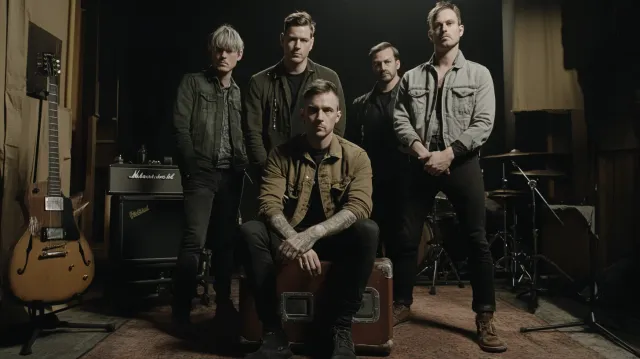
Headshots
Band Press Photos: How to Stage a Group So It Reads as One Identity
How band press photos are staged so five people read as one act — spacing, height, wardrobe palette, who anchors the frame — plus what a Boston band should book and bring to get group frames and individual portraits in one session.
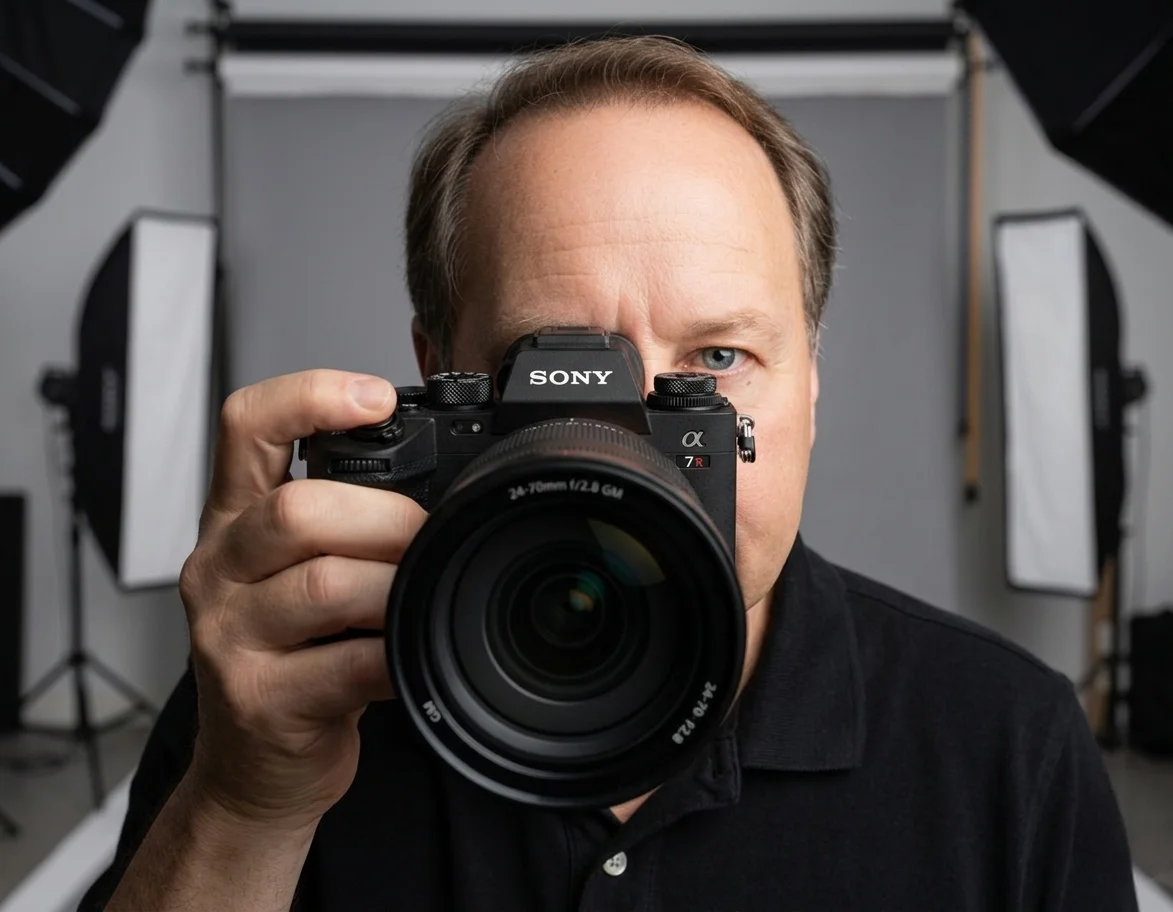
Chris McCarthy
Professional Photographer, Photography Shark · September 12, 2026
A band press photo has a harder job than a solo portrait: it has to read as one act while still giving five people individual presence. Get it wrong and you have a lineup — five individuals standing in a row, no hierarchy, no energy, nothing that says what the band sounds like. Get it right and the image works everywhere from a festival grid to a full-page feature. This covers how the staging actually works, what to agree on before the session, and what to book so you leave with everything the release needs.
If you want the broader context first — headshots versus press photos, how genre shapes lighting, solo session structure — start with the complete musician headshot and press photo guide. This piece is the band-specific version.
The Lineup Problem
Almost every weak band photo fails the same way. Everyone stands shoulder to shoulder, facing front, evenly spaced, at the same distance from the camera. It reads as a police lineup or a team photo, and the reason is structural: an evenly spaced row gives the eye nowhere to go. There is no entry point, no hierarchy, nothing to look at second.
Fixing it is not about finding a clever pose. It is about three decisions made before anyone presses a shutter.
Depth. Someone is closer to the camera than someone else. Even six inches of stagger breaks the row and creates a foreground and a background, which is what makes the group read as a three-dimensional arrangement rather than a flat strip.
Height variation. Bands are usually a range of heights already, and the instinct is to hide it. Do the opposite: seat one member, have another lean, put someone on a riser or a case. Varied eye lines give the frame a rhythm.
An anchor. One person holds the centre of gravity — not necessarily the frontperson, and not necessarily the tallest. The anchor is whoever the composition is built around, and everyone else is arranged in relation to them. Without an anchor, a group photo has no subject.
None of this is something a band should arrive having solved. It is the photographer's job to stage it, and if nobody is actively staging, the photo defaults to the lineup.
Wardrobe: A Palette, Not a Uniform
The single most common band wardrobe mistake is everyone dressing well independently. Five people who each look good separately can still produce an incoherent group frame, because the eye reads colour relationships before it reads individual outfits.
The fix is a palette agreed in advance. Pick a tonal range — all muted earth tones, all black and grey with one accent, all saturated jewel colours — and let each member choose their own pieces inside it. The group reads as one act; nobody looks like they were dressed by someone else.
A few practical rules that hold across genres:
- Avoid competing loud logos. Two band members in different loud graphic tees pull against each other and against you.
- Busy patterns fight in groups. What reads as personality in a solo portrait becomes visual noise across five people.
- Match formality levels. One member in a suit and one in a hoodie reads as an accident unless the contrast is deliberate and staged.
- Bring a second look if the session length allows. A cleaner set and a bolder set from one visit doubles what the release can use.
The underlying principle is the same one that governs what to wear for any professional portrait: clothing should signal identity without becoming the subject. In a group frame, the identity being signalled is the band's, not five separate ones.
Group Frames and Individual Portraits Are Not Optional Alternatives
Bands consistently underestimate how many individual portraits they need. The group frame carries the announcement — but then:
- Venues and festivals often want one image per member for lineup pages.
- Press features pull individual portraits for pull-quotes and member profiles.
- Socials need member-specific images for anything that is not a whole-band post.
- Streaming and artist platforms increasingly surface individual artist pages.
The critical part is that these get shot in the same session, under the same light. Individual portraits taken months apart, in different rooms, with different lighting and grading, never match — and the mismatch is obvious the moment someone looks at your press kit as a set rather than one image at a time. A band session should produce a group set and a matched individual portrait for every member, graded together, delivered together.
That is why the band session here is built as one 90-minute visit covering both rather than as a group shoot with individual portraits sold separately. Getting five working musicians into one room on one day is the genuinely hard part of the whole exercise. When it happens, you should leave with everything.
Energy Has to Be Directed
There is a specific failure mode with bands: everyone is comfortable performing and uncomfortable standing still. On stage the energy is obvious. In a studio, with no instruments in hand and no song playing, the same five people go stiff and self-conscious within about ninety seconds.
Working through that is direction, not luck. Stance and weight distribution, what the hands are doing, shoulder angles, where each person is looking, whether the expression is held or caught between beats. It is also managed socially — a band that is laughing at something between setups gives you frames that a band being told to "look natural" never will.
Instruments help, and they are welcome in the frame. Holding something familiar gives people somewhere to put their hands and shifts them back into a posture they already know. Bring them.
Studio or Location
Both have a place, and most bands eventually want both.
Studio gives complete control of light, background, and consistency. It is the only reliable way to get group frames and matching individual portraits in a single visit, and it produces images that hold up at every size — a circular playlist thumbnail and a printed poster on a venue wall are very different demands on one file. For a press library that has to serve a whole release cycle, the studio is the sensible default.
Location adds a sense of place that can define a specific release — a venue, a rehearsal room, an urban backdrop, a landscape that matches the record. It buys atmosphere at the cost of control, and it carries weather and permission risk that a release deadline may not have room for.
The efficient pattern: shoot the press library in the studio, then add a location frame if the concept for that particular record calls for it.
What to Sort Before the Session
Bands that arrive having settled these get noticeably more out of the time:
- The palette. One group message, settled a week out, not in the parking lot.
- A reference or two. Two or three images whose mood is close to what you want. Not to copy — to establish vocabulary, because "moody" means five different things.
- Where the images are going. A press library for a release cycle is a different brief from a single announcement image or cover art with crop room reserved for type.
- Who is actually coming. Individual portrait counts and staging both depend on the real number, and a missing member means either a reshoot or a group photo that is wrong by the time it runs.
- Load-in needs. Instruments, amps, anything bulky. Free on-site parking and ground-floor access in Rockland means this is a non-issue here, but it is worth asking anywhere you book.
Booking a Band Session in Boston
The studio is at 83 E Water Street in Rockland, MA — about 25 minutes south of downtown Boston via Route 3, in a converted mill building with free on-site parking and ground-floor load-in. That last detail matters more to bands than to anyone else; arriving in two cars with gear should not be the hardest part of the day.
A full band session is $1,095 for up to five members and runs about 90 minutes: several group configurations plus an individual portrait for each member, 25 hand-retouched images, every image delivered in multiple crops at print and web resolution, and a full promotional license covering streaming profiles, your EPK, venue and festival listings, posters, press, and release artwork. Additional members are $125 each, including their individual portrait. Turnaround is 3–5 business days, with rush available when a release date will not move.
Solo artists and duos are better served by the solo and press kit session formats, and if you would rather run your own shoot with your own photographer, the room is available by the hour through studio rental.
Ready to book? Get in touch with your lineup, your release timeline, and any references you are working from.
Related reading: Musician headshots and press photos — the complete guide · EPK photos: what bookers and press actually need · Musician headshots and band press photos in Boston
Frequently Asked Questions
How do you take a good band photo?
A strong band photo balances the group as a single unit while giving each member presence. That comes from deliberate spacing rather than a straight line, varied heights and body angles so the eye moves through the frame, a cohesive wardrobe palette agreed in advance, and direction on expression so the energy matches the music. The photographer should be staging the group actively — if everyone is standing where they happened to walk in, the photo will look like it.
What should a band wear for press photos?
Agree on a palette, not a uniform. The goal is that the group reads as one act while each member still looks like themselves, so pick a tonal range — all muted earth tones, all black and grey, all saturated colour — and let people choose their own pieces inside it. Avoid competing loud logos and busy patterns, which fight each other in a group frame and date the image fast. Bring a second look if the session allows for it.
How long does a band photo session take?
About 90 minutes for a four or five piece is comfortable. That covers several group configurations plus an individual portrait for every member without anyone getting rushed at the end — and the individual portraits matter, because your EPK, socials, and member-specific press all need them. Larger lineups need more time, mostly because every additional person adds staging decisions rather than shooting time.
Should a band shoot in a studio or on location?
Studio for the press library, location for atmosphere — most bands eventually want both. The studio gives full control of light and background, which is what makes a set usable at every size from a playlist tile to a printed poster, and it is the only reliable way to get consistent group frames and matching individual portraits in one visit. A location frame adds a sense of place that suits a specific release, at the cost of control and weather risk.
Do we need individual portraits as well as the group photo?
Yes, and shooting them in the same session is the only way to get them looking like a set. The group frame carries the release announcement, but venues often want a single image per member, press features pull individual portraits, and socials need them for member-specific posts. Shot separately months apart under different light, they never quite match — which is visible to anyone looking at your press kit as a whole.
How much do band press photos cost in Boston?
A full band session at Photography Shark is $1,095 for up to five members, including group press frames, an individual portrait for each member, 25 hand-retouched images, and a full promotional license for streaming profiles, EPK, venue listings, posters, and press. Additional members are $125 each, including their individual portrait. Galleries are delivered in 3-5 business days, with rush turnaround available when a release date will not move.
Related Posts
Headshots
JCPenney Portraits vs. an Independent Photographer: An Honest Boston Buyer's Guide
Headshots
Studio Photographers Near Me: A Boston & South Shore Local Guide
Headshots
What Boston Modeling Agencies Want in Submission Headshots
Headshots
AIA Boston Directory Headshot Requirements
Headshots
How to Choose a Boston Headshot Photographer
Headshots
Physician Headshots in Boston and on the South Shore
You Might Also Like
About the Author
Chris McCarthy
Chris McCarthy has run Photography Shark Studios in Rockland, MA for over 10 years and 500+ sessions, with executive headshot work for Rockland Trust, Clean Harbors, M&T Bank, and McCarthy Planning; founder portraits for AI startups including Lowtouch.ai; product photography for South Shore brands like Lauren's Swim; and headshots across South Shore legal, medical, financial, and academic practices. Every session is personally shot and edited by Chris on Sony mirrorless and Godox strobe systems — no assistants, no outsourcing, no batch retouching. Galleries deliver in 3–5 business days. More about the photographer →
Photography Shark · Boston & South Shore MA
Ready to Book a Session?
Professional headshots, senior portraits, boudoir, and model portfolios. Studio in Rockland, MA — 25 miles south of Boston. Sessions from $395.