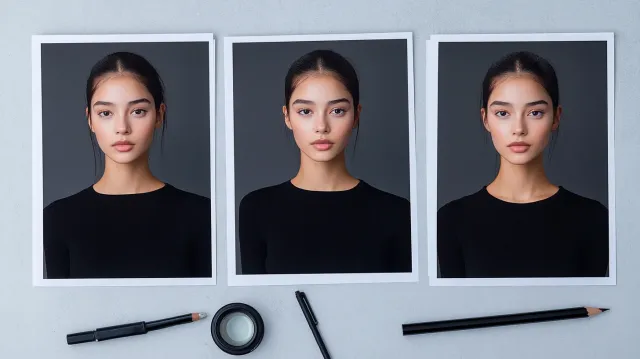
Headshots
Dance Headshot Examples: Four Frames Broken Down
Annotated dance headshot examples — four working frames analyzed element by element, plus the failure patterns that make an otherwise good photo unusable at an audition.
Chris McCarthy
Professional Photographer, Photography Shark · August 22, 2026
Most advice about dance headshots is a list of rules. This page is the rules applied to actual frames. Below are four working dance headshots broken down element by element, followed by the failure patterns that turn an otherwise decent photograph into one that does not survive an audition submission.
I photograph dancers at a studio in Rockland, MA, 35 minutes south of Boston. If you want the underlying principles first, the main dance headshots guide covers them. If you are trying to calibrate — to look at something and decide whether your own gallery measures up — start here.
If you have seen enough and want session details, dance headshots and audition photos in Boston has the formats and pricing — including the full-length frame most auditions ask for alongside the headshot. Otherwise, read on.
How to Read These
Before the examples, one instruction that changes what you notice: look at them small.
Audition panels, casting directors, and agency staff first encounter your headshot as a thumbnail in a grid or a small image in a submission portal. A photograph that is beautiful at full screen and muddy at 200 pixels has failed at the size that matters. Every breakdown below notes what survives the shrink and what does not.
Example 1 — Classic Female Dance Headshot
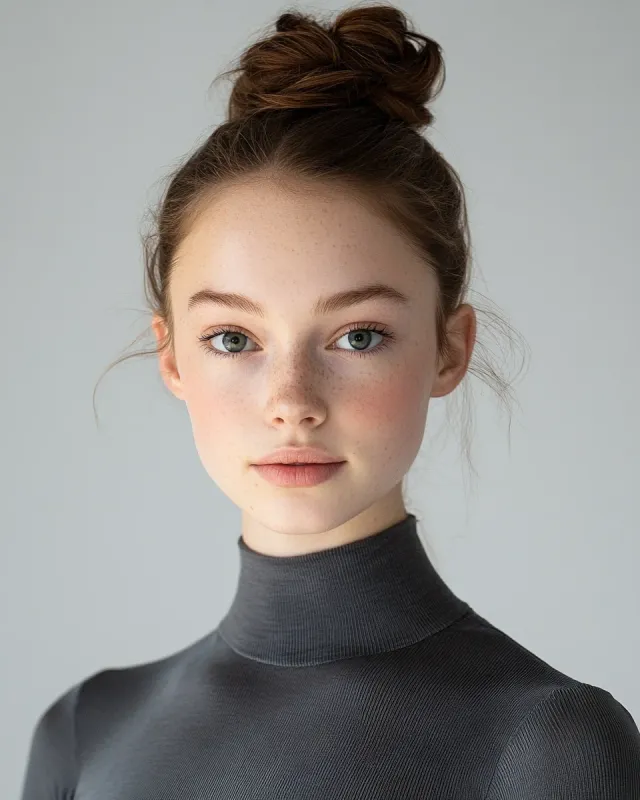
What is working:
- Eyes are the sharpest thing in the frame. Focus is on the near eye, with a clear catchlight. At thumbnail size this is what makes the face read as present rather than flat.
- Hair up, neck exposed. The bun does two jobs — it matches how she will present in the room, and it reveals the neck and jaw line that a classical panel is reading.
- The background disappears. Mid-grey, evenly lit, no gradient drawing the eye. Nothing to look at except her.
- Wardrobe adds no information. A fitted solid leotard. You do not notice it, which is the whole point.
- Light is soft and slightly above eye level, giving the cheekbones shape without dropping shadow into the eye sockets.
Why it survives the shrink: high contrast between face and background, eyes clearly defined, no fine detail carrying the image.
Where it would be submitted: company auditions, BFA and summer intensive applications, school profiles — anywhere the priority is honest recognition.
Example 2 — Male Dance Headshot
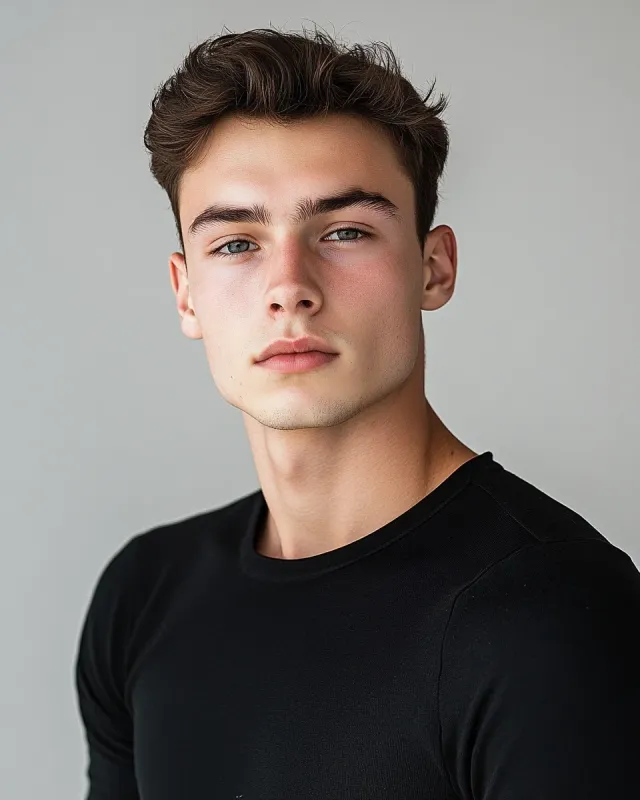
What is working:
- Shoulders are square and grounded, chest open, neck long. Carriage reads before expression does, and a collapsed posture communicates something you cannot fix in retouching.
- The expression is settled rather than performed. Direct eye contact, a very slight ease at the mouth. It reads as someone who is comfortable being looked at — which, in a rehearsal room, is information.
- Fitted dark top, simple neckline. Frames the face and the line of the shoulders without competing.
- Retouching is conservative. Skin texture is intact. He would be recognizable walking in the next morning, which is the entire functional test.
Common mistake this example avoids: male dancers frequently under-prepare wardrobe on the assumption that it matters less. It does not. A stretched crew neck or a poorly fitting tee is visible immediately and reads as unconsidered.
Example 3 — Commercial Dance Headshot
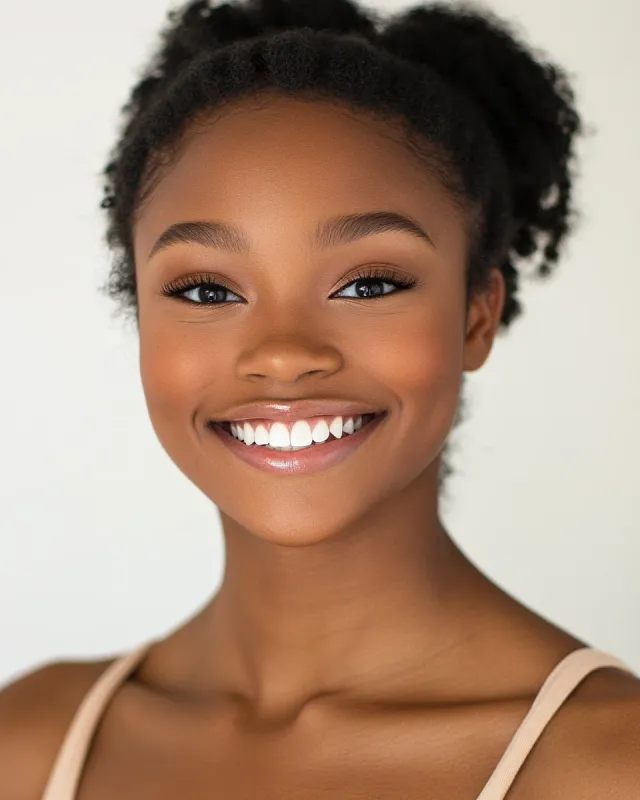
What is different here, and why:
- The smile is genuine and reaches the eyes. Commercial casting is buying a person clients want on set for a long day. Warmth communicates that faster than anything else in the frame, and a manufactured smile is visible even at thumbnail size — it shows in the eyes, not the mouth.
- Hair is styled as she wears it, not pulled back. Commercial work wants the person, not the structure.
- Lighting carries more shape and warmth than the classical examples, with stronger catchlights.
- The background is lighter and warmer. Slightly more energy; still clean.
Where it would be submitted: dance agency rosters, commercial breakdowns, music video and industrial casting, convention faculty profiles. The commercial dance headshots guide covers this end of the market in full.
The mistake to avoid: sending this image to a classical company. It is a good photograph in the wrong room, and it reads as a dancer who has not looked at the company's work.
Example 4 — Ballet and Classical
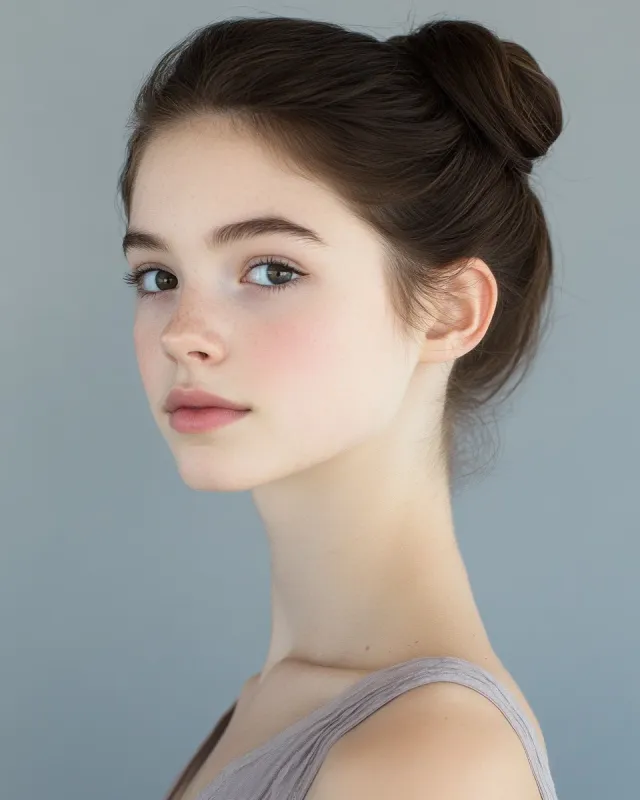
What is working:
- Maximum restraint. Black leotard, clean neckline, hair fully up. Everything that could add information has been removed.
- The expression is calm and still — present, not blank, not smiling. Getting here is a directing problem; holding a still face on command produces tension around the mouth that a camera picks up instantly.
- Even light describes the bone structure honestly. Classical staff are reading the head and neck as a structure, and lighting that sculpts too aggressively withholds exactly what they opened the file to see.
- Symmetrical, centred framing. Formal on purpose.
The full set of classical conventions — including the technical photographs that accompany the headshot — is covered in the ballet headshots guide.
The Failure Patterns
Nearly every unusable dance headshot fails in one of these ways. This list is more useful than the positive examples, because these are the things you can check in your own gallery tonight.
| Problem | What it looks like | Why it matters |
|---|---|---|
| Shadowed eyes | Dark sockets, no catchlight | The face reads as absent at small size |
| Overhead light | Shadow under brow and nose | Ages the face and hides the eyes |
| Phone distortion | Enlarged nose, narrowed ears | You do not match your photo in the room |
| Busy background | Brick, foliage, visible texture | Competes with the face at thumbnail size |
| Over-retouching | Plastic skin, softened jaw | Removes recognition and structural information |
| Wardrobe competing | Pattern, logo, bright print | The eye goes to the shirt first |
| Performance makeup | Stage-weight liner and lip | Reads as a production still, not a headshot |
| Too-tight crop | No shoulders, no neck | Loses carriage and reads as a passport photo |
| Out of date | Different hair length or color | Defeats the photo's primary purpose |
| A dance photo used as a headshot | Full body, mid-phrase, in costume | It is not a headshot, however good it is |
A Ten-Second Self-Check
Open your current headshot and answer these:
- At thumbnail size, can you see the catchlights in the eyes?
- Is the background genuinely empty, or is there something in it you have stopped noticing?
- Does your hair match how you present at auditions in this genre?
- Would someone who watched you dance for ninety seconds last Tuesday pick you out of a stack from this photo?
- Is it less than eighteen months old — or six, if you are still growing?
- Do you have a second look for the other kind of submission you make?
A no on question four is the serious one. Everything else is a quality problem; that one is a functional failure. The dance audition headshots guide covers what the panel is physically doing with the image and why recognition outranks everything.
Booking a Session
A dance session at Photography Shark covers a clean classic look and a second look matched to your genre, with expression and carriage directed in real time rather than left to you to produce. You leave with fully retouched images at honest levels, multiple crops sized for print, audition portals, and square database fields, and full personal use. Sessions start at $395; add full-body technical or movement images and we build a longer studio session so it happens in one visit.
Session formats and pricing are on the book a dance headshot session in Boston page. The studio is in Rockland, MA — an easy drive from Boston, Quincy, Hingham, Braintree, Weymouth, and the wider South Shore. Get in touch or call (781) 312-8824.
Free download: dance headshot guide, free to download — what auditions ask for, dancewear, hair and makeup, and submission sizes in one PDF.
Related reading: Dance headshots: the full guide · Dance audition headshots: what to submit · Ballet headshots · Commercial dance headshots · Professional headshot examples
Frequently Asked Questions
What does a good dance headshot look like?
Sharp, well-lit eyes with a visible catchlight; soft even light that gives the jaw and cheekbones shape without harsh shadow; a clean neutral background; fitted solid wardrobe that frames the face rather than competing with it; and a likeness honest enough that the panel recognizes you at the check-in table. Styling changes between genres, but those five elements hold across every one of them.
How can you tell a bad dance headshot?
The reliable tells are eyes in shadow or slightly out of focus, light coming from above that puts shadow in the eye sockets, a background with visible texture or clutter, wardrobe that pulls attention from the face, retouching heavy enough that skin looks like plastic, and wide-lens phone distortion that enlarges the nose. Any one of those makes the photo work harder than it should; two or three together make it unusable.
Should a dance headshot be smiling?
It depends on the genre you are submitting to. Commercial dance headshots lead with a genuine, eye-reaching smile because commercial casting is buying warmth and approachability. Classical and contemporary submissions generally want a calmer, more still expression. Most working dancers keep both in their set and choose per submission.
What background is best for a dance headshot?
A clean neutral — mid grey, light grey, or a soft warm neutral. Grey is the most versatile because it separates from almost any hair color and wardrobe, and it reads as professional across classical and commercial submissions alike. Avoid black backgrounds with dark hair, pure white unless it is lit deliberately, and any environment with visible texture, brickwork, or foliage.
How many dance headshot looks should you have?
Two as a working minimum: one clean classic look and one matched to the genre you submit to most. Dancers working across commercial and concert work usually want three — a warm commercial look, a grounded neutral look, and a classical look if they still audition for classical companies.
Can you compare your own headshot against these examples?
Yes, and the most useful way is to shrink it. View your headshot at thumbnail size next to the examples on this page. Nearly every problem — shadowed eyes, a busy background, wardrobe that competes, an expression that reads as tense — becomes more obvious small than large, and thumbnail size is how casting and audition panels first see it anyway.
Related Posts
You Might Also Like
About the Author
Chris McCarthy
Chris McCarthy has run Photography Shark Studios in Rockland, MA for over 10 years and 500+ sessions, with executive headshot work for Rockland Trust, Clean Harbors, M&T Bank, and McCarthy Planning; founder portraits for AI startups including Lowtouch.ai; product photography for South Shore brands like Lauren's Swim; and headshots across South Shore legal, medical, financial, and academic practices. Every session is personally shot and edited by Chris on Sony mirrorless and Godox strobe systems — no assistants, no outsourcing, no batch retouching. Galleries deliver in 3–5 business days. About the photographer →
Photography Shark · Boston & South Shore MA
Ready to Book a Session?
Professional headshots, senior portraits, boudoir, and model portfolios. Studio in Rockland, MA — 25 miles south of Boston. Sessions from $395.